

- Loblaw
- Canadian Pacific Kansas City (CPKC)
- Bombardier
- Samsung
- Coca-Cola
- Gildan Activewear
featuredRegistered GIC rateLock in a guaranteed 2.75% in your RRSP for one year.go to site
Best RRSP ratesCompare and find the top RRSP accounts and rates currently available in Canada.read now
MoneySense is a long-established personal finance publication serving Canadians since 1999. Our editorial team of trained journalists works with independent experts to evaluate financial products and services. We compare offerings from major banks, credit unions and card issuers to help readers find competitive options.
Loblaw still adding Canadian products but CEO says ‘Buy Canadian’ trend may not last
Loblaw Companies Ltd (TSE: L)
- Q1 net income: $503 million or $1.66 per diluted share, up from $459 million or $1.47 a year earlier.
- Revenue: $14.1 billion for the quarter, up from $13.6 billion the prior year.
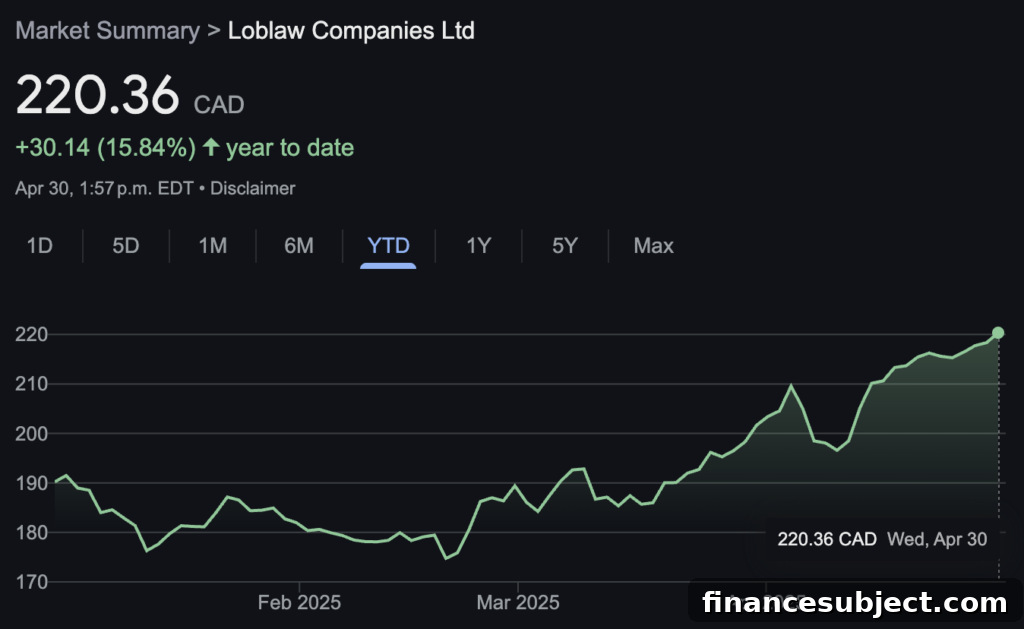
Loblaw Companies Ltd. is actively increasing the number of Canadian-made products on its shelves as consumers respond to trade tensions between Canada and the U.S. CEO Per Bank told analysts the retailer is sourcing more goods from domestic growers and manufacturers, though he cautioned the buying pattern may not be permanent.
Online grocery data shows a clear short-term shift toward Canadian products since U.S. tariffs were announced, Bank said. He noted that under 4% of Loblaw’s PC and No Name branded items are sourced from the U.S., and teams are testing many new Canadian products to reduce reliance on U.S. suppliers.
Tariffs have put upward pressure on some food costs, and Loblaw says it is working to keep prices down. The company has started highlighting Canadian items in stores, flagging products affected by tariffs, and added a “swap and shop” feature in its loyalty app to make domestic alternatives easier to find.
Asked whether the preference for Canadian goods would endure, Bank said he expects some of the shift to remain but predicted only about a third might become permanent. He emphasized that price and quality still dominate purchase decisions: when Canadian products are comparable in price—within roughly 5%—customers tend to choose local items.
Loblaw reported strong sales momentum: net earnings available to common shareholders were $503 million for the quarter ended March 22, up from $459 million a year earlier. On an adjusted basis the company earned $1.88 per diluted share, slightly ahead of analyst estimates.
Food retail same-store sales rose 2.2% while drug retail same-store sales improved 3.8%. Loblaw also confirmed plans to invest $2.2 billion in 2025 to open 80 new grocery stores and pharmacies, many in smaller discount formats. The expansion is part of a broader $10 billion five-year plan that includes adding pharmacy care clinics.
The board raised the dividend by 10% to 56.4 cents per common share, marking the 14th consecutive annual dividend increase.
Return to menu.
CPKC lowers financial forecast amid ‘trade storm,’ but stresses new trade flows
Canadian Pacific Kansas City Ltd (TSE: CP)
- Q1 net income: $909 million, up from $774 million a year earlier.
- Revenue: $3.80 billion for the quarter, up from $3.52 billion the prior year.
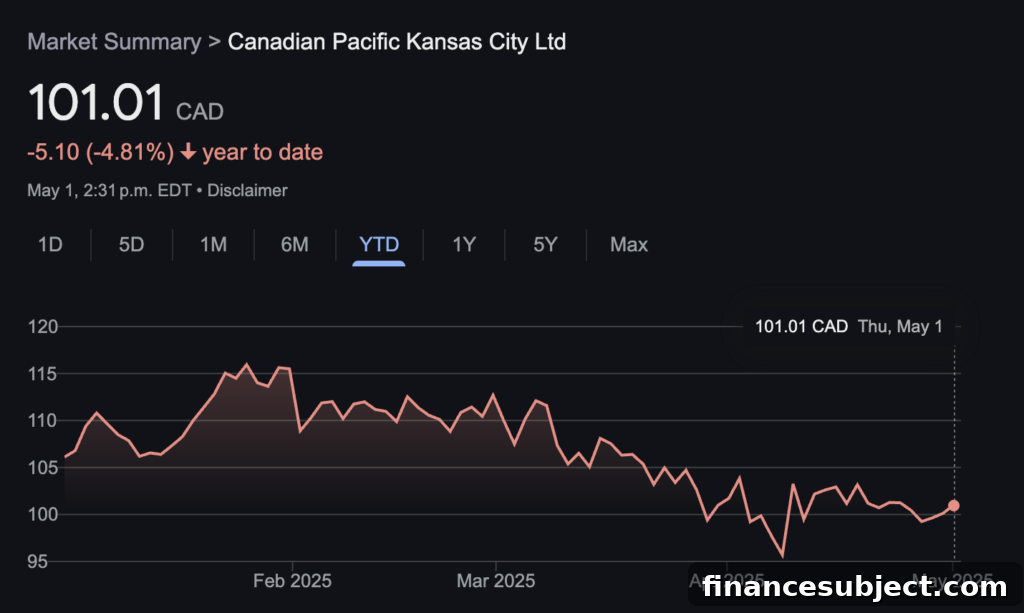
Canadian Pacific Kansas City Ltd. (CPKC) has reduced its full-year financial guidance as the company navigates ongoing uncertainty over U.S. tariffs and shifting trade rules. Management describes the situation as a “trade storm” and is aggressively pursuing new customer relationships and routing alternatives.
Chief Marketing Officer John Brooks said teams launched an intensive 60-day sales effort to meet over 500 customers and secure new business. CEO Keith Creel added that new north-south shipping opportunities are already emerging: more refined fuels, LPG, plastics and grains are moving directly from Canada to Mexico, creating fresh revenue streams originating in Alberta.
CPKC trimmed its 2025 adjusted diluted EPS growth outlook to 10%–14% from a prior 12%–18%, citing evolving trade policy and recessionary risk. As the only freight railway linking Canada, the U.S. and Mexico directly, CPKC stands to gain when supply chains shorten and middlemen are eliminated, enabling more direct shipments of appliances, furniture and consumer goods from Mexico to Canada.
Despite disruptions—such as changes in auto shipments following tariffs and duties on steel and aluminum—CPKC reported solid operational results. First-quarter net income rose to $909 million and adjusted core diluted earnings increased to $1.06 per share, slightly above consensus. Revenues were up 8% year over year to $3.80 billion, and overall cargo volumes remained steady across major categories.
Return to menu.
Bombardier buoyant despite trade hurdles, forecasts big demand for business jets
Bombardier Inc Class B (TSE:BBD.B)
- Q1 profit: $44 million, down from $110 million a year earlier.
- Revenue: $1.52 billion for the quarter, up from $1.28 billion the prior year.
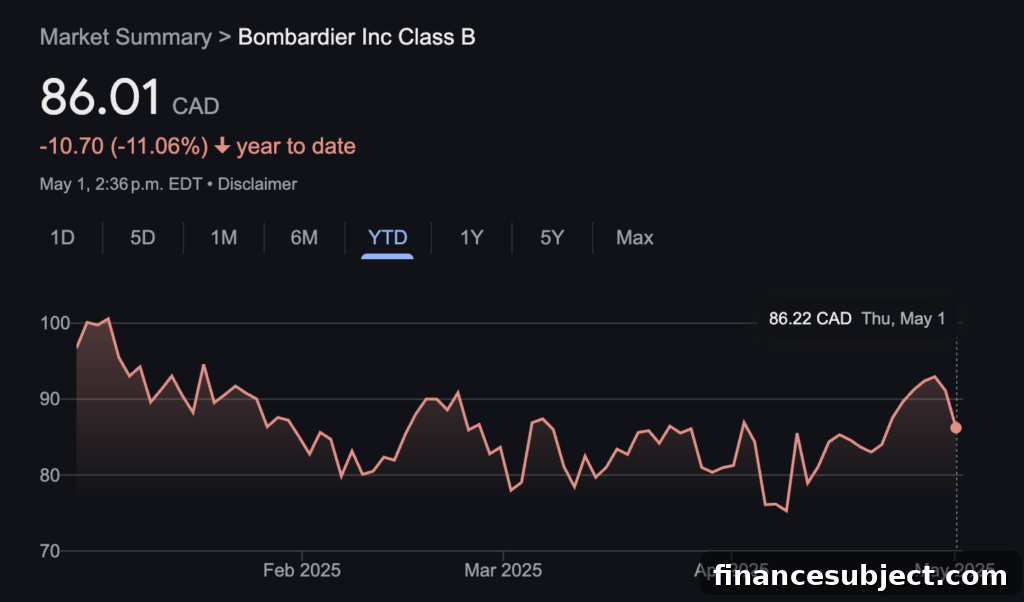
Bombardier’s CEO Éric Martel expressed confidence despite tariffs and economic uncertainty, pointing to a strong start to the year. The company expects to deliver more than 150 aircraft in 2025, up from 146 last year, and projects at least a 7% revenue increase to over US$9.25 billion with adjusted earnings rising around 14% to more than US$1.55 billion.
Bombardier now has clearer tariff guidance and said its aircraft qualify under USMCA terms, providing temporary relief from 25% duties. The company’s book-to-bill ratio held at a robust level, indicating steady near-term demand. Steel and aluminum cost concerns were already incorporated into Bombardier’s guidance.
For the quarter ended March 31, Bombardier reported net income of $44 million while revenue climbed 19% year over year to $1.52 billion. Adjusted earnings per share rose to $0.61, though slightly below some analyst expectations. The company’s order backlog remained substantial at about US$14.2 billion.
Return to menu.
Samsung reports revenue increase thanks to mobile phone sales but its chip business suffers
Samsung Electronics Co Ltd (KRX: 005930)
- Q1 operating profit: 6.7 trillion won (about US$4.7 billion), up from 6.61 trillion won a year earlier.
- Revenue: 79.14 trillion won (about US$56 billion), a quarterly record.
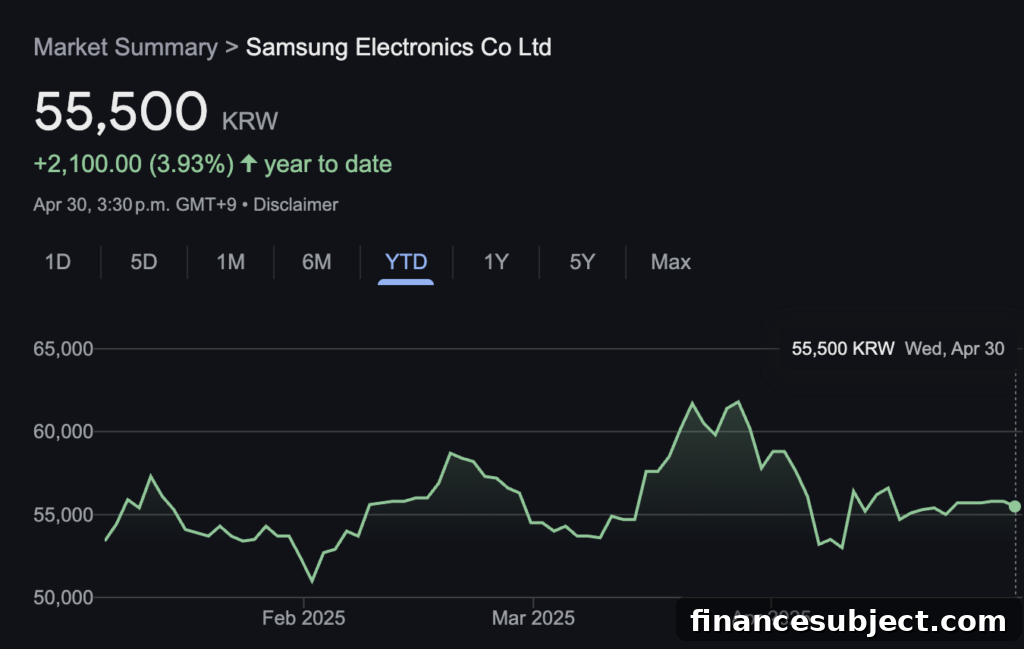
Samsung posted an all-time quarterly high for consolidated revenue driven by strong sales of its Galaxy S25 flagship and other premium devices. Operating profit rose modestly year over year, but the company cautioned that its semiconductor division faced headwinds.
Chip-related earnings were pressured by falling average selling prices and weaker demand for high-bandwidth memory as customers await next-generation chips. Still, the mobile business’s strength helped deliver record revenue for the March quarter.
Return to menu.
Coca-Cola reports better-than-expected quarterly profit, says it can manage through tariffs
Coca-Cola Co (NYSE: KO)
(All figures in U.S. dollars)
- Full-year adjusted EPS outlook: Now expected to grow 7%–9%, down from 8%–10% previously.
- Q1 revenue: $11.1 billion, down 2% year over year.
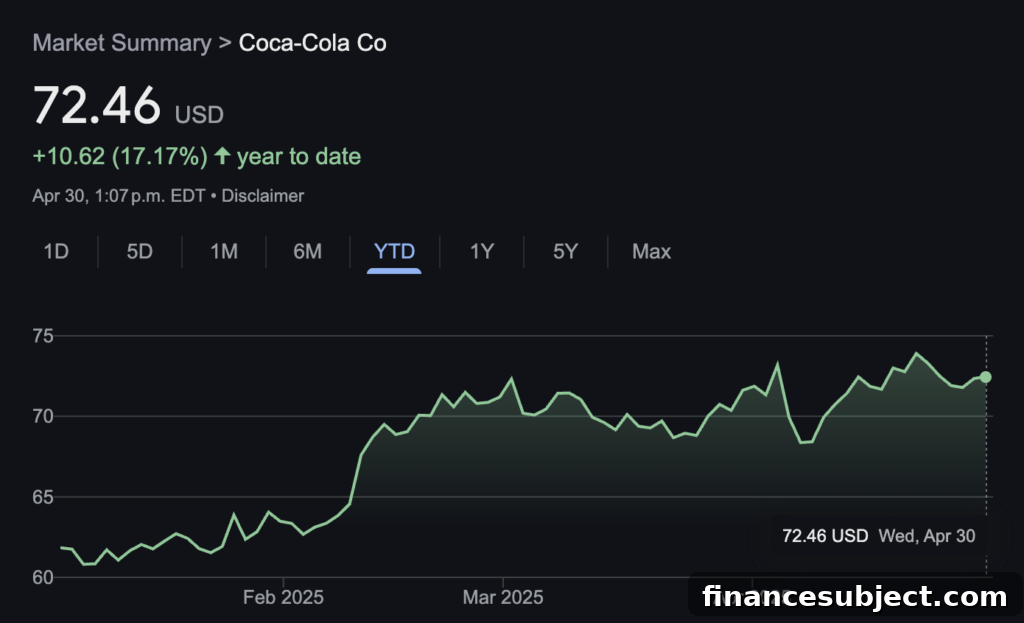
Coca-Cola beat first-quarter expectations and said it can manage the effects of tariffs—particularly a 25% duty on aluminum—that have challenged beverage makers. CFO John Murphy noted the company has several levers to offset cost increases, including supplier adjustments and packaging shifts.
Global unit case volumes rose 2% in the quarter, helped by strong demand in China, India and Brazil and a 14% gain for Coca-Cola Zero Sugar. North American volumes fell modestly, but pricing initiatives and a higher mix of premium products helped offset declines. Revenue declined 2% to $11.1 billion, while adjusted net income and EPS modestly exceeded expectations. Coca-Cola trimmed its full-year adjusted earnings growth outlook slightly due to the tariff environment and other headwinds.
Management also addressed a social media controversy earlier in the year that briefly affected U.S. sales among some Hispanic consumers; executives said the claims were unfounded and that targeted promotions are helping recovery. Overall, Coke’s leadership remains focused on managing costs and protecting consumers’ brand loyalty amid uncertain consumer sentiment near the U.S.–Mexico border.
Return to menu.
Gildan Activewear sees Q1 profit rise to USD $84.7 million, net sales also up
Gildan Activewear Inc (TSE: GIL)
(All figures in U.S. dollars)
- Q1 net income: $84.7 million, up from $78.7 million a year earlier.
- Adjusted earnings: $89.8 million, versus $99.1 million a year ago.
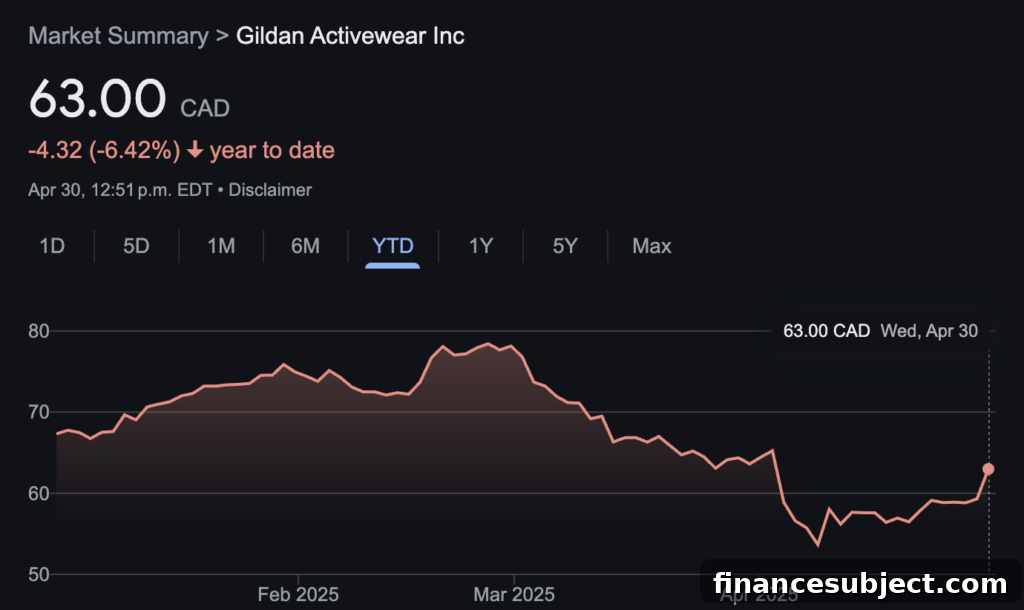
Gildan reported higher net income for the quarter, with adjusted earnings translating to $0.59 per diluted share—essentially flat year over year and slightly above analyst expectations. The Montreal-based apparel company continues to manage costs and demand dynamics while operating in U.S. dollars.
Tools
MoneySense’s ETF Screener Tool
Read more about investing:
- Best ETFs in Canada
- Cineplex, Roots and Delta Air Lines report earnings
- Canadian companies facing supply-chain challenges in wake of U.S. tariffs
- Buying your first stocks in Canada