

Despite recent U.S. trade tensions and tariffs, Canadian investors remain an appealing market for U.S. asset managers offering actively managed exchange-traded funds (ETFs).
In October 2024, Capital Group — known for the American Funds family — introduced four actively managed ETFs in Canada that cover global equities and fixed income. In the same month, JPMorgan Asset Management launched two Canadian-listed ETFs modelled after its U.S. equity income strategies. JPMorgan expanded its Canadian lineup in March 2025, listing two additional funds on the Toronto Stock Exchange: the JPMorgan US Value Active ETF (JAVA) and the JPMorgan US Growth Active ETF (JGRO). These Canadian listings give domestic investors access to strategies already available in the U.S.
Active funds face a steep challenge. S&P Global’s SPIVA scorecard shows persistent underperformance among active managers: over the past 15 years, 89.5% of U.S. large-cap blend funds lagged the S&P 500. The shortfall is even larger for style-specific mandates, with 95.08% of large-cap value and 95.91% of large-cap growth funds underperforming their S&P 500 style benchmarks.
That said, the JPMorgan name carries weight, and both JAVA and JGRO charge a 0.44% management fee. That fee may look reasonable to advisors and retail investors pursuing an active approach, but it must be weighed against index alternatives and historical outcomes. Below is a closer look at how these funds work and how they compare with index ETFs.
Tools
MoneySense’s ETF Screener Tool
How JAVA and JGRO work
Both JAVA and JGRO use a traditional, discretionary active-management approach rather than a rules-based or algorithmic model. Portfolio managers generate ideas through company research, industry conferences and direct engagement with management teams. They follow a bottom-up process, starting with individual company analysis instead of a top-down macro view.
JPMorgan describes this approach as “fundamental, bottom-up,” emphasizing deep research and analyst insight to identify stocks the teams believe will outperform over a market cycle.
How JAVA and JGRO stocks are picked
The funds differ by investment focus. JAVA targets companies that combine quality and attractive valuation. Managers assess business models, financial strength, management quality and key fundamentals such as free cash flow and earnings. The portfolio generally holds roughly 130–200 stocks and tends to be more concentrated than a broad market ETF, with positions split between quality and value-oriented exposures.
JGRO is focused on growth. Managers evaluate the durability and scale of a company’s growth, competitive positioning and leadership, and forecast how fundamentals may evolve relative to market expectations. JGRO’s holdings typically range from about 100 to 400 stocks, with position sizes reflecting the team’s conviction in each idea.
Exact inputs and weighting rules are not fully disclosed — a deliberate choice to protect proprietary processes — but the discretionary, conviction-driven construction is a defining trait of both funds.
Rankings
The best ETFs in Canada
Who manages the U.S. active ETFs sold in Canada?
The Canadian-listed JAVA and JGRO are managed by the same teams that oversee the U.S. versions. JAVA’s team includes long-tenured managers such as Scott Blasdell, Andrew Brandon, David Silberman and John Piccard. JGRO is managed by Giri Devulapally and Felise Agranoff. In the U.S. the funds are established: JGRO has around USD 4.9 billion in assets under management, while JAVA has about USD 3.09 billion.
How the U.S. active ETFs compare with index ETFs
Although the Canadian listings are new, the U.S. equivalents have track records dating back to October 2021. Both funds receive Morningstar Silver Medalist ratings, which indicate analyst conviction that the funds have a reasonable chance to outperform peers or relevant benchmarks on a risk-adjusted basis over a market cycle. Morningstar’s ratings can be useful, but they should not be the only input when choosing a strategy.
Comparing performance to common, low-cost benchmarks offers additional context. From October 5, 2021, through April 23, 2025, JAVA returned a compound annual growth rate (CAGR) of 6.93% versus Vanguard Value ETF (VTV) at 7.59%. Over the available window (August 9, 2022, through April 23, 2025), JGRO returned 14.91% CAGR while Vanguard Growth ETF (VUG) returned 14.61%.
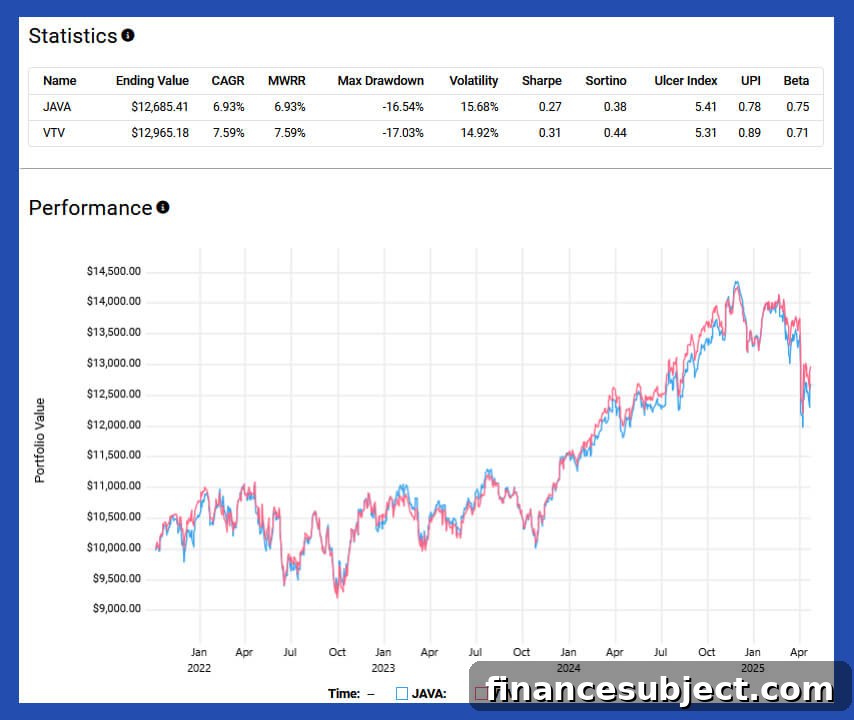
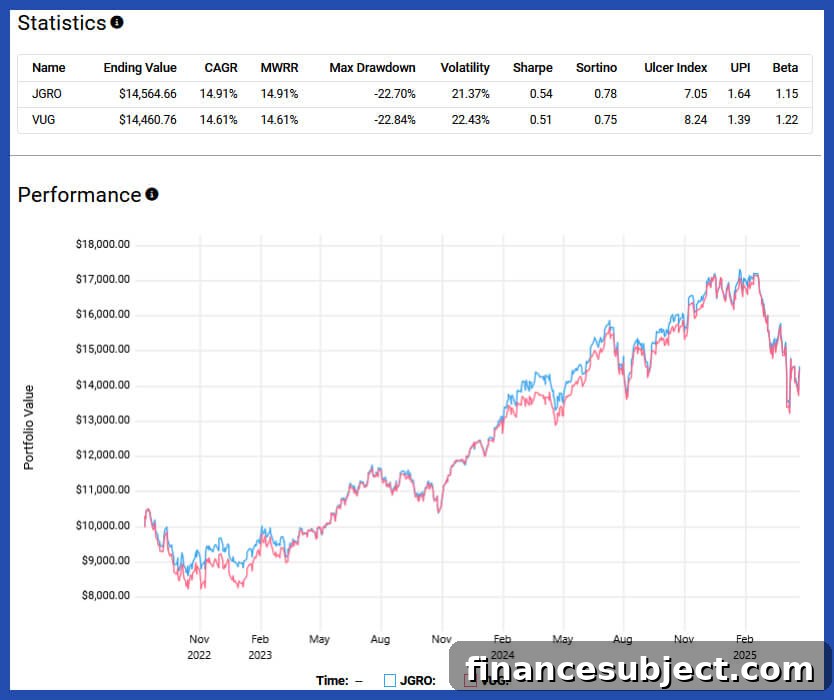
Cost matters. JAVA and JGRO charge 0.44% annually, while ETFs such as VTV and VUG charge 0.04%. That 40-basis-point gap can be a meaningful long-term drag on returns. Portfolio overlap also reduces the argument for active managers: as of April 24, JAVA and VTV shared 99 holdings — 61.5% of JAVA’s 165 stocks and 30.4% of VTV’s 335. JGRO shared 58 holdings with VUG, representing 51.8% of JGRO’s 114 stocks and 35.8% of VUG’s 170. These overlaps suggest active and passive portfolios often hold many of the same core positions.
Are U.S. active ETFs worth the fee?
For many Canadian investors, low-cost index ETFs provide similar exposure to value and growth at a much lower fee. Over time, a lower expense ratio compounds into a significant advantage. Active ETFs like JAVA and JGRO must consistently deliver outperformance that exceeds their higher fees to justify the cost.
Active strategies may suit advisors and investors who believe in the managers’ research capabilities and accept the risk of prolonged underperformance relative to an index. Buying an active ETF is as much a bet on the people managing the fund as it is a bet on the strategy itself.
At 0.44%, these JPMorgan ETFs are relatively reasonably priced for active management, particularly in the Canadian context. If active exposure is a priority, JAVA and JGRO could be among the more cost-effective active options available. Their presence may also encourage greater competition and potentially put downward pressure on fees across the ETF market.
Ultimately, competition is beneficial. Whether you choose an imported or homegrown ETF, examine holdings, costs and the management team before investing — and don’t rely solely on marketing claims.
Read more about ETFs in Canada:
- Best U.S. equity ETFs
- Is your bond ETF actually a safe investment? Here’s how to check
- How to stay invested in U.S. stocks without the tech overweight
- ETF strategies to help Canadian investors combat a weak loonie