

Welcome to the Canadian Crypto Observer. Financial journalist and author Aditya Nain provides clear analysis of market-moving headlines to help Canadian investors navigate cryptocurrency markets.
Canadians — and investors worldwide — are feeling the economic tremors of a tariff dispute with the United States. During periods of heightened uncertainty, many look for safe-haven assets. Is bitcoin (BTC) one of them?
Like gold, bitcoin is often promoted as a store of value because neither is issued or controlled by a single government or corporation. The logic is straightforward: global assets not tied to one country’s monetary policy can offer protection during geopolitical or economic stress. But that argument overlooks a key reality: crypto prices can swing wildly. For instance, BTC moved from about USD 84,500 to USD 74,000 between April 2 and April 9, 2025, underscoring the asset’s short-term volatility.
Bitcoin can serve as an alternative asset in a diversified portfolio, but it’s not wise to rush into selling all your stocks, bonds, gold or cash and replace them with BTC. Over its relatively short history, bitcoin has behaved more like a high-risk growth asset—similar to stocks—than a traditional short-term safe haven. That means it can fall sharply in market sell-offs and rise quickly when liquidity returns or when positive news hits the market.
Sell-off around “Liberation Day”
| Bitcoin (IBIT) | Gold (GLD) | S&P 500 (SPY) | U.S. 10-year Treasury bills | |
|---|---|---|---|---|
| March high (USD) | $51.44 | $288.14 | $583.77 | 4.38% |
| April low (USD) | $43.59 | $273.71 | $494.48 | 4.01% |
| Percentage drop | 15.26% | 5% | 15.29% | 8.44% |
Three takeaways from the Liberation Day sell-off
- In the short term, neither bitcoin nor gold behaved like classic safe-haven assets. While both can outpace inflation over long periods, investors typically move into U.S. Treasury bonds during sudden market stress. The table above shows bond yields fell immediately after Liberation Day, indicating a flight into bonds. (A few days later, a broader sell-off affected U.S. bonds and the dollar as global investors adjusted to the tariff developments.)
- The S&P 500 fell almost as far as BTC from March highs to April lows. Historically, BTC would be expected to decline more sharply in a market sell-off. That the two fell in similar measure suggests bitcoin’s risk-return profile is evolving as institutional adoption and mainstream investment products grow.
- The equal decline in the S&P 500 highlights concentration risk in the index. Shortly before the sell-off, the seven largest companies — sometimes called the “Magnificent 7” — represented roughly 32% of the index. That level of concentration is a useful reminder to review diversification across asset classes, not necessarily to shift entirely into bitcoin or gold.
Also read
The best crypto platforms and apps
Our independent rankings of the top crypto exchanges available in Canada.
Bitcoin or gold: Which is the better diversifier?
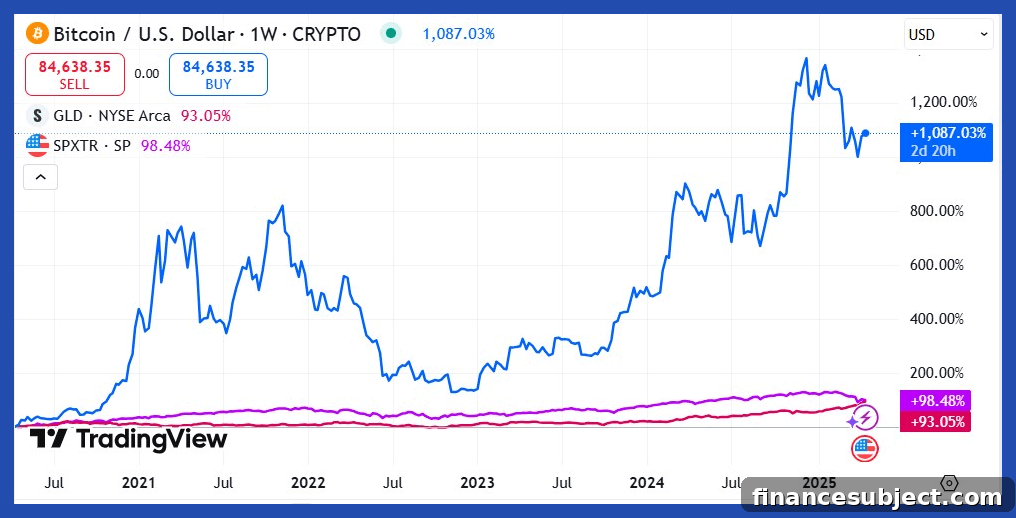
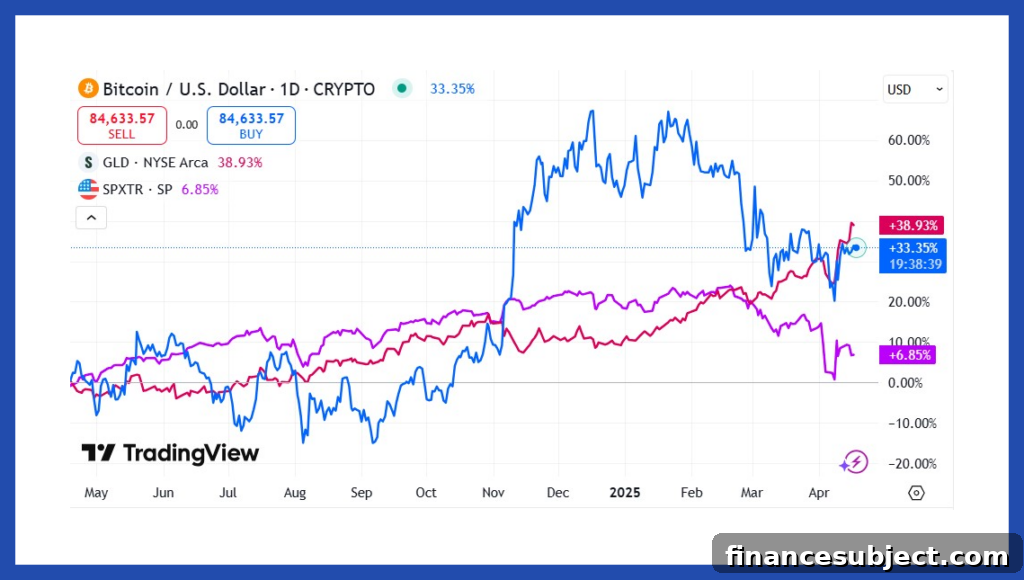
With the S&P 500’s decline matching BTC in early 2025, and with gold showing strong returns, many Canadian investors are asking how bitcoin and gold compare as diversifiers. Below are return figures for two time horizons: five years and one year. These snapshots tell different stories.
| Return terms | BTC | Gold (GLD) | S&P 500 total return |
|---|---|---|---|
| 5-year return | 1,087% | 93.05% | 98.43% |
| 1-year return | 33.42% | 38.93% | 6.85% |
Source: These figures were compiled from datasets created on tradingview.com.
Over five years, bitcoin’s gains far outpaced both gold and the S&P 500. Over one year, gold and bitcoin were close leaders while the S&P 500 lagged. These differing horizons illustrate how asset performance can vary dramatically depending on the time frame considered.
5-year historical returns of BTC, gold (GLD) and the S&P 500
1-year historical returns of BTC, gold (GLD) and S&P 500
My takeaway: both gold and bitcoin can serve as portfolio diversifiers. Historically, investors preferred gold because bitcoin’s swings were extreme. But bitcoin’s volatility appears to be moderating as institutional adoption increases. Research from Ark Invest shows realized bitcoin volatility has trended lower since 2011 and recently reached multi-year lows.
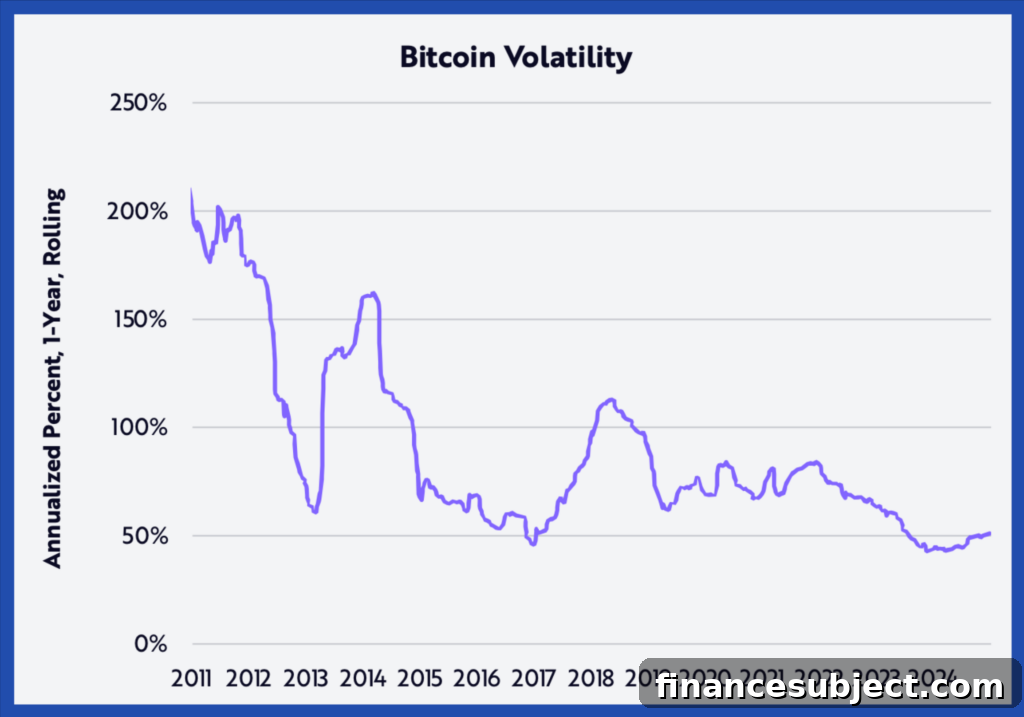
Because of bitcoin’s strong long-term returns, falling volatility, and the growing availability of crypto ETFs that are eligible for registered accounts (TFSA, RRSP, RESP, FHSA), BTC is increasingly considered alongside gold as a diversifying allocation.
- Strong historical returns for BTC
- Decreasing realized volatility over time
- Easy access through regulated crypto ETFs
- ETF eligibility for registered Canadian accounts
Canada’s (and the world’s) first Solana ETFs
Canada has again led with crypto innovation by approving spot Solana (SOL) ETFs, which launched on April 16, 2025. Multiple issuers received approval to offer SOL spot ETFs — including Purpose, Evolve, CI Galaxy and 3iQ — making Solana the second altcoin (after Ethereum) available through a spot ETF in Canada.
Solana is a high-performance blockchain known for low fees and fast transaction speeds. Developers use it for Web3 projects such as NFTs, brand loyalty initiatives and tokenization of real-world assets. Launched in March 2020, Solana ranks among the largest cryptocurrencies by market capitalization. As of April 28, 2025, its market cap was approximately USD 75.7 billion.
Two of the new ETFs — SOLL and SOLQ — include staking rewards. Staking lets funds earn yield on held tokens, and those rewards can be passed through to ETF holders. If SOL appreciates over the long term, investors in these ETFs could potentially benefit from both capital gains and staking income.
Key details on the new SOL spot ETFs in Canada are shown below:
| Purpose Solana ETF |
Evolve Solana ETF |
CI Galaxy Solana ETF |
3iQ Solana Staking ETF |
|
|---|---|---|---|---|
| Ticker | SOLL | SOLA | SOLX | SOLQ |
| Management fee | 0.39% | 0% until Dec. 31, 2025, then 1% | 0% until Jul. 16, 2025, then 0.35% | 0% for first 12 months, then 0.15% |
| Assets under management (AUM) | USD 8.6 million | USD 6.56 million | USD 5.4 million | USD 86.6 million |
| Eligible for registered accounts | Yes | Yes | Yes | Yes |
View a list of crypto spot ETFs available in Canada for more details on how these products can fit into a portfolio.
Tools
MoneySense’s ETF Screener Tool
Resources on crypto taxation in Canada
As tax season closes, here are helpful resources to understand crypto taxation and reporting:
- What you need to know about crypto taxes in Canada
- How to calculate crypto capital gains tax in Canada — a simple breakdown
Invest only if crypto fits your risk profile
Cryptocurrencies are speculative and volatile. Investing in bitcoin, Solana or other digital assets involves market, technological and regulatory risks. Consider your investment objectives, time horizon and risk tolerance before allocating to crypto. Stay cautious about scams and use regulated platforms when possible.
Newsletter
Get MoneySense financial tips, news and advice in your inbox.
More about crypto:
- Will bitcoin crash in 2025?
- Bitcoin tops USD $100,000 for the first time
- Price of bitcoin hits a new high and other crypto news
- How to protect your crypto from hacks