

Welcome to the Canadian Crypto Observer. Financial journalist and author Aditya Nain provides context on major stories shaping the cryptocurrency market to help Canadian investors make informed decisions.
Is crypto crashing?
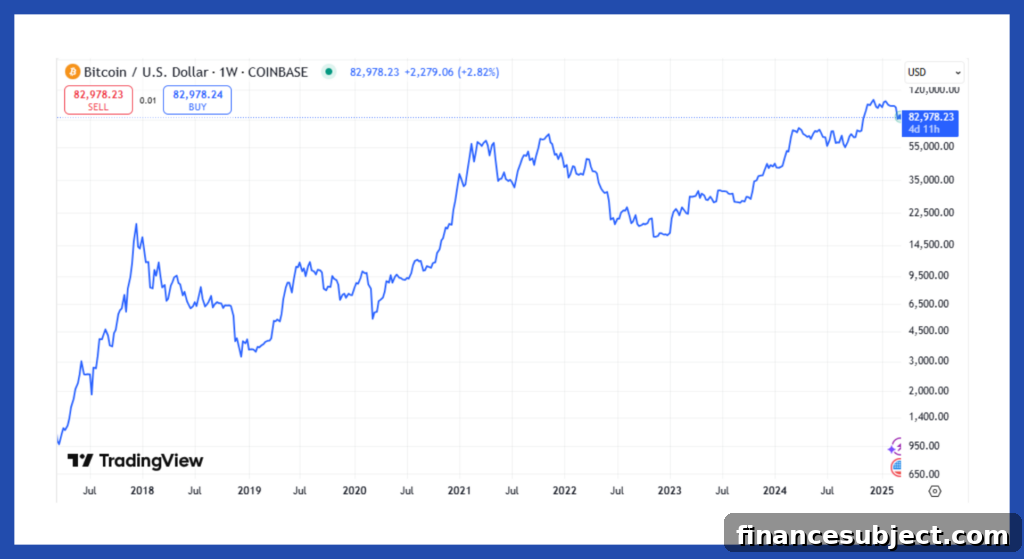
The wider stock market has weakened recently—and bitcoin has moved lower alongside it. Since December 2024, bitcoin (BTC) declined from above $106,000 to under $78,000 in recent days (all figures in this article are U.S. dollars). That represents roughly a 26% drop, with much of the decline occurring in February and March. Market participants point to rising geopolitical friction and trade tensions as amplifying fears of higher inflation, an economic slowdown, or both. For Canadian investors, that creates uncertainty, but it also helps to see the fall in historical context.
Also read
The best crypto platforms and apps
A roundup of the top crypto exchanges and apps available in Canada.
Crypto crash or just a correction?
A 26% decline can feel dramatic to investors used to traditional stock volatility, but in crypto this is often considered a correction rather than a full-blown crash. In equities, a 20% fall typically marks a bear market; in cryptocurrencies, declines of 30% or more are common and often shake out traders who cannot tolerate the large swings. When a deeper crypto bear market has arrived in the past—roughly every three to four years—bitcoin has sometimes fallen more than 80% from peak to trough.
Even with those deep drawdowns, bitcoin’s long-term gains have been substantial. From March 10, 2017, to March 10, 2025, BTC appreciated by over 8,400%, implying a compounded annual growth rate well above typical asset returns. That past performance illustrates the asset’s historical volatility and its potential for large multi-year gains, but it should not be taken as a guarantee of similar returns going forward. Bitcoin’s market has matured, and its risk-return profile has changed as adoption and liquidity have increased.
Viewed on a logarithmic scale, BTC’s rapid gains over the last decade have moderated in recent years. The recent pullback is painful for holders, yet not out of line with bitcoin’s historical pattern of sharp rallies followed by meaningful corrections.
Should you be greedy when others are fearful?
Long-term investors sometimes view steep pullbacks as buying opportunities. The famous adage attributed to Warren Buffett—be greedy when others are fearful and fearful when others are greedy—captures the contrarian approach many investors use in volatile markets.
One practical gauge of market sentiment is the fear-and-greed index for crypto. At the time of writing, that index is signaling significant fear, which for some investors can highlight a potential entry point, provided they accept the high risk involved.
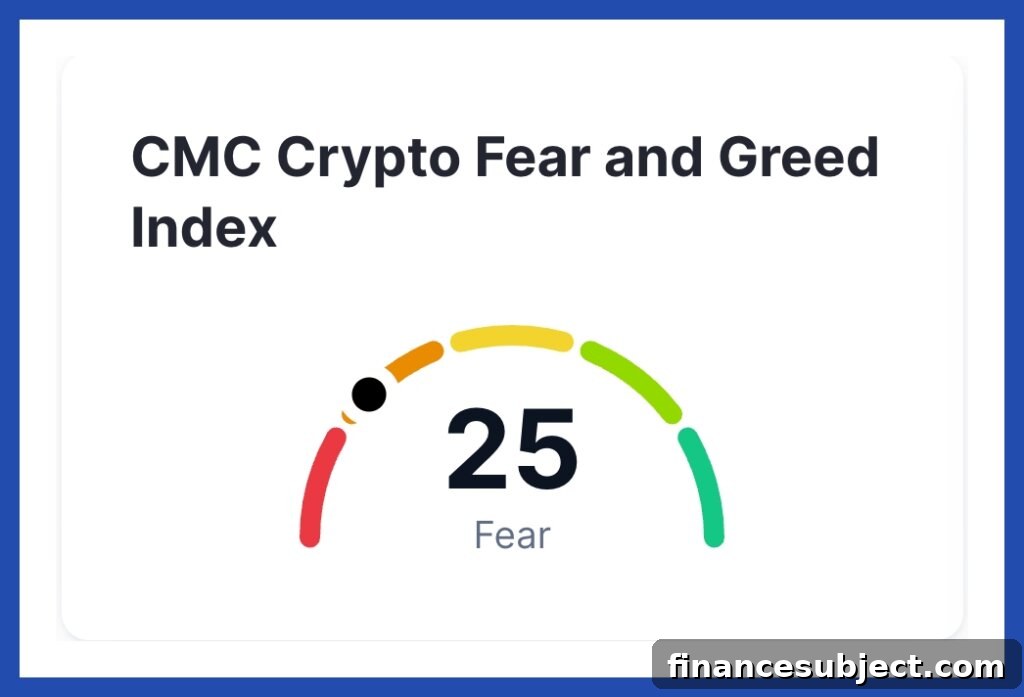
The index reading shown above was 25, a level that sits in the “fear” zone and edges toward extreme fear. Historically, times of extreme fear can present buying opportunities for investors with a long horizon and a strong tolerance for volatility.
CMC Fear and Greed Index in the recent past
The index has trended toward fear over the past month, according to recent snapshots.
| Timeline | Fear and Greed Index | Index result |
|---|---|---|
| At press time (Mar. 18, 2025) | 25 | Fear |
| Previous week | 15 | Extreme fear |
| Previous month | 38 | Fear |
Some market observers, including analysts at major asset managers, argue the correction has pulled bitcoin’s valuation back to levels that are easier to justify for long-term buyers. These views are often based on models that assess supply dynamics, on-chain activity and flows into crypto investment products. Such perspectives are useful for framing possible opportunities, but they are not predictions.
With the momentum trade in reverse, Bitcoin has corrected back to about $85k. Judging by open interest and ETP flows, this seems to be mostly caused by tourists who jumped on the momentum train last November. When the price action gets noisy and volatile, it’s always good to…
— Jurrien Timmer (@TimmerFidelity)
Will the upcoming federal election affect crypto in Canada?
A federal election is expected in April 2025. Political change in one country can influence markets, but Canada’s crypto ecosystem already rests on several established foundations that suggest continuity regardless of the next government.
Based on public commentary from political figures, one major party appears more openly enthusiastic about crypto than another. That said, the practical regulatory and market frameworks that support crypto in Canada are already in place and are unlikely to be overturned overnight. Examples include:
- A defined process to register and regulate crypto trading platforms, with major exchanges operating under or pursuing compliance with those rules.
- Guidance from the Canada Revenue Agency on how various crypto transactions are taxed.
- Canada’s early approval of spot bitcoin ETFs, which were launched well before similar products in other jurisdictions.
- A domestic listing of several public companies involved in cryptocurrency and blockchain businesses.
Given these structural elements, a change of government is not expected to upend the basic operating environment for crypto in Canada. That said, policymakers can influence details such as taxation, enforcement and investor protections, so market participants should stay informed about any regulatory proposals.
Tools
MoneySense’s ETF Screener Tool
Canada’s first levered crypto ETFs have launched
Canadian investors now have access to levered bitcoin and ether exchange-traded funds offered by Evolve ETFs. Levered ETFs use derivatives to magnify the daily returns of the underlying asset. That amplifies both gains and losses, making these products suitable primarily for traders and experienced investors.
The Evolve Levered Bitcoin ETF (LBIT) and the Evolve Levered Ether ETF (LETH) trade on the Toronto Stock Exchange and offer exposure of approximately 1.25 times the daily price moves of BTC and ETH by using up to 25% leverage. For example, a 1% daily rise in BTC could translate into about a 1.25% gain for LBIT on the same day; conversely, a 1% daily drop in BTC would likely produce a roughly 1.25% loss for LBIT.
For most long-term retail investors, conventional spot ETFs—rather than levered products—remain the more appropriate vehicle for gaining exposure to cryptocurrencies. Levered funds are best reserved for those who understand time-decay effects, margin risks and the need for active monitoring.
Crypto price swings are common
Bitcoin, ethereum, XRP, solana and many other crypto assets are speculative and prone to large price swings. Recent moves—from highs above $109,000 to levels below $80,000 for BTC—underscore the asset class’s volatility. Crypto investing carries market, technological and regulatory risks. Only invest amounts you can afford to lose, align crypto exposure with your financial goals and time horizon, and be vigilant about fraud and security threats.
More about crypto:
- Will bitcoin crash in 2025?
- Bitcoin tops USD$100,000 for the first time
- Price of bitcoin hits new high after Trump victory, and more crypto news
- How to protect your crypto from hacks
Newsletter