

When Selena Gusikoski and her family first saw materials about the registered disability savings plan (RDSP), they didn’t rush to open an account. Gusikoski is one of five siblings and her youngest brother, Cody, has a disability. The family already coordinates closely to support Cody’s independence and quality of life, and because he has a low income, the RDSP initially didn’t seem like a practical option.
“We had received information about RDSPs from various organizations over the years, but we always put it off,” Gusikoski recalls. “It was one of those things we told ourselves we’d get to later.”
They’re not alone. More than 1.45 million Canadians are eligible to open an RDSP, yet only about 36% of eligible people had one at the end of 2022, according to Statistics Canada. Awareness is low: a recent Equitable Bank–commissioned study for Concentra Trust found only 17% of Canadians surveyed knew about RDSPs or understood how these plans work.
Gusikoski, who serves as director of registered plans at Concentra Trust, says it wasn’t until she began working with credit unions to offer RDSPs that she saw how beneficial the program could be for her brother. Walking through the process professionally helped her recognize features she and many other families had missed.
“Going through it from start to finish opened my eyes,” she says. “Many people don’t realize the government grants, bonds and the long-term growth potential available through an RDSP. That lack of awareness means a lot of missed opportunities for Canadians with disabilities.”
What is an RDSP?
Introduced by the federal government in 2008, the registered disability savings plan (RDSP) is a tax-advantaged savings account designed to help eligible Canadians with disabilities save for the long term. Financial institutions across Canada, including credit unions, offer RDSPs.
To qualify as an RDSP beneficiary, an individual must be approved for the federal disability tax credit (DTC), have a Social Insurance Number (SIN), be a resident of Canada and be under 60 years of age. A beneficiary can have only one RDSP.
Like other registered plans, RDSPs grow tax-deferred: investment growth, government grants and bonds accumulate in the plan and are taxed in the hands of the beneficiary when withdrawn. Personal contributions are not taxed when contributed, and the account can hold a range of qualifying investments.
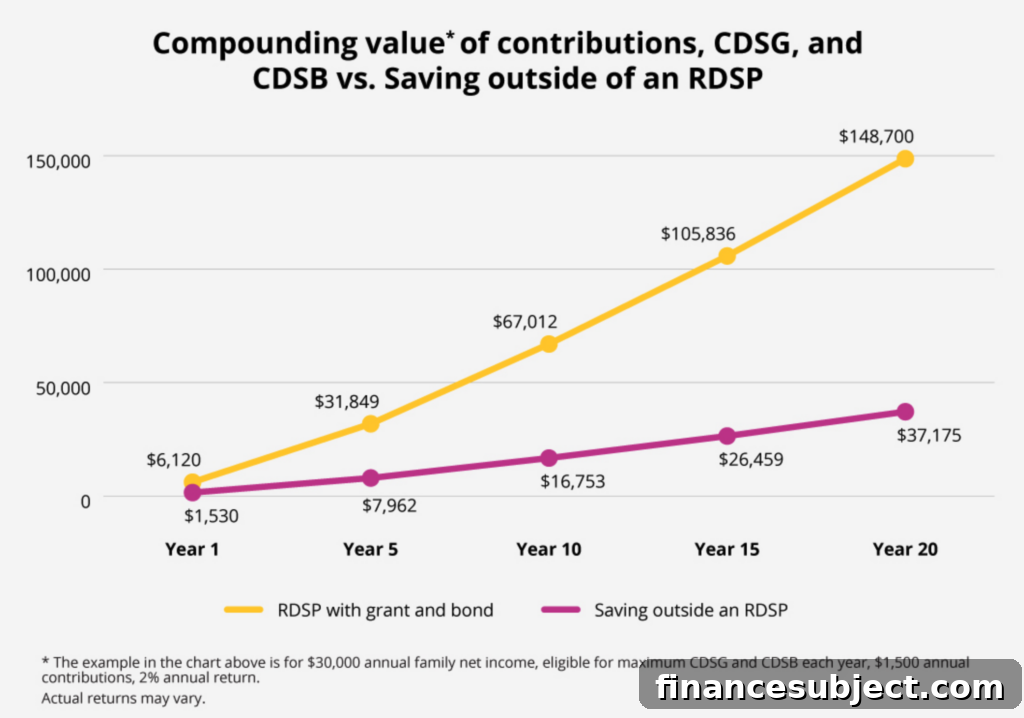
An RDSP has three main components: personal contributions, Canada Disability Savings Grants (CDSG) and Canada Disability Savings Bonds (CDSB). Contributions are deposits you or your family make into the plan. Grants and bonds are government top-ups that depend on family income and other criteria. The table below summarizes how the grants and bonds work:
| Canada Disability Savings Grant (CDSG) | Canada Disability Savings Bond (CDSB) | |
|---|---|---|
| How it works | Paid by the Government of Canada based on contributions and the beneficiary’s family net income reported two years earlier (for example, 2024 grants are based on 2022 tax returns). Income thresholds are indexed annually by the Canada Revenue Agency (CRA). The CDSG is payable on contributions made until December 31 of the year the beneficiary turns 49. | Available to RDSP holders with low to modest family income; no personal contribution is required. The CDSB’s income thresholds are indexed annually by the CRA and it is payable until December 31 of the year the beneficiary turns 49. |
| Amount | For the 2025 calendar year, the maximum annual RDSP grant is $3,500 for families with income of $114,750 or less, and $1,000 for families with income over $114,750. | For the 2025 calendar year, up to $1,000 per year for families with net income of $37,487 or less; a partial amount is available for families with net income between $37,487 and $57,375. |
| Lifetime maximum | Up to $70,000 | Up to $20,000 |
The Government of Canada publishes historical matching rates, and it also provides an RDSP calculator to help estimate potential grants and bonds. These government top-ups can turn modest contributions into a substantial financial cushion. The RDSP also allows a 10-year “carry forward” of missed contributions and associated grants and bonds once a beneficiary is approved for the DTC, which can boost the total amount received.
For Gusikoski’s family, opening an RDSP for Cody provided both practical support and emotional reassurance. “Knowing there’s a little nest egg for Cody gives our mom peace of mind,” she says. “It’s comforting to know that if his health changes, there’s money set aside. It also relieves some pressure on us siblings, since we’re the ones who would step in to help.”
How to make RDSP contributions
Contributions can be made through the financial institution that holds the RDSP, or with the assistance of a financial advisor or investment firm. There is no annual contribution limit, but the lifetime contribution limit for an RDSP is $200,000. RDSPs can hold a variety of qualifying investments such as guaranteed investment certificates (GICs), mutual funds and more, allowing beneficiaries to match investment choices to their goals and risk tolerance.
How to make RDSP withdrawals
Withdrawals from an RDSP can be taken as single disability assistance payments (DAPs) or as recurring lifetime disability assistance payments (LDAPs). Grants and bonds usually must remain in the RDSP for 10 years to avoid triggering a repayment requirement. Each DAP requires a request to the financial institution, while LDAPs are set up once and must begin by the end of the calendar year in which the beneficiary turns 60. LDAPs continue until the beneficiary’s death or until the plan’s funds are exhausted, at which point the RDSP closes.
Beneficiaries must understand the RDSP’s 10-year repayment rule: if the plan is terminated, ceases to be an RDSP, the beneficiary loses DTC approval before age 60 and withdrawals are made, or the beneficiary dies, then all grants and bonds paid into the account in the previous 10 years must be repaid to the federal government. There are exceptions and special provisions—such as when life expectancy falls below five years or at age 60—but Gusikoski stresses that an RDSP is best considered a medium- to long-term savings vehicle.
Start catching up on RDSP contributions and grants today
Gusikoski emphasizes that educating yourself is the most important first step for anyone considering an RDSP. Even small contributions matter: “Whether it’s $50 or $1,000, if you can secure at least a 100% government match in grants, that return is significant,” she says. Greater awareness and sharing of information could substantially increase contributions to RDSPs across Canada.
Beyond the financial benefits, Gusikoski values the sense of independence the RDSP gave her brother. “Seeing his account statement and walking him through it was empowering for him. It made him excited to see his own savings growing.”
Learn more about Concentra Trust’s RDSP program.
About the survey
The survey was conducted by Equitable Bank for Concentra Trust among members of the Angus Reid Forum between Sept. 26 and 30, 2024. The sample included 1,510 online Canadians who are Angus Reid Forum members, with surveys conducted in English and French. For comparison purposes, a probability sample of this size would carry a margin of error of +/- 3 percentage points, 19 times out of 20.
Equitable Bank and its wholly owned subsidiaries, including Concentra Trust, do not provide tax advice. Please consult your financial advisor to discuss the tax implications and benefits of an RDSP.
Newsletter
Get free MoneySense financial tips, news & advice in your inbox.
This article is sponsored.
This paid post is informative and may reference a client’s product or service. It was written, edited and produced by MoneySense with assigned freelancers.
More about RDSPs:
- RDSP myths, explained
- Estate planning and trusts for a beneficiary with a disability
- Disability, income splitting and tax reduction
- How to roll over money from an RRSP to an RDSP?