

Allan Small, Senior Investment Advisor at the Allan Small Financial Group with iA Private Wealth, reviews the week’s financial headlines and explains what they mean for Canadian investors.
Third-quarter tech earnings are in
Earnings season is under way, and major technology companies have released their third-quarter results, following a strong showing from the big U.S. banks last week. The banks’ reports and CEO commentary highlighted one key point: consumer savings are shrinking, which could reduce spending and slow the economy in the months ahead. The figures below are reported in U.S. dollars where noted.
This week’s tech reports—from Microsoft, Alphabet, Meta and IBM—help explain why technology has been the dominant source of market growth over the past year. Much of that momentum stems from investments in artificial intelligence, particularly generative AI, which is reshaping business processes and consumer products. New AI-capable chips and software upgrades are prompting fresh upgrade cycles for smartphones, laptops and cloud services, and fueling corporate revenue growth.
Big tech earnings highlights
Key results announced this week:
- Microsoft (Nasdaq: MSFT): Earnings per share $2.99 (vs. $2.65 expected). Revenue rose 13% to $56.5 billion.
- Alphabet (Nasdaq: GOOGL): Earnings per share $1.55 (vs. $1.45 expected). Revenue rose 11% to $77 billion.
- Meta (Nasdaq: META): Earnings per share $4.39 (vs. $3.63 expected). Revenue rose 23% to $34.15 billion.
- IBM (NYSE: IBM): Adjusted earnings per share $2.20 (vs. $2.13 expected). Revenue rose 4.6% to $14.75 billion.
Microsoft
Microsoft stood out in the quarter, beating Wall Street expectations. Revenue climbed 13% to $56.5 billion, and the company now trades at about 30 times earnings. Its Intelligent Cloud segment, which includes Azure and much of its AI development, grew by roughly 29% to $24.3 billion—evidence that cloud platforms and AI services remain core growth drivers.
Alphabet
Alphabet, the parent of Google and YouTube, posted $77 billion in quarterly revenue, up 11% year over year, driven mainly by search and YouTube advertising. After several quarters of single-digit growth, the return to double-digit top-line growth was encouraging. Some investors reacted to slightly softer-than-expected cloud results by selling the stock, which may offer a buying opportunity for longer-term investors focused on secular digital-ad and cloud trends.
Meta
Meta delivered a strong quarter, with revenue up 23% year over year to $34.15 billion—its fastest growth rate since 2021—supported by a rebound in digital advertising. User engagement remains substantial: Meta reported about 2.09 billion daily active users and 3.05 billion monthly active users, meaning a significant portion of the global population uses Facebook or Instagram regularly. That scale keeps the company highly attractive to advertisers.
IBM
IBM also topped expectations, reporting $14.75 billion in revenue, a 4.6% increase year over year, and net income of $1.7 billion (or $1.84 per share), compared with a year-earlier loss driven by a pension settlement. IBM’s business is split between IT consulting and software, with software continuing to be the main revenue engine. The software division generated $6.27 billion in revenue, while consulting contributed $4.96 billion. Like many legacy tech firms, IBM is investing in AI across its product lines to sustain future growth.
Amazon
Amazon reported record third-quarter profits, boosted by strong growth in its highly profitable cloud business, and the shares rose on the news. Although the stock had already rallied substantially year to date, Amazon’s results underscore the continued strength of cloud services in driving profit margins for large tech platforms.
Why tech remains the primary growth engine
While bank earnings offer a snapshot of overall economic resilience and consumer balance-sheet health, tech earnings answer a different question: where is growth coming from? The message from this earnings season is clear—growth is alive in technology and looks set to continue. For investors seeking growth exposure, holding several large-cap tech names is increasingly important. In many ways, these companies are becoming the consumer staples of the digital era—essential services people and businesses rely on regardless of the economic cycle.
Bank of Canada pauses interest rate hikes
The widely expected decision from the Bank of Canada (BoC) was to pause interest-rate increases this week, and Governor Tiff Macklem did exactly that. The pause temporarily relieves pressure on households and businesses that have already felt the effects of higher borrowing costs, but it doesn’t erase the cumulative impact of previous hikes. Many Canadians worry that further increases could push more households and firms into distress and raise the odds of a recession.
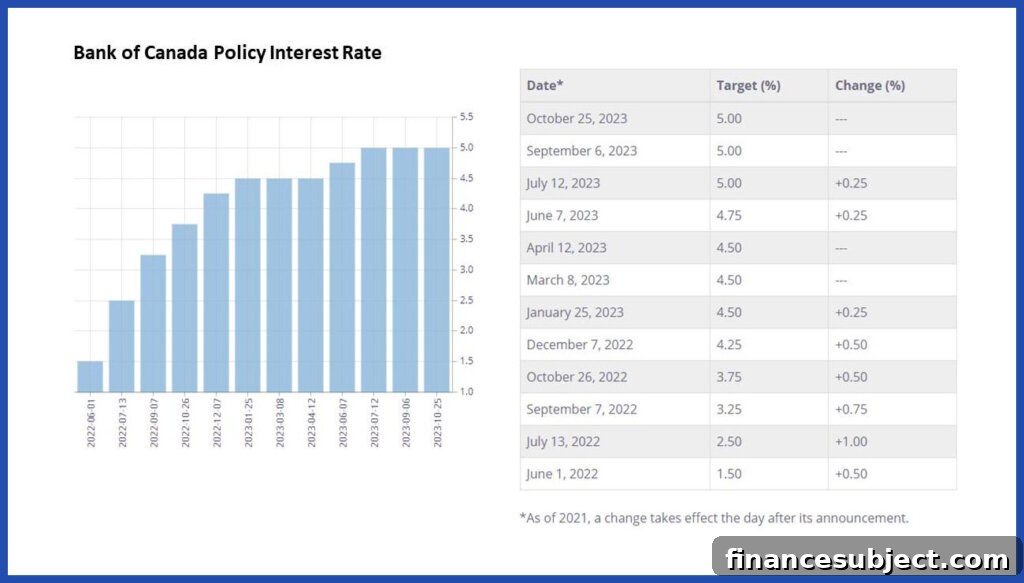
Provincial leaders had urged the BoC to hold off on more hikes to shield households from added strain, even though the central bank remains above its 2% inflation target. That raises an important policy question: how aggressive should central banks be when weighing inflation targets against employment and broader economic stability? Some investors and commentators argue a slightly higher tolerable inflation rate with stronger employment and consumption would be preferable to forcing a recession to reach a rigid 2% goal.
The BoC has raised its policy rate multiple times since early 2022, and central banks often emphasize a lag between monetary-policy moves and their effects on the economy. That lag complicates decisions: policymakers must judge how long to wait for prior rate increases to show up in the data before changing course.
Ahead of the decision, Ontario’s premier publicly expressed opposition to further rate hikes, noting that higher interest rates are hurting people and businesses that are already struggling to pay their bills. — Doug Ford
With borrowing costs much higher than in the low-rate era, many Canadians face tougher choices. For households and businesses that carried debt through the period of very low interest rates, the shift to higher financing costs is painful. The BoC’s stance signals that the era of cheap credit is over for the foreseeable future, and Canadians will need to adjust plans that assumed prolonged, ultra-low rates.
U.S. 10-year Treasury yields briefly topped 5%
Early in the week, the yield on the benchmark 10-year U.S. Treasury briefly rose above 5%—a level not seen since 2007. Rising long-term yields reflect several forces: strong U.S. growth expectations, inflation concerns, and the large volume of government debt the Treasury must place in the market. To attract buyers, the Treasury must offer higher yields when demand is tighter, pushing yields upward.
Higher yields and higher policy rates together create a meaningful headwind for risk assets. When policy rates rise, borrowing costs increase, consumers cut back on discretionary spending, and investors reassess valuations across equity markets. Rising bond yields also give investors a higher-risk-free return alternative to stocks, creating competition for investor capital that hasn’t been as acute in years.
Some investors sell technology shares in response to higher rates, yet many large tech firms have strong balance sheets, substantial cash flows and less reliance on borrowing. These companies can still deliver high growth that outpaces the higher yields, so blanket sell-offs may not make sense for long-term investors focused on secular growth opportunities.
The emergence of meaningful yields on government bonds and attractive returns on high-quality fixed income assets changes the landscape for Canadian investors who once faced the “TINA” problem—“there is no alternative” to equities. With 10-year yields in the 4–5% range, low-growth dividend stocks and other income vehicles face tougher competition for investor dollars.
All eyes on mortgage rates
Mortgage rates are rising. In the U.S., average mortgage rates have approached 8%, while Canada’s average mortgage rate sits around 6.33%. The prime lending rate in Canada is now about 7.2%, up sharply from around 2.7% in March 2022. Homeowners with variable-rate mortgages have already felt the impact: many of these rates have risen substantially, and a large volume of mortgages is scheduled to renew over the next two years.
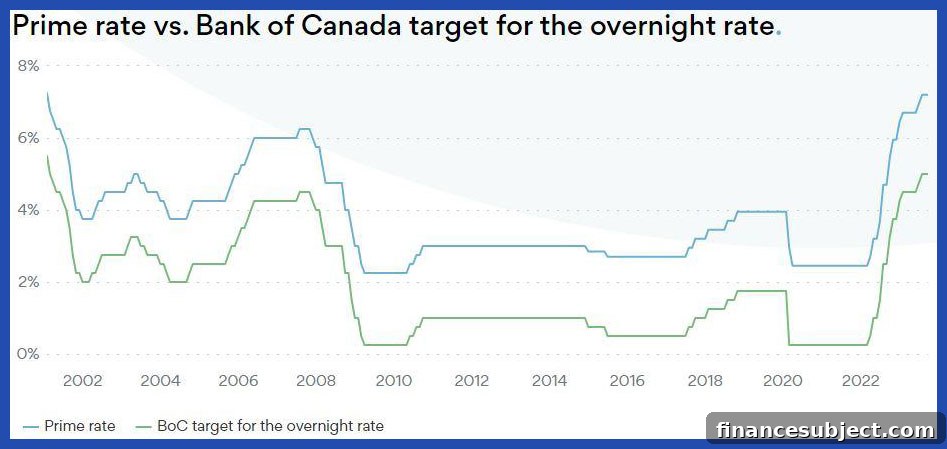
Analysts estimate hundreds of billions of dollars in mortgages will come up for renewal in the near term. If the BoC raises rates again, prime and mortgage rates would rise further, squeezing household budgets and reducing consumer spending—another channel through which monetary policy can slow the economy.
Higher mortgage costs can also depress housing demand, which has been a major source of wealth for many Canadians over the past two decades. A slowdown in housing demand could produce falling prices, trigger negative equity for some homeowners and reduce household net worth—consequences that would feed back into weaker consumer spending and economic growth.
Given those trade-offs, the question remains whether the BoC’s strict focus on reaching a 2% inflation target justifies the economic pain higher rates can cause. It’s a difficult balance between price stability and protecting employment and household balance sheets. In my view, the costs of an overly aggressive rate stance can be very real for many Canadians.