

Kyle Prevost, editor of Million Dollar Journey and founder of the Canadian Financial Summit, shares financial headlines and provides context for Canadian investors.
Borrowers relieved as interest rate stays at 5%
The Bank of Canada (BoC) announced on Wednesday that it will keep its policy interest rate at 5% until at least the next decision date, October 25. The decision followed surprising negative GDP figures and a small uptick in unemployment, so the pause was widely anticipated.
The BoC acknowledged the slowdown, stating that “the Canadian economy has entered a period of weaker growth.” At the same time, the bank maintained a cautious tone, noting it remains “prepared to increase the policy interest rate further if needed.” That warning signals the BoC is keeping options open while watching incoming data closely.
Several prominent politicians publicly criticized the central bank’s recent tightening, including Finance Minister Chrystia Freeland, Ontario Premier Doug Ford and British Columbia Premier David Eby. Many economists stress the importance of central-bank independence, and public attacks risk muddying the public debate around monetary policy. Clear communication and political restraint are important while policymakers navigate difficult trade-offs.
Those trade-offs are real. Tackling inflation often requires policies that reduce demand—effectively raising borrowing costs until spending moderates. That process can be painful for households and businesses, but central banks aim to restore price stability precisely because prolonged high inflation erodes living standards. The BoC appears intent on balancing that medicine with care to avoid unnecessary harm.
On the market reaction, the Canadian dollar was essentially unchanged after the decision. For savers, the current rate environment presents opportunities: many institutions still offer attractive fixed-income options, such as five-year GICs yielding around 5% or more. If you’re looking to preserve capital and lock in higher yields, now may be a good time to consider laddering or securing longer-term guaranteed rates.
China’s deflating expectations
While high inflation is painful, deflation can be an even more dangerous scenario. Deflationary expectations tend to freeze consumer spending: when prices are expected to fall, households delay purchases, which reduces demand, pressures corporate revenues, and can trigger layoffs—creating a self-reinforcing downward spiral.
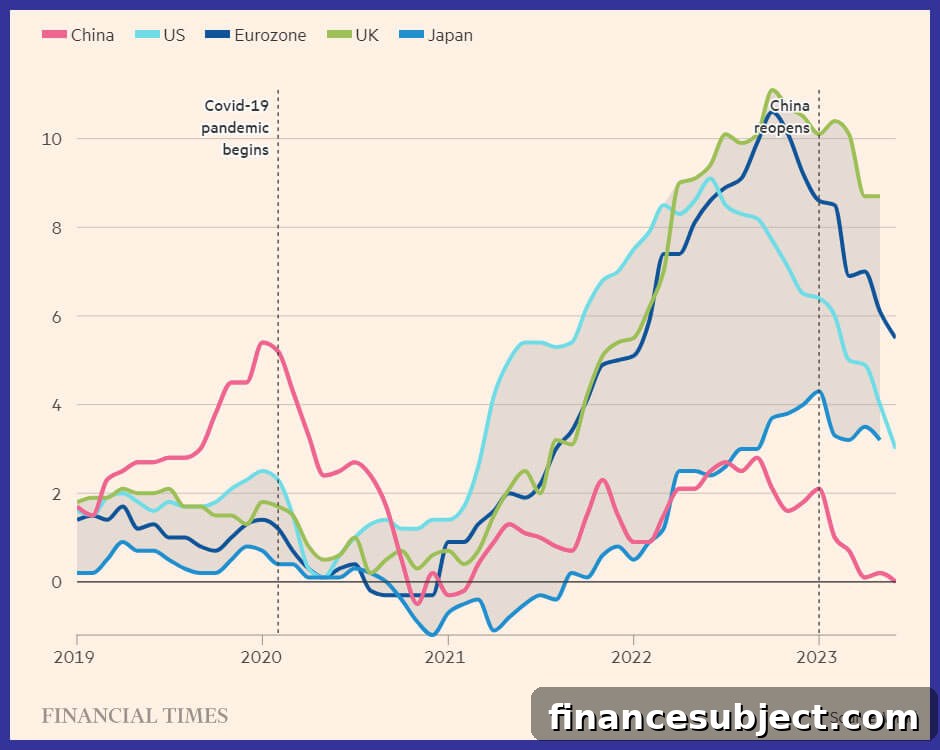
China has taken steps this week to shore up its housing market and loosen monetary policy as authorities try to avoid a deeper deflationary slide. But consumer confidence remains fragile. Many households appear to be saving rather than spending, and bank deposits in China have risen even as policy has eased—an indicator that people are prioritizing liquidity and self-insurance over consumption.
Experts point to factors that have unnerved Chinese consumers, including strict zero-COVID policies that disrupted incomes and routines, and a dramatic correction in property values. Real estate accounts for a substantial portion of China’s economy and is a primary store of household wealth; when property prices fall, the wealth effect reduces consumption and investment.
Recent headlines about property developers and weak housing demand have amplified concerns. Some economists warn the country may be flirting with deflationary pressures and urge policy action to stimulate demand. Given China’s sizable role in global trade, slower Chinese consumer spending can have ripple effects for commodity exporters and global growth—something Canadian investors and policymakers will watch closely.
Couche-Tard share prices in need of refuelling
Quebec-based convenience and retail operator Alimentation Couche-Tard (ATD/TSX) released mixed results in its latest quarter. Reported earnings per share were $0.85 (above the $0.79 consensus), while revenues missed expectations at $15.62 billion versus $16.12 billion estimated. Much of the year-over-year decline reflects lower fuel prices rather than any deterioration in the underlying retail business.
Shares slipped roughly 1.5% following the release. The company said it continues to face inflationary cost pressures but highlighted strategic progress, including the planned acquisition of roughly 2,200 service stations from TotalEnergies SE, expected to close in 2023. Couche-Tard also launched a loyalty program called Inner Circle in Florida, already attracting 2.7 million members—an initiative that could strengthen customer retention and margins over time.
For investors interested in retail exposure, Couche-Tard’s scale, network and international reach remain attractive features, even as short-term volatility accompanies fuel-price swings and acquisition integration.
The Danish wunderkind grows by helping people shrink
Danish pharmaceutical company Novo Nordisk (NOVO-B/CPH), maker of popular GLP-1 treatments such as Wegovy and Ozempic, has risen to become one of Europe’s largest companies by market capitalization—approaching roughly USD 430 billion. The company’s rapid growth reflects strong demand for its treatments and solid financial performance.

Some context on Novo Nordisk’s rise:
- Net profit has climbed sharply year to date, reflecting strong sales of weight-management and diabetes medications.
- Novo’s market value now exceeds many household-name global companies.
- The company’s valuation is comparable to—or larger than—the annual GDP of some smaller countries.
- Competition is emerging: U.S. peers are advancing rival drugs that could affect future growth.
Innovations in healthcare can create significant shareholder value, and Novo’s trajectory underscores how advances in treatment can reshape industries and investor expectations. Still, investors should weigh competitive risks and regulatory developments when assessing long-term prospects.