
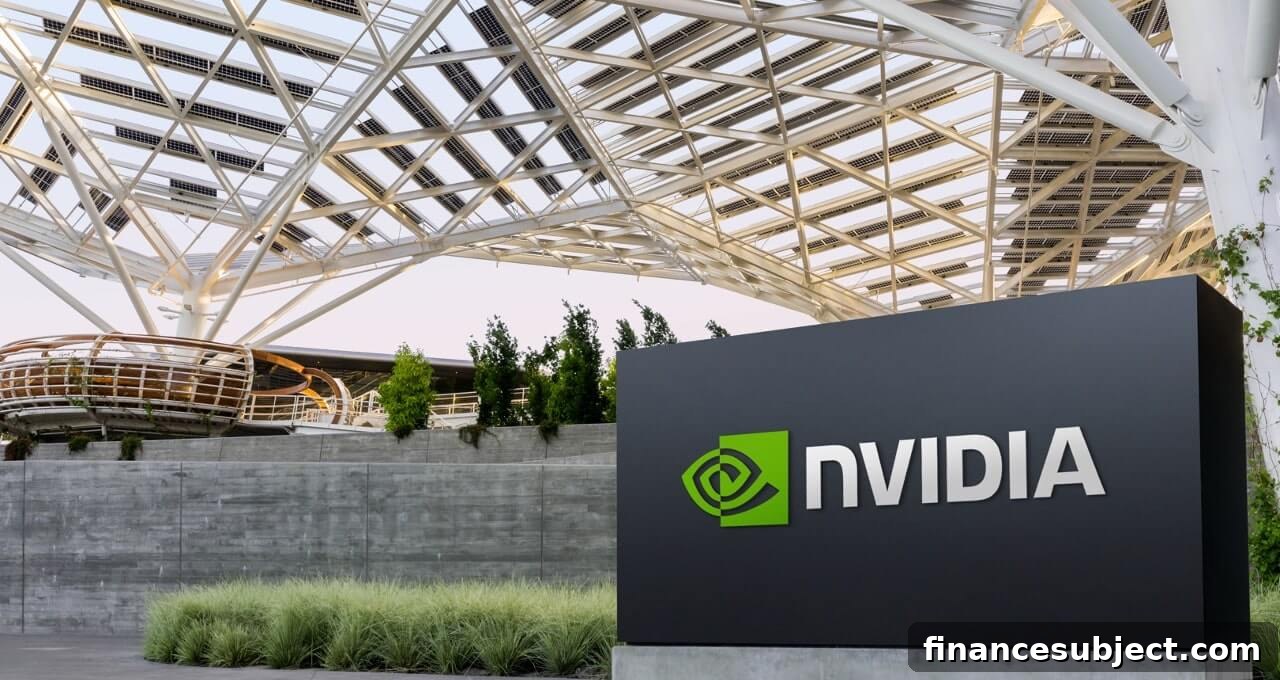
Nvidia announced Monday that, for the first time, it will manufacture its artificial intelligence (AI) supercomputers on U.S. soil.

The company has secured more than one million square feet of manufacturing and testing space to produce and validate its specialized Blackwell chips in Arizona and to assemble AI supercomputers in Texas. Nvidia says this move is part of a broader investment that could support as much as half a trillion dollars of AI-related infrastructure over the next four years.
“The engines of the world’s AI infrastructure are being built in the United States for the first time,” Nvidia founder Jensen Huang said. “Adding American manufacturing helps us better meet the incredible and growing demand for AI chips and supercomputers, strengthens our supply chain and boosts our resiliency.”
How is Nvidia responding to tariffs?
Nvidia’s expansion into U.S. manufacturing comes against a backdrop of shifting trade policy. The current administration has indicated that temporary tariff exemptions for certain consumer electronics—such as smartphones and laptops—are short-term measures while officials develop a more targeted tariff framework for semiconductors and related components.
White House officials, including the president, have characterized recent exemptions as limited relief rather than permanent policy changes. U.S. Commerce Secretary Howard Lutnick told ABC’s “This Week” that while some devices are exempt from reciprocal tariffs, they remain subject to forthcoming semiconductor-specific tariffs that could be implemented in the coming months. For Nvidia, moving production stateside is presented as a way to reduce exposure to changing tariff rules and to increase control over a critical part of its supply chain.
Nvidia chip and supercomputer manufacturing plants in the U.S.
Nvidia confirmed it has begun Blackwell chip production at Taiwan Semiconductor Manufacturing Company (TSMC) facilities in Phoenix and is establishing supercomputer assembly operations in Texas, working with partners including Foxconn in Houston and Wistron in Dallas. The company describes these AI systems as the core compute platforms for “AI factories”—data centers specifically designed to train and run large-scale artificial intelligence models.
Nvidia projects that building components and systems in the United States will support significant employment growth and long-term economic benefits. The company says U.S.-based manufacturing will create thousands of high-skilled jobs directly and, through the broader supply chain, could contribute to the creation of many more positions across testing, packaging, assembly and operations.
Mass production at the new facilities is expected to ramp up within roughly 12 to 15 months. Nvidia also plans partnerships with Taiwan-based packaging and testing firms such as SPIL and Amkor to carry out final assembly and quality control work in Arizona, consolidating multiple steps of the chip production process closer to end markets and major cloud and enterprise customers.
The Trump Effect and AI
The White House framed Nvidia’s announcement as evidence of an industrial comeback tied to federal policy, calling the effort “the Trump Effect in action.” Officials credited recent U.S. policy priorities aimed at boosting domestic chip manufacturing and technology investment for helping attract projects and capital back to American soil.
Earlier this year, the administration highlighted a major private-sector initiative involving OpenAI, Oracle and SoftBank to fund and build AI infrastructure. That partnership, named Stargate, was described as supporting the construction of data centers and associated power-generation capacity to serve large-scale AI workloads in Texas. Initial commitments were reported at around $100 billion with potential to scale up to significantly larger sums over time.
Read more about stocks:
- How did Nvidia become a good buy? Here are the numbers
- Nvidia’s fourth-quarter earnings analysis: revenue up, production up
- What does Nvidia’s stock split mean for Canadian investors?