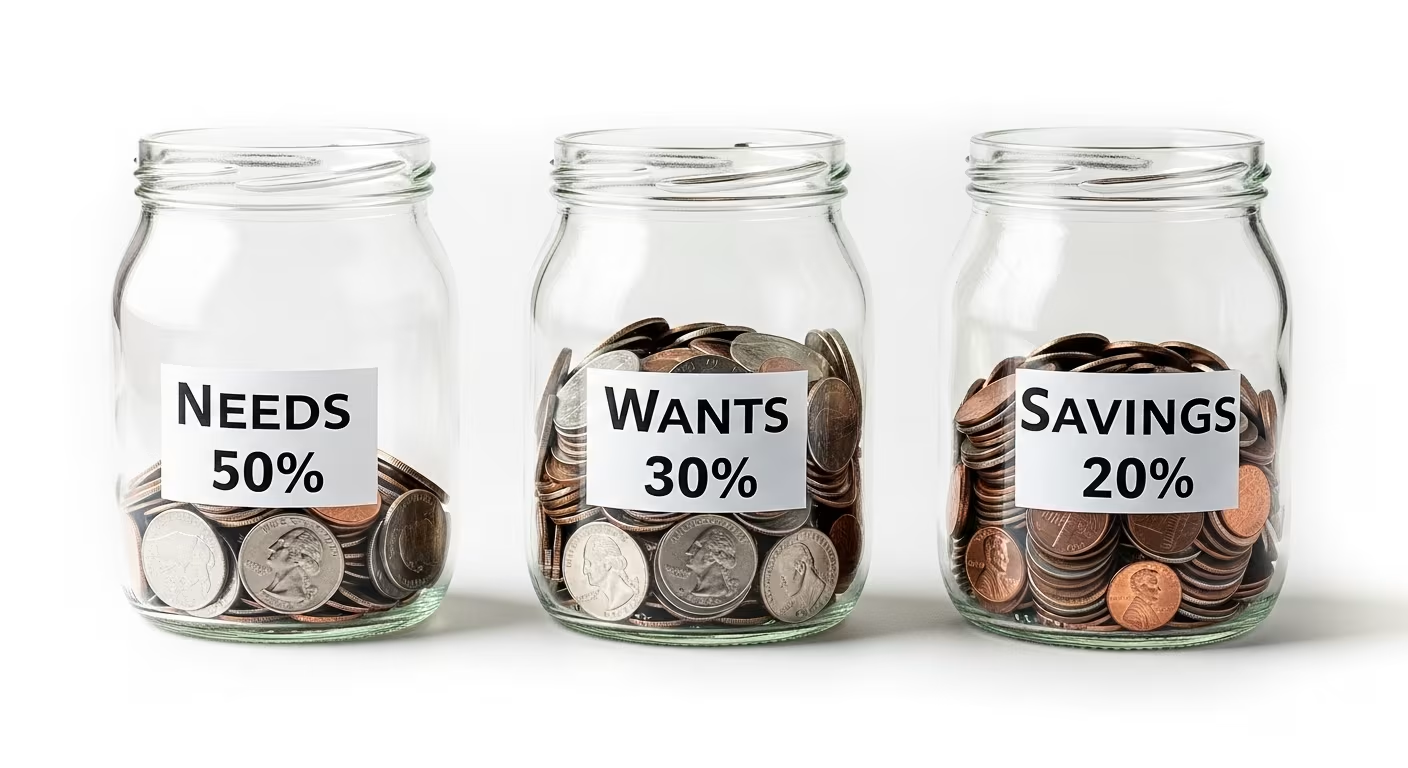
Elizabeth Warren popularized one of budgeting's most memorable frameworks: the 50/30/20 rule. Allocate 50% of your after-tax income to needs, 30% to wants, and 20% to savings and debt repayment. It's elegant in its simplicity, easy to remember, and has become the default budgeting advice for beginners. But here's the question everyone's asking in 2026: does this framework still work, or has the changing economy made it outdated?
The short answer: it works, but not for everyone, and you might need to adjust it.
Understanding the 50/30/20 Rule
50% — Needs: Essential expenses required for survival and basic functioning.
- Housing (rent or mortgage)
- Utilities (electricity, water, gas, internet)
- Groceries and basic food
- Insurance (health, auto, renters)
- Transportation to work
- Minimum debt payments
- Essential medications
30% — Wants: Everything else that makes life enjoyable but isn't required.
- Dining out and entertainment
- Subscriptions (streaming, apps, gym)
- Hobbies and personal interests
- Clothing beyond basics
- Vacation travel
- Gifts
20% — Savings and Debt:
- Emergency fund contributions
- Retirement savings (401(k), IRA)
- Extra debt payments beyond minimums
- Investing
- Sinking funds for future expenses
The Math in 2026
The median household income in 2026 is approximately $89,000-$90,000, translating to roughly $5,500-$6,500 monthly after taxes depending on location and filing status.
Using the 50/30/20 rule on $6,000 monthly after-tax income:
- Needs: $3,000
- Wants: $1,800
- Savings/Debt: $1,200
Let's test if these allocations are realistic.
Where the Rule Gets Challenged
Housing Costs Have Exploded
The rule suggests housing should consume about 25-30% of your budget, leaving room for other needs in the 50% category. But median rent for a one-bedroom apartment in many metropolitan areas exceeds $2,000/month in 2026.
If you earn $6,000 monthly after taxes and pay $2,200 for rent, that's already 37% of income on housing alone—leaving only 13% for all other needs.
Healthcare Costs Keep Rising
Health insurance premiums, copays, and out-of-pocket maximums have increased significantly. A family health insurance plan can cost $1,200-$1,800/month in 2026. For many households, healthcare alone could consume 15-25% of income.
Childcare Costs
If you have children, childcare costs in 2026 can range from $1,000-$2,500/month per child depending on location. That single expense could consume your entire "needs" allocation.
Student Loan Debt
With the average student loan balance around $35,000, monthly payments can range from $300-$600. Add credit card debt (with average APRs at 23.77% in 2026), and debt payments quickly consume the savings allocation.
Who the 50/30/20 Rule Works Best For
The rule works well if you:
- Live in a moderate cost-of-living area
- Earn median income or above
- Have no children or minimal childcare costs
- Have limited or no student loans
- Don't have significant medical expenses
- Have stable, predictable income
In these circumstances, 50/30/20 provides an excellent starting framework.
Adjusted Versions for 2026
The 60/20/20 Split
If your needs genuinely consume more:
- 60% for needs
- 20% for wants
- 20% for savings/debt
This acknowledges reality for higher cost-of-living areas while maintaining savings discipline.
The 50/20/30 Flip
Prioritize savings over wants:
- 50% for needs
- 20% for wants
- 30% for savings/debt
Particularly valuable if you're behind on retirement savings (the 2026 401(k) limit is $24,500, or $35,750 with catch-up contributions for ages 60-63).
The 70/20/10 Reality Check
For high-cost cities or those rebuilding:
- 70% for needs
- 20% for wants
- 10% for savings/debt
Not ideal, but realistic for some situations. The key is acknowledging where you are while working toward better ratios.
The 80/20 Aggressive Saver
For FIRE (Financial Independence, Retire Early) pursuers:
- 50% for needs
- 10% for wants
- 40% for savings/debt
This requires serious lifestyle adjustments but accelerates financial independence dramatically.
Making 50/30/20 Work in 2026
Reduce Housing Costs
Housing is typically the biggest budget item. Options include:
- Getting a roommate
- Moving to a lower cost-of-living area
- Downsizing
- Negotiating rent at renewal
- House hacking (renting out a room)
Audit Your "Needs"
Some expenses feel necessary but aren't:
- A car payment might be a want if public transit is available
- That premium gym membership when a basic one works
- Expensive phone plans when budget carriers offer similar service
- Subscription services disguised as necessities
Maximize the 20% Savings
Even if you adjust the percentages, protect your savings rate:
- Take full advantage of your employer's 401(k) match
- Use a Roth IRA (2026 limit: $7,500, or $8,600 for 50+)
- Build emergency savings in a high-yield account (4-5% APY available in 2026)
- Automate transfers so saving happens before spending
Optimize Tax-Advantaged Accounts
2026 contribution limits make tax-advantaged saving more powerful:
- 401(k): $24,500 ($32,500 with catch-up for 50+, $35,750 for ages 60-63)
- IRA/Roth IRA: $7,500 ($8,600 for 50+)
- HSA: Provides triple tax benefits if you have a high-deductible health plan
Reduce High-Interest Debt
With credit card APRs averaging 23.77% in 2026, paying down high-interest debt provides a guaranteed return. Every dollar toward a 24% credit card balance is a 24% return.
Tracking Your Percentages
How to calculate your actual percentages:
- Add up total monthly after-tax income
- List all expenses from the past three months
- Categorize each expense as need, want, or savings/debt
- Divide each category by total income
- Compare to your target percentages
If you're currently at 65/30/5, don't try to jump to 50/30/20 immediately. Improve by 5% per category over several months.
When to Deviate from the Rule
The 50/30/20 rule is a guideline, not a law. Deviate when:
Building emergency fund: Temporarily allocate more to savings until you have 3-6 months of expenses.
Paying off high-interest debt: Redirect "wants" money to debt until credit cards are paid.
Saving for major purchase: Adjust percentages for a defined period to reach a down payment or other goal.
Income significantly increases: Consider maintaining expenses while dramatically increasing savings rate.
Income decreases: Prioritize needs and minimum savings until stability returns.
Real Examples
Example 1: Urban Professional
Income: $6,500/month after taxes Rent: $2,200 (34%) Other needs: $1,500 (23%) Wants: $1,100 (17%) Savings/debt: $1,700 (26%)
Actual split: 57/17/26 — Adjusted for high housing costs while maximizing savings.
Example 2: Family with Childcare
Income: $8,000/month after taxes Childcare: $2,000 Other needs: $3,000 Wants: $1,000 Savings: $2,000
Actual split: 62.5/12.5/25 — Childcare pushes needs higher, wants reduced accordingly.
Example 3: Recent Graduate with Student Loans
Income: $4,200/month after taxes Student loans: $450 Other needs: $2,100 Wants: $650 Additional savings: $1,000
Actual split: 61/15/24 — Loans as needs, limited wants, protecting savings.
Inflation-Adjusted Alternatives to the 50/30/20 Rule
The 50/30/20 rule was designed in an era of lower housing costs. In 2026, with rents consuming 40-50% of income in many cities according to Harvard's Joint Center for Housing Studies, the original split feels mathematically impossible for many households.
The 60/30/10 Rule: Allocates 60% to needs, 30% to wants, and 10% to savings. While trending as a realistic alternative, financial experts warn that saving only 10% may not be enough for retirement. This works best as a temporary framework while you increase income or reduce fixed costs.
The 70/20/10 Rule: Combines needs and basic wants at 70%, keeps savings at 20%, and limits pure discretionary spending to 10%. This acknowledges that the line between needs and wants has blurred — is internet a need or want in 2026?
The 80/20 Rule: The simplest approach. Save 20%, spend 80% however you want. No category tracking required. This works best for people who hit their savings targets but hate detailed budgeting.
The real lesson: The specific percentages matter less than the principle — spend less than you earn and save consistently. If your needs genuinely consume 60% of your income, adjust the other categories rather than abandoning budgeting entirely. The worst budget is the one you don't follow.
When the 50/30/20 Rule Still Works
The rule remains effective when your housing costs stay below 30% of gross income, you live in a moderate cost-of-living area, you have no significant medical expenses, and your income is stable and above the median. For dual-income households earning above $120,000 combined, the 50/30/20 split often works as intended.
Personalizing Your Percentages
The most effective approach in 2026 is to calculate your actual needs percentage first, then allocate savings (aim for at least 15-20%), and let wants absorb the remainder. This data-driven method respects your reality while maintaining financial progress. Track for three months before setting permanent percentages — most people underestimate their true needs by 10-15%.
Real-World Budget Allocation Examples
Understanding percentages is theoretical. Here is how the 50/30/20 rule looks at different income levels in 2026:
$40,000 salary (~$3,100/month after tax):
- Needs $1,550: Rent $1,000, utilities $150, groceries $250, transport $100, insurance $50 — tight but possible in low-cost areas
- Wants $930: Dining $200, entertainment $100, subscriptions $80, personal $150, miscellaneous $400
- Savings $620: Emergency fund $300, retirement $220, sinking funds $100
$75,000 salary (~$5,000/month after tax):
- Needs $2,500: Rent $1,500, utilities $200, groceries $400, transport $200, insurance $200
- Wants $1,500: More breathing room for lifestyle choices
- Savings $1,000: $500 to 401(k), $300 emergency fund, $200 extra debt payments
$120,000 salary (~$7,500/month after tax):
- Needs $3,750: Higher housing quality, better insurance options
- Wants $2,250: Travel fund, hobby investments, quality-of-life upgrades
- Savings $1,500: Maximize 401(k) at $24,500/year limit, invest remainder
At lower incomes the needs category inevitably exceeds 50%, which is exactly why alternatives like the 70/20/10 rule exist. The key is maintaining at least a 10-15% savings rate regardless of income level.
The Annual Budget Review
Regardless of which percentage-based rule you follow, conduct a thorough annual review every January. Compare your actual spending to your planned allocations across all 12 months. Identify categories where you consistently over or under-budget. Adjust your percentages to reflect reality rather than forcing yourself into arbitrary targets. Your budget should fit your life, not the other way around. As income changes, debt decreases, or life circumstances shift, your ideal percentages will naturally evolve.
The Bottom Line
The 50/30/20 rule remains a valuable starting point in 2026, but it requires customization. Don't let rigid adherence to percentages prevent you from budgeting at all. Any intentional allocation beats no budget.
The principles behind 50/30/20 still apply:
- Live below your means
- Distinguish needs from wants
- Prioritize savings
- Remain flexible
Whether you follow 50/30/20, 60/20/20, or your own custom split, the act of intentionally directing your money matters most. Start where you are, improve steadily, and adjust as circumstances change.
Comments (0)
No comments yet. Be the first to share your thoughts!
Leave a Comment