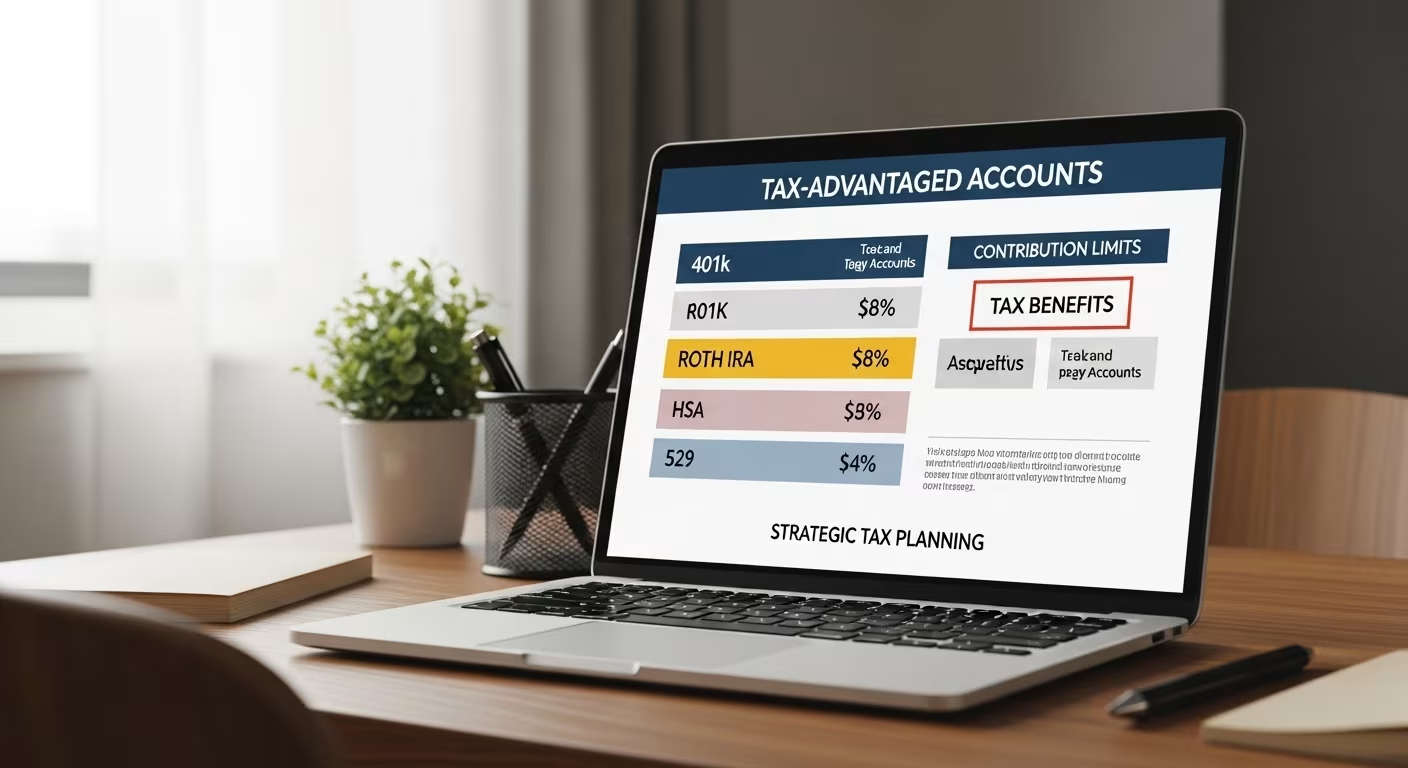
Tax-advantaged accounts are among the most powerful wealth-building tools available. They shelter your investments from taxes—either now or in retirement—letting your money grow faster. Understanding which accounts to use, in what order, and how to maximize them can save you hundreds of thousands of dollars over your lifetime.
Tax-Advantaged Accounts Ranked by Tax Benefit (2026)
| Account | Tax Going In | Tax on Growth | Tax Coming Out | 2026 Limit |
|---|---|---|---|---|
| HSA | Deductible | Tax-free | Tax-free (medical) | $4,300/$8,550 |
| Roth 401(k) | After-tax | Tax-free | Tax-free | $24,500 |
| Roth IRA | After-tax | Tax-free | Tax-free | $7,500 |
| Traditional 401(k) | Pre-tax | Tax-deferred | Taxed as income | $24,500 |
| Traditional IRA | Deductible (if eligible) | Tax-deferred | Taxed as income | $7,500 |
| 529 Plan | After-tax (state deduction varies) | Tax-free | Tax-free (education) | Varies |
| Taxable Brokerage | After-tax | Taxed (dividends/gains) | Taxed (capital gains) | Unlimited |
The optimal order: HSA first (triple tax advantage) > employer match > Roth IRA > remaining 401(k) > taxable brokerage.
The HSA Super Power
The HSA is the only account with a triple tax benefit:
- Contributions are tax-deductible (saves 22-37% immediately)
- Growth is tax-free (no taxes on dividends, capital gains, or interest)
- Withdrawals are tax-free for qualified medical expenses
Advanced HSA strategy: Pay medical expenses out of pocket today, invest your HSA in index funds, save receipts, and reimburse yourself years later. Your HSA grows tax-free, and you get tax-free withdrawals whenever you choose—even 20 years later. After age 65, you can withdraw for any purpose (taxed like a traditional IRA).
HSA contribution limits (2026): Individual $4,300, Family $8,550, plus $1,000 catch-up if 55+.
An HSA contributed at $4,300/year from age 30 to 65, invested at 7% return, grows to approximately $600,000—a tax-free healthcare fund for retirement.
Types of Tax Advantages
Pre-Tax (Tax-Deferred)
How it works: Contributions reduce taxable income now; pay taxes when you withdraw
Examples: Traditional 401(k), Traditional IRA, 403(b), SEP IRA
Best when: You're in a higher tax bracket now than you expect in retirement
After-Tax (Tax-Free Growth)
How it works: Contributions don't reduce taxable income; withdrawals are tax-free
Examples: Roth 401(k), Roth IRA
Best when: You're in a lower tax bracket now than you expect in retirement
Triple Tax-Advantaged
How it works: Tax deduction now, tax-free growth, tax-free withdrawals
Examples: HSA (for medical expenses)
Best when: Always (if you can use it for medical expenses)
Retirement Accounts
401(k)/403(b)/457
2026 contribution limits:
- Employee: $24,500
- Catch-up (50+): $8,000 additional
- Total (including employer): $70,000
Key features:
- Employer matching (free money)
- Payroll deduction (easy saving)
- Limited investment choices
- Required minimum distributions at 73
Roth option: Many plans offer Roth 401(k)—same limits, after-tax contributions
Traditional IRA
2026 contribution limit: $7,500 ($8,600 if 50+)
Deductibility: Phase-out if covered by workplace plan
- Single: $83,000-$93,000
- Married: $133,000-$143,000
Key features:
- More investment choices than 401(k)
- Anyone with earned income can contribute
- Required minimum distributions at 73
Roth IRA
2026 contribution limit: $7,500 ($8,600 if 50+)
Income limits:
- Single: $153,000-$168,000 phase-out
- Married: $242,000-$252,000 phase-out
Key features:
- Tax-free qualified withdrawals
- No required minimum distributions
- Contributions accessible anytime
- Five-year rule for earnings
SEP IRA (Self-Employed)
2026 contribution limit: 25% of net self-employment earnings, up to $70,000
Key features:
- Simple setup
- High contribution limits
- Flexible contributions
- Same rules as Traditional IRA for withdrawals
Solo 401(k) (Self-Employed)
2026 contribution limit: $24,500 employee + 25% of earnings (up to $70,000 total)
Key features:
- Higher contributions at lower income levels than SEP
- Roth option available
- Loan provision possible
- More paperwork than SEP
SIMPLE IRA (Small Employers)
2026 contribution limit: $16,500 employee + employer match
Key features:
- For businesses with 100 or fewer employees
- Employer must contribute
- Two-year waiting period for transfers
Health Savings Account (HSA)
The Triple Tax Advantage
- Contributions: Tax-deductible
- Growth: Tax-free
- Withdrawals: Tax-free (for qualified medical expenses)
No other account offers this triple benefit.
2026 Contribution Limits
- Individual coverage: $4,300
- Family coverage: $8,550
- Catch-up (55+): Additional $1,000
Requirements
- Enrolled in HSA-eligible high-deductible health plan (HDHP)
- Not covered by other non-HDHP health plan
- Not enrolled in Medicare
- Not claimed as dependent
HSA as Retirement Account
Strategy: Pay medical expenses out-of-pocket now, invest HSA funds, use tax-free in retirement for healthcare costs
After age 65: Can withdraw for any purpose (taxed like Traditional IRA if not for medical)
Why HSA Is So Powerful
$8,550/year invested for 20 years at 7% = ~$370,000 for tax-free healthcare in retirement
Education Accounts
529 Plans
What: State-sponsored education savings accounts
Tax treatment:
- Contributions: Not federally deductible (may be state-deductible)
- Growth: Tax-free
- Withdrawals: Tax-free for qualified education expenses
Qualified expenses:
- Tuition and fees
- Room and board
- Books and supplies
- Computer and equipment
- K-12 tuition (up to $10,000/year)
Contribution limits: High (often $300,000+ lifetime per beneficiary)
No income limits
Coverdell Education Savings Account
Contribution limit: $2,000/year
Income limits: Phase-out starts at $95,000 single, $190,000 married
Advantage: More investment flexibility than 529 Disadvantage: Low limit, income restrictions
Comparison: 529 vs. Coverdell
Most people: 529 (higher limits, no income restrictions) For K-12 with specific investment preferences: Consider Coverdell
Flexible Spending Accounts (FSA)
Healthcare FSA
2026 limit: ~$3,300
Use it or lose it: Generally must use by end of plan year (some plans allow carryover of ~$640)
What it covers: Medical expenses, copays, prescriptions, some OTC items
Dependent Care FSA
Limit: $5,000 per household
What it covers: Childcare while working, eldercare expenses
Tax savings: Reduces taxable income (15-30%+ savings depending on bracket)
FSA vs. HSA
| Feature | FSA | HSA |
|---|---|---|
| Employer plan required | Yes | HDHP required |
| Rollover | Limited | Unlimited |
| Contribution limits (2026) | ~$3,300 | $4,300/$8,550 |
| Investment | No | Yes |
| Portability | No | Yes |
If you have choice: HSA is generally better long-term
Account Prioritization
The Optimal Order
- 401(k) to employer match: Free money—never skip this
- HSA maximum (if available): Triple tax advantage
- 401(k) to maximum: $24,500 tax-advantaged
- Roth IRA maximum: $7,500 tax-free growth
- Taxable brokerage: Additional savings
- 529 (if saving for education): After retirement accounts
Why This Order?
Employer match: 50-100% instant return HSA: Best tax treatment available 401(k): Highest contribution limits Roth IRA: Tax-free growth, flexibility Taxable: Still beneficial, just fewer tax advantages
Adjustments Based on Situation
No employer match: Skip to HSA, then Roth/Traditional IRA, then 401(k)
Low income now (expect higher later): Emphasize Roth accounts
High income now: Emphasize pre-tax accounts
Tax Diversification
Why It Matters
You don't know future tax rates. Having money in different account types provides flexibility.
Three buckets:
- Pre-tax (Traditional 401k/IRA): Taxed on withdrawal
- Tax-free (Roth IRA/401k): No tax on withdrawal
- Taxable (brokerage): Capital gains rates
In Retirement
You can manage taxable income by choosing which accounts to withdraw from:
- Need to stay under a threshold? Use Roth
- Low income year? Convert traditional to Roth
- High income year? Use taxable accounts
Contribution Strategies
Max Out in Order
Don't spread contributions thin. It's generally better to max one account before starting another.
Front-Load When Possible
Money invested earlier has more time to grow. Front-loading contributions (more in January) beats equal monthly contributions.
Caveat: Some employer matches require contributing throughout year. Check your plan.
Catch-Up Contributions (50+)
| Account | Regular Limit | Catch-Up | Total |
|---|---|---|---|
| 401(k) | $24,500 | $8,000 | $32,500 |
| IRA | $7,500 | $1,100 | $8,600 |
| HSA | $4,300/$8,550 | $1,000 | $5,300/$9,550 |
Automate Everything
- 401(k): Payroll deduction
- IRA: Monthly auto-transfer
- HSA: Payroll deduction or auto-transfer
Set once, adjust annually.
Common Mistakes
Not Getting Full Employer Match
Leaving free money on the table—possibly thousands per year.
Ignoring HSA Investment Option
Many people treat HSA as checking account. Invest it for tax-free growth.
Over-Contributing
Excess contributions face penalties. Know limits and track contributions.
Wrong Beneficiary Designations
Retirement accounts pass by beneficiary designation, not will. Keep updated.
Not Using Available Accounts
Some people aren't aware of all options (HSA, backdoor Roth, mega backdoor).
Taking Action
This Week
- Determine which accounts you have access to
- Check current contribution rates
- Verify you're getting full employer match
- Review HSA eligibility
This Month
- Increase 401(k) contribution toward maximum
- Open and fund HSA if eligible
- Open Roth IRA if not already
- Set up automatic contributions
This Year
- Work toward maxing priority accounts
- Review and update beneficiaries
- Consider backdoor Roth if over income limits
- Explore mega backdoor Roth if available
Annually
- Increase contributions (especially after raises)
- Rebalance investments
- Review contribution limits (they change)
- Ensure you're maximizing available space
Tax-advantaged accounts are the foundation of wealth building. Every dollar you can shelter from taxes grows faster. Prioritize these accounts, maximize contributions over time, and let tax-advantaged compounding do the heavy lifting for your financial future.
The Tax Savings Stack: A Real-World Example
Profile: Sarah, 35, earns $95,000, married filing jointly
| Account | Annual Contribution | Tax Savings (22% bracket) |
|---|---|---|
| 401(k) | $24,500 | $5,390 |
| HSA | $8,550 (family) | $1,881 |
| Roth IRA | $7,500 | $0 (after-tax, but tax-free growth) |
| Dependent Care FSA | $5,000 | $1,100 |
| Total | $45,550 | $8,371 in annual tax savings |
Sarah reduced her taxable income from $95,000 to roughly $57,000 by utilizing tax-advantaged accounts—dropping her effective tax rate significantly. Over 30 years, that $8,371/year in tax savings, invested at 7% return, grows to approximately $790,000.
The lesson: Tax-advantaged accounts are not just about retirement savings—they are the single most effective legal tax reduction strategy available to most Americans. Every dollar contributed to a pre-tax account is a dollar the IRS cannot touch until you withdraw it, ideally in a lower tax bracket during retirement.
Start small: Even contributing $100/month to each account ($300 total) captures meaningful tax benefits while building good habits. Increase by 1% of income each year.
The bottom line: tax-advantaged accounts are the closest thing to free money in personal finance. Max them out before putting a single dollar in a taxable brokerage account.
Comments (0)
No comments yet. Be the first to share your thoughts!
Leave a Comment