
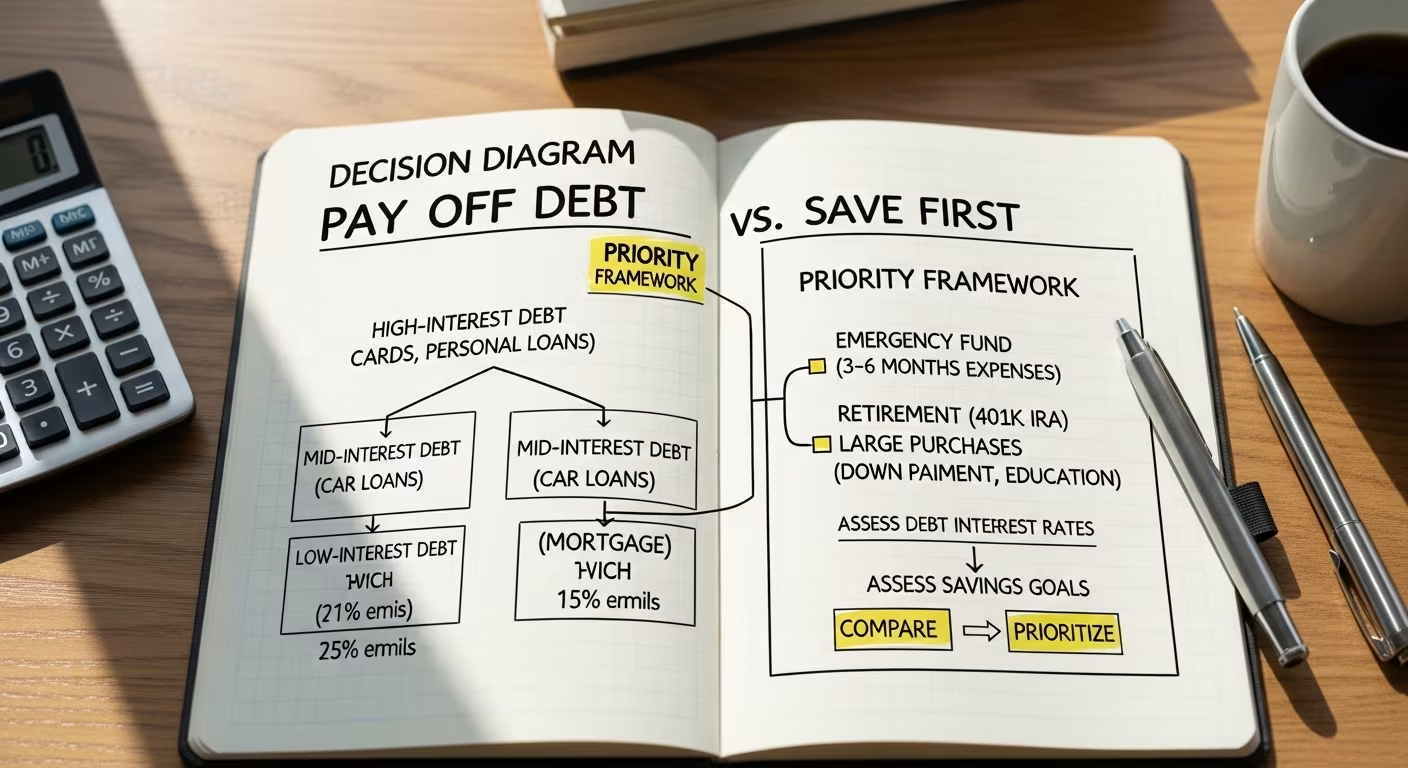
This question plagues nearly everyone with debt: Should I focus on paying off what I owe, or should I save money first? The answer isn't one-size-fits-all—it depends on your specific situation. But there are clear principles that lead to the optimal decision for almost everyone.
The Core Tension
Arguments for paying off debt first:
- Debt interest (especially credit cards at 23.77% average APR) exceeds savings returns
- Debt creates stress and reduces financial flexibility
- Being debt-free feels liberating
- You can't invest your way out of high-interest debt
Arguments for saving first:
- Without savings, emergencies create new debt
- Savings provide security and options
- Some savings earn returns close to debt interest
- Psychological comfort of having cash
Both arguments have merit. The solution is understanding which applies to your situation—and finding the right balance.
The Framework: What to Do First
Here's the decision framework that works for most people:
Priority 1: $1,000 Starter Emergency Fund
Before aggressively paying debt OR saving more, build a $1,000 mini emergency fund.
Why: Without any savings, the first car repair or medical bill goes on a credit card. You pay off debt, then accumulate more debt. The cycle continues.
$1,000 breaks the cycle. It covers most common emergencies (car repairs, minor medical bills, appliance failures) without reaching for credit cards.
Timeline: 1-3 months of focused effort
Priority 2: Employer 401(k) Match
If your employer matches 401(k) contributions, contribute enough to get the full match.
Why: Employer match is 100% return on investment—free money. A 50% match means your dollar immediately becomes $1.50. No debt payoff or savings account offers that return.
Example:
- Employer matches 50% up to 6% of salary
- You earn $60,000
- You contribute 6% ($3,600/year)
- Employer adds 3% ($1,800/year)
- That's $1,800 free money annually
Skip this only if: You're in debt crisis (can't make minimums) or your company has no match.
Priority 3: Pay Off High-Interest Debt
Now attack debt with interest rates above 7-8%.
Why: Credit card debt at 23.77% APR is an emergency. Every month you carry that balance, nearly 2% of it evaporates to interest. No savings account or typical investment reliably returns 23.77%.
What counts as high-interest:
- Credit cards (15-30% APR)
- Personal loans (10-25% APR)
- Payday loans (300%+ APR—this is crisis mode)
- Private student loans (8%+ variable)
- Some auto loans (10%+ APR)
Method: Use debt avalanche (highest interest first) or debt snowball (smallest balance first). Avalanche saves more money; snowball provides quicker wins.
Priority 4: Expand Emergency Fund to 3 Months
Once high-interest debt is gone, build emergency fund to 3 months of essential expenses.
Why: With high-interest debt eliminated, the risk calculus changes. 3 months of expenses protects against job loss or major emergencies without immediately sliding back into debt.
Timeline: 6-12 months of saving after debt payoff
Priority 5: Pay Off Medium-Interest Debt
Debt with 4-7% interest rates:
- Auto loans (5-9% typical)
- Some student loans (5-8%)
- Older personal loans
Why: At this interest range, the math is closer. Your money could earn 7-10% in the market, but guaranteed debt elimination at 5-7% is still attractive—especially for risk-averse individuals.
Priority 6: Expand Emergency Fund to 6 Months
With medium-interest debt cleared, reach 6 months of expenses.
Why: Full financial security. Job loss, major medical issues, extended emergencies—you're protected.
Priority 7: Invest and Pay Off Low-Interest Debt
Low-interest debt (under 4%):
- Mortgages (2.5-6% depending on when obtained)
- Some student loans
- 0% promotional financing
Why: Historically, the stock market returns 7-10% annually. If your mortgage is at 3.5%, investing extra money (expected return 7-10%) may outperform paying extra on mortgage (guaranteed 3.5% return).
But this is personal preference:
- Risk-tolerant: Invest, carry low-rate debt longer
- Risk-averse: Pay off all debt, then invest
- Hybrid: Split extra money between both
The 2026 Interest Rate Landscape
Understanding current rates makes this decision clearer:
| Debt/Savings Type | Typical Rate (2026) |
|---|---|
| Credit cards | 23.77% APR (average) |
| Personal loans | 12-18% APR |
| Student loans (federal) | 5.50-8.05% |
| Auto loans | 6.5-9.5% |
| Mortgage | 6.5-7.0% |
| High-yield savings | 4.50-5.00% APY |
| 401(k) average return | 7-10% (long-term) |
| S&P 500 average return | ~10% (historical) |
The math becomes obvious: paying off a 23.77% credit card balance is equivalent to earning a guaranteed 23.77% return on your money. No investment reliably beats that. But a 5.50% student loan versus a 10% average stock market return? The math favors investing.
The Mathematics: When Debt Payoff Wins
Credit Card Example
Situation: $8,000 credit card debt at 23.77% APR
Option A: Put $500/month toward debt
- Debt paid off in 19 months
- Total interest paid: ~$1,400
Option B: Put $500/month into savings (earning 4.5%)
- After 19 months: ~$9,700 saved
- But debt after 19 months: ~$10,800 (grew due to minimum payments)
- Net position: -$1,100
Conclusion: Pay off high-interest debt. The math overwhelmingly favors it.
Student Loan Example
Situation: $20,000 student loans at 5.5% APR
Option A: Put $500/month extra toward loans
- Paid off faster
- Save ~$2,500 in interest
Option B: Invest $500/month (expected 7% return)
- After same period: ~$25,000+ invested
- Still owe some student loan
- Net position: likely positive, but market-dependent
Conclusion: Closer call. Either choice is reasonable. Personal risk tolerance decides.
Special Situations
If You're In Debt Crisis
Signs of crisis:
- Can't make minimum payments
- Using credit cards for necessities
- Being contacted by collectors
- Considering bankruptcy
Action: Stop everything else. Focus 100% on stabilizing:
- Make minimum payments to avoid collections
- Cut expenses drastically
- Increase income urgently
- Consider debt counseling or bankruptcy attorney
If You Have 0% Promotional APR
Credit cards or loans with 0% promotional rates change the calculation:
- Save the money instead of paying early
- BUT: Set money aside for full payoff before promo ends
- Missing promo end = back-interest often at 20%+
Don't get caught unprepared when 0% ends.
If You're Close to Retirement
Less time for market recovery. Consider:
- Paying off all debt including mortgage
- Building larger cash reserves
- More conservative approach overall
If You're Young (20s-30s)
Time compounds investment returns. Consider:
- Aggressive 401(k)/Roth IRA contributions
- Paying minimums on low-interest debt
- Investing extra funds in index funds
- Using time advantage for market growth
If You Have Irregular Income
Build larger emergency fund (6-12 months):
- Income gaps are emergencies
- More cash buffer = less debt risk
- Save during good months for lean months
The Psychological Factor
Mathematics say pay high-interest debt first. Psychology sometimes disagrees.
If you need motivation:
- Snowball method (smallest debts first) provides quick wins
- Some people hate all debt and will pay mortgage early despite math
- Seeing savings grow feels rewarding
If you need security:
- Building savings first provides peace of mind
- Some will save before paying debt that "feels" manageable
- Emergency fund reduces anxiety
Both approaches work if you stick with them. The best plan is one you'll follow.
Creating Your Personal Plan
Step 1: List All Debts
For each debt, note:
- Balance
- Interest rate
- Minimum payment
- Type (credit card, student, auto, mortgage)
Step 2: Assess Emergency Fund
How much do you have currently? What's your 3-month and 6-month target?
Step 3: Check Retirement Match
Does your employer match? What percentage do you need to contribute to get full match?
Step 4: Apply the Framework
- If emergency fund < $1,000 → Build to $1,000
- If not getting full 401(k) match → Contribute to get match
- If high-interest debt exists → Attack it aggressively
- If emergency fund < 3 months → Build to 3 months
- If medium-interest debt exists → Pay it off
- If emergency fund < 6 months → Build to 6 months
- Remaining: Invest and optionally pay low-interest debt
Step 5: Allocate Monthly Cash Flow
After essential expenses, how much can you direct to debt/savings?
Allocate according to your current priority step.
Common Mistakes
Mistake 1: All-or-Nothing Thinking
"I'll save OR pay debt." Often the answer is both—starter emergency fund AND debt payoff.
Mistake 2: Ignoring Interest Rates
Paying extra on a 3% mortgage while carrying 23% credit card debt is backward.
Mistake 3: No Emergency Fund
Paying off debt without savings leads to re-accumulating debt when emergencies hit.
Mistake 4: Skipping 401(k) Match
Foregoing 100% return (employer match) to pay 6% debt doesn't make sense.
Mistake 5: Analysis Paralysis
Debating the "perfect" approach for months while interest accrues. Good enough action beats perfect inaction.
Real-World Example: The Balanced Approach
Meet Taylor: $8,000 credit card debt (23.77% APR), $22,000 student loans (5.50%), $500 in savings, earning $55,000/year with a 4% employer 401(k) match.
Taylor’s optimal plan:
- Month 1-2: Build $1,000 starter emergency fund (saving $500/month)
- Month 1 onward: Contribute 4% to 401(k) to capture full employer match ($183/month, employer adds $183)
- Month 3-18: Attack credit card debt with $450/month extra payments. At 23.77% APR, eliminating this saves $1,900/year in interest
- Month 19-24: Build full 3-month emergency fund ($6,000)
- Month 25 onward: Pay minimums on student loans, max out Roth IRA ($625/month), increase 401(k) to 10%
By month 24, Taylor has: zero credit card debt, a funded emergency fund, 10% going to retirement, and student loans being paid normally. Total interest saved versus paying minimums: roughly $4,200.
Taking Action Today
- Today: List all debts with balances and interest rates
- Today: Check current savings balance
- Today: Confirm 401(k) match details
- This week: Determine your current priority step
- This week: Calculate monthly amount available for debt/savings
- This week: Set up automatic transfers to execute your plan
The Snowball Effect of Good Decisions
Once you eliminate high-interest debt, the money that was going to interest payments becomes available for wealth-building. If you were paying $300/month in credit card interest, that’s $3,600/year that now flows into investments. At a 7% average return, that $300/month grows to over $120,000 in 20 years. Every dollar freed from debt interest becomes a dollar building your future.
The debt versus savings question has a framework that works for most people. Follow the priorities, adjust for your situation, and take action. The worst decision is no decision while interest accumulates and financial stress continues. Start today with whatever resources you have—even $50 toward your starter emergency fund or one extra payment on your highest-rate card moves you forward.
Comments (0)
No comments yet. Be the first to share your thoughts!
Leave a Comment