
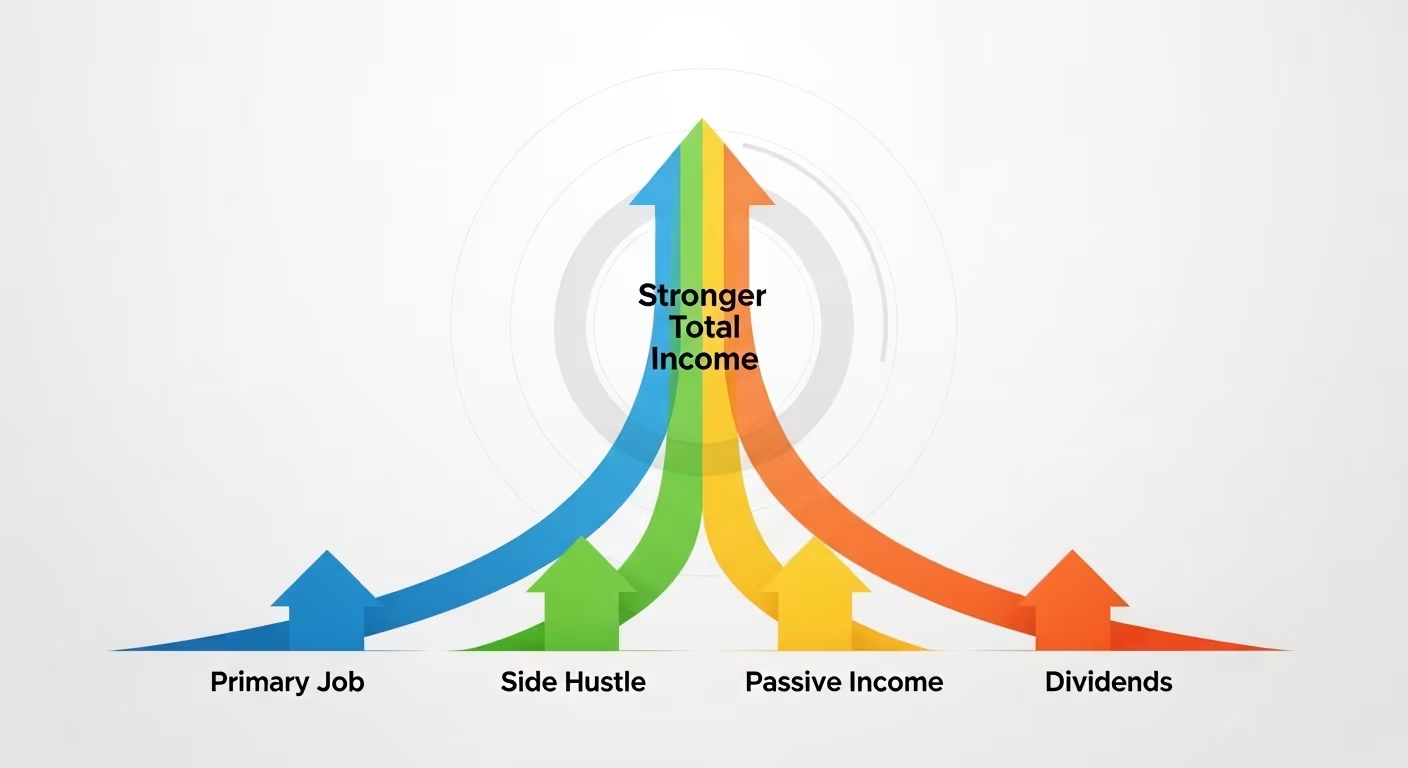
Multiple Income Streams: Why You Need Them and How to Build
The idea of multiple income streams has shifted from a niche financial strategy to a mainstream priority — and for good reason. A single income source, no matter how stable it appears, exposes you to risks that can upend your financial life in months. Job loss, industry disruption, a health event, or a company downsizing can eliminate your primary income with little warning. Building multiple income streams provides resilience, accelerates wealth building, and creates options that a single paycheck never can.
This guide covers why income diversification matters, the different types of income streams available, how to realistically build them without burning out, and which paths tend to be most viable depending on your existing skills and time.
Why Multiple Income Streams Are No Longer Optional
The financial case for multiple income streams has always existed. But several converging trends have made it more urgent than ever.
Job security has weakened. The implicit contract of decades of stable employment in exchange for loyalty has frayed substantially. Layoffs now happen at profitable companies. Entire departments are eliminated. AI-driven automation is displacing roles faster than labor markets can absorb displaced workers. Depending on a single employer for 100% of your income is a concentration risk that most people would never accept in an investment portfolio.
Income growth from a single source is capped. A salaried employee can realistically expect 2–5% annual raises in most industries. A second income stream has no such ceiling. A freelance service, digital product, or rental property can grow much faster in the right conditions — or at least provide a floor when the primary income stalls.
Tax advantages favor multiple income streams. Business income — even part-time freelancing or a side hustle — qualifies for deductions unavailable to W-2 employees: a portion of your home office, equipment, software, professional development, and more. A sole proprietor can also access retirement accounts like the Solo 401(k) or SEP-IRA that allow for far larger annual contributions than a standard employee plan.
Financial independence requires it. If your goal is financial independence — enough passive income to cover your expenses without active work — you need investment income, rental income, or business income beyond your salary. A paycheck alone doesn't get you there.
The Seven Types of Income
Personal finance literature often cites seven categories of income. Understanding them helps you choose the right streams for your situation.
1. Earned income. Your salary or hourly wages from employment. Taxed at ordinary income rates — the highest tax rate category. Most people start here and only here.
2. Business income. Revenue from a business you own and actively operate. Taxed as ordinary income (or self-employment income) but with significant deduction opportunities.
3. Freelance or consulting income. Similar to business income but typically tied to your time and expertise rather than a scalable business model. A highly skilled consultant can earn significantly more per hour than their salaried equivalent.
4. Dividend income. Payments from stock holdings, typically from mature, profitable companies. Qualified dividends are taxed at lower capital gains rates rather than ordinary income rates — a meaningful tax advantage.
5. Rental income. Income from renting real property. Taxed as ordinary income but with deductions for depreciation, mortgage interest, and expenses — often making the effective tax rate much lower than the nominal rate.
6. Capital gains income. Profit from selling appreciated assets (stocks, real estate, business interests). Long-term capital gains (assets held more than one year) are taxed at preferential rates.
7. Royalty income. Passive income from intellectual property you've created or licensed: books, courses, music, software, patents. Once created, royalties can continue indefinitely with minimal ongoing effort.
Building toward passive income streams (dividends, rental, royalties, capital gains) is the long game. Most people start by adding active income streams (freelancing, consulting, a second job) before transitioning to passive ones.
Active Income Streams: Starting Points That Work
If you're starting from zero, active income streams are the most accessible entry point. They require more of your time but less upfront capital.
Freelancing in your professional domain. Whatever you do in your day job — writing, coding, design, accounting, marketing, legal work — there is likely a freelance market for it. Platforms like Upwork, Toptal, and LinkedIn make it easier than ever to find clients. The advantage: you're monetizing skills you already have. The limitation: your income is tied to your time.
Consulting. If you have 5+ years of expertise in a field, you may be able to offer consulting at rates of $100–$500+ per hour. Consulting engagements often come through professional networks and referrals rather than platforms. The key differentiator from freelancing: consultants typically charge for their expertise and recommendations, not for execution time.
Tutoring and teaching. Platforms like Varsity Tutors, Wyzant, and Chegg Tutors connect tutors with students at competitive hourly rates. For academic subjects, standardized test prep, languages, or music, demand is reliably high. This is particularly accessible for people with teaching backgrounds or strong academic credentials.
Gig economy work. Rideshare driving, food delivery, task-based platforms (TaskRabbit, Handy), and similar apps offer immediate income with flexible hours. The income ceiling is low and the work is time-intensive, but these can bridge gaps or provide a reliable second stream for people with limited specialized skills.
Part-time employment. A second part-time job — evenings, weekends, or in a completely different industry — is the most straightforward second income stream. The income is reliable and no client acquisition is required.
Scalable Income Streams: Building Beyond Your Time
The limitation of active income is that it's bound by hours. To build truly multiple income streams, you eventually need income that doesn't require proportional time investment.
Digital products. An online course, e-book, template, plugin, or piece of software can be created once and sold indefinitely. The creation requires significant upfront work, but the ongoing income is largely passive once the product has an audience and distribution channel. Platforms like Gumroad, Teachable, and Etsy (for digital goods) provide distribution.
Content creation and monetization. A YouTube channel, podcast, or newsletter with a meaningful audience generates income through advertising, sponsorships, and affiliate commissions. The time to reach monetization is typically measured in years rather than months — but the income can scale far beyond what any hourly service can produce.
Affiliate income. If you have a blog, newsletter, or social media audience, you can earn commission by recommending products and services relevant to your audience. Affiliate income works best when it's genuinely aligned with content you're already creating — not when it's shoehorned into irrelevant content.
Licensing and royalties. Musicians, photographers, and visual artists can license their work through stock platforms. Writers can publish books (traditional or self-published). Software developers can sell templates, plugins, or SaaS products. Royalties from intellectual property can continue for years or decades after the initial creation effort.
Investment Income: The Long-Term Passive Engine
True passive income — income that requires no ongoing active work — primarily comes from deployed capital. This is the end state most personal finance strategies aim for, but it typically requires years of accumulation before the income becomes meaningful.
Dividend investing. Building a portfolio of dividend-paying stocks or index funds that include dividend payers produces regular income distributions. A $500,000 portfolio with a 3% average dividend yield produces $15,000 per year — entirely passively. The challenge: accumulating $500,000 takes years of consistent investing.
Real estate rental income. A rental property generating net cash flow after mortgage, taxes, insurance, and maintenance is a classic income stream. The barrier to entry is the down payment and the management burden, but real estate also offers appreciation, tax advantages through depreciation, and inflation protection as rents tend to rise over time.
REITs. Real Estate Investment Trusts allow you to earn real estate income without buying property. REITs are required by law to distribute at least 90% of their taxable income to shareholders as dividends, making them a high-yield income vehicle accessible through any brokerage account.
High-yield savings and CDs. These are not wealth-building vehicles, but they provide reliable, low-risk income on emergency funds and short-term savings. At competitive rates, meaningful cash holdings can generate several hundred to several thousand dollars annually with zero management burden.
Peer-to-peer lending and private credit. Higher-risk lending platforms offer yields above traditional fixed income but carry meaningful default risk. Appropriate only for investors who understand the risk profile and treat it as a small portion of their overall portfolio.
How to Build Multiple Income Streams Without Burning Out
The most common failure mode for multiple income streams is overcommitment. People add a side hustle on top of a demanding job, neglect their primary income, damage their health, and abandon the side project within months.
Start with one. Don't try to build three income streams simultaneously. Choose the one most aligned with your existing skills, available time, and financial goals. Get it to a stable, cash-generating state before adding the next one.
Protect your primary income. Your primary job is almost certainly your largest income source. Don't let a side project jeopardize it through distraction, exhaustion, or (if relevant) conflict of interest. Check your employment agreement for any restrictions on outside work.
Time-box your experiments. Commit to a specific side project for 90 days with a clear success metric. If the project hits the metric (e.g., $500/month), continue and scale. If it doesn't, cut it and try something else. This prevents indefinite investment in projects with no traction.
Automate and delegate early. As soon as a side income stream generates enough to hire help or invest in tools that reduce your time burden, do it. A freelance writer who earns $2,000/month but spends 40 hours on it has a demanding second job. The same writer earning $2,000/month from automated content distribution while spending 8 hours has a business.
Track income, time, and effective hourly rate. Calculate the income generated, divide by hours invested, and evaluate whether that rate is worth the trade-off versus what else you could do with that time. A side project generating $50/hour is worth continuing; one generating $8/hour may not be, depending on your alternatives.
The Tax Side of Multiple Income Streams
Multiple income streams create tax complexity you need to manage proactively.
Self-employment income (freelancing, consulting, gig work) is subject to self-employment tax (currently 15.3% on the first ~$160,000 of net self-employment income as of recent years) in addition to ordinary income tax. The IRS expects quarterly estimated tax payments if you'll owe more than $1,000 in taxes on your self-employment income. Failing to make estimated payments results in penalties.
Keep meticulous records of income and deductible expenses for any business income. Common deductions include home office (if you use dedicated space), equipment, software subscriptions, professional development, and the deductible portion of self-employment tax.
A tax professional or CPA familiar with self-employed individuals is worth their fee when your side income exceeds $10,000–$15,000 annually. The IRS provides guidance on self-employment taxes at https://www.irs.gov/businesses/small-businesses-self-employed/self-employed-individuals-tax-center.
Building Your Income Stack: A Practical Roadmap
A realistic roadmap for building multiple income streams might look like this:
Year 1: Identify your highest-leverage active income stream. Launch freelancing, consulting, or a digital product in your area of expertise. Target $500–$1,000/month in supplemental income. Use this income to accelerate debt payoff or increase investment contributions.
Years 2–3: Optimize the first stream to require less of your time. Begin building a second stream, ideally one that is more scalable or passive than the first. Continue maximizing retirement account contributions.
Years 3–5: Invest side income into dividend-paying stocks, real estate, or other passive vehicles. The goal is to have at least one stream that generates income without proportional time investment.
Years 5+: Review your income stack annually. Eliminate streams that have low ROI on your time. Scale streams with growth potential. Reinvest passive income to accelerate its compounding.
There is no shortcut to building multiple income streams. What looks like an overnight success from the outside is almost always years of consistent effort, iteration, and reinvestment. But the financial resilience and optionality created by genuine income diversification is worth the sustained effort.
None of this is financial advice. Your situation depends on variables this article can't see — taxes, risk tolerance, time horizon, dependents. A fiduciary advisor can model your specific case.
Comments (0)
No comments yet. Be the first to share your thoughts!
Leave a Comment