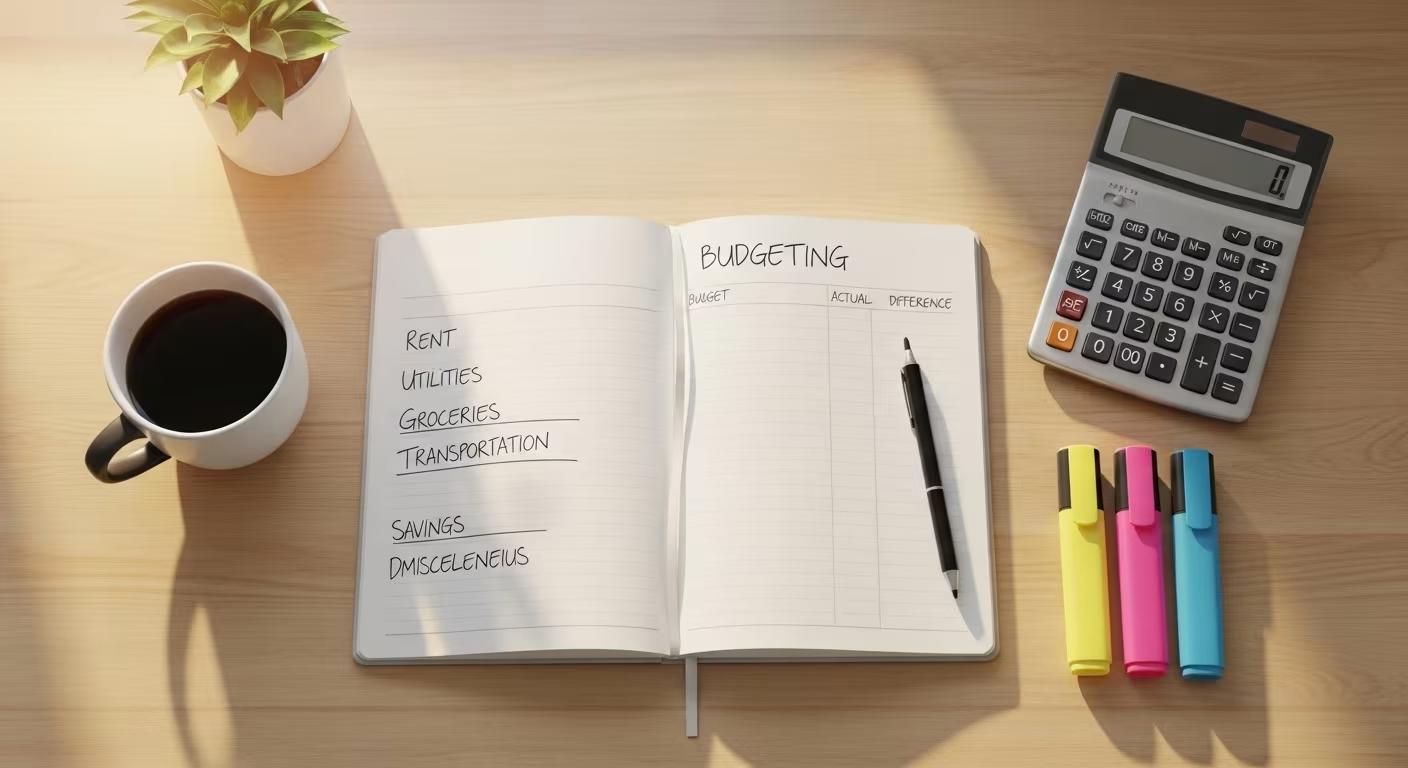
If you've ever wondered where your money goes each month, you're not alone. The average American household earns around $89,000-$90,000 annually in 2026, yet many families struggle to build savings or pay down debt. Budgeting isn't about restriction—it's about giving your money intentional direction so it works for you instead of against you.
Think of a budget like a GPS for your finances. You wouldn't drive across the country without knowing your destination. The same logic applies to money. A budget shows where your money comes from and where it goes. When you have that clarity, everything changes.
Why Budgeting Actually Matters
Studies show that people who budget have 30% more savings than those who don't. In 2026, with the median household income at approximately $89,000 and credit card interest rates averaging 23.77%, having a clear financial plan is more critical than ever.
Consider this: If you carry a $5,000 credit card balance at 24% APR, you're paying roughly $1,200 per year in interest alone. A budget helps you see where money leaks occur and how to redirect those funds toward debt payoff or savings.
Step 1: Calculate Your Income
Start with your actual take-home pay—money after taxes and deductions. For most Americans working full-time, the median weekly earnings are $1,214, translating to roughly $4,850-$5,200 monthly after taxes.
Include all income sources:
- Primary salary/wages
- Side hustle income
- Investment dividends
- Rental income
- Any government benefits
If your income varies, use the average of your last three months or use your lowest month to ensure you're always covered.
Step 2: Track Your Spending
Before creating a budget, understand your current spending. Track every dollar for one month. Use your bank statements, credit card statements, and receipts.
Categorize your spending into:
Fixed Expenses: Rent/mortgage, car payments, insurance, subscriptions Variable Necessities: Groceries, utilities, gas, minimum debt payments Discretionary: Dining out, entertainment, shopping, hobbies
Most people are shocked to discover where their money actually goes. That $5 daily coffee? That's $150/month or $1,800/year. Those small subscriptions add up too—the average American pays $219/month on subscriptions in 2026.
Step 3: Choose a Budgeting Method
The 50/30/20 Rule Allocate 50% of after-tax income to needs, 30% to wants, 20% to savings and debt.
On a $5,000 monthly income, that's $2,500 for needs, $1,500 for wants, and $1,000 for savings/debt.
Zero-Based Budgeting Every dollar gets assigned a job before you spend it.
Income minus all allocated expenses equals zero. This method offers complete control but requires more active management.
Envelope System Allocate cash to physical or digital "envelopes" for each spending category.
When an envelope is empty, spending stops in that category.
Pay Yourself First Automate savings immediately when income arrives, then spend what remains.
This prioritizes savings without requiring willpower.
The 70/20/10 Rule (Inflation-Adjusted Alternative) In 2026, with housing costs consuming 30-40% of income in many cities, the traditional 50/30/20 split feels unrealistic for many households.
The 70/20/10 rule offers a pragmatic alternative: 70% toward needs and basic wants combined, 20% toward savings and debt payoff, and 10% toward discretionary spending. This framework acknowledges that essentials have gotten more expensive while still preserving a savings habit. If your rent alone takes 35% of your income, forcing yourself into a 50% needs cap creates frustration and budget abandonment. The 70/20/10 approach provides breathing room without sacrificing financial progress.
Hybrid Approach: Combining Methods Many successful budgeters combine elements of multiple methods.
A common pattern: use 50/30/20 (or 70/20/10) as a high-level framework to check overall allocation, then apply zero-based thinking within the "needs" category where fixed expenses dominate. This gives you both the simplicity of percentage-based rules and the precision of zero-based tracking where it matters most.
Step 4: Create Your Budget Categories
A practical budget includes:
Needs (50%):
- Housing (rent/mortgage): 25-30%
- Utilities: 5-10%
- Groceries: 10-15%
- Transportation: 10-15%
- Insurance: 5-10%
- Minimum debt payments
Wants (30%):
- Dining out
- Entertainment and streaming
- Shopping
- Hobbies
- Gym membership
- Personal care
Savings and Debt (20%):
- Emergency fund
- Retirement contributions (401(k), IRA)
- Extra debt payments
- Sinking funds
Step 5: Automate What You Can
Automation removes willpower from the equation. Set up automatic transfers for:
- Retirement contributions: The 2026 401(k) limit is $24,500, with an additional $8,000 catch-up for those 50+
- Savings account transfers
- Bill payments
- Debt payments
High-yield savings accounts currently offer 4-5% APY in 2026—significantly better than the 0.39% national average for traditional savings.
Using AI for Budget Planning in 2026
Artificial intelligence has transformed personal budgeting. Google's Gemini can analyze your spending patterns in Google Sheets and suggest category adjustments. ChatGPT can help you create personalized budget templates based on your income and goals. YNAB's AI features now predict upcoming expenses based on your spending history.
AI-powered insights to leverage:
- Spending pattern analysis: Upload 3 months of bank statements and AI tools can identify spending patterns you might miss, like gradually increasing subscription costs or seasonal spending spikes.
- Bill negotiation: Services like Rocket Money use AI to identify subscriptions you've forgotten and negotiate lower rates on your behalf, saving the average user $240 annually.
- Predictive budgeting: Modern apps predict when you're likely to overspend based on historical data and send preemptive alerts.
However, don't outsource your financial awareness entirely. The goal is to understand your money deeply enough that the budget becomes intuitive, not to create dependency on an app.
Step 6: Track and Adjust Monthly
Your budget isn't set in stone. Review it monthly:
- Did you stay within each category?
- Which areas consistently overflow?
- What unexpected expenses occurred?
- What adjustments make sense for next month?
Use budgeting apps like YNAB ($14.99/month), Mint (free), or EveryDollar to simplify tracking.
Budgeting for Irregular Income
If your income varies month-to-month:
- Calculate your baseline monthly expenses
- Build a larger emergency fund (4-6 months instead of 3)
- Budget based on your lowest expected income month
- When you earn more, allocate excess to savings or debt
Common Budgeting Mistakes
Starting too strict: Allowing zero fun money leads to budget burnout. Include some discretionary spending.
Forgetting irregular expenses: Annual subscriptions, car registration, holiday gifts. Use sinking funds to save monthly for these.
Not accounting for emergencies: Unexpected expenses happen. Without an emergency fund, you'll rely on credit cards.
Ignoring debt interest: High-interest debt (credit cards averaging 23.77% APR) should be prioritized.
Never adjusting: Life changes. Your budget should adapt to income changes, new expenses, or shifting priorities.
Budgeting by Personality Type
Nearly 50% of survey respondents still prefer traditional pen-and-paper budgeting, while mobile apps are the second most popular method. The best budgeting system is less about math and more about behavior. Different personality types thrive with different approaches:
The Detail-Oriented Planner: You enjoy tracking every transaction. Zero-based budgeting is your ideal method. Use spreadsheets or YNAB for granular control. Your risk: analysis paralysis and spending too much time on the budget itself.
The Big-Picture Thinker: You want simplicity. The 50/30/20 rule gives you guardrails without micromanagement. Automate everything possible and check in monthly. Your risk: not catching small leaks that add up.
The Spontaneous Spender: You resist restriction. The Pay Yourself First method works best because you save automatically and spend the rest guilt-free. Your risk: overspending in non-essential categories without realizing it.
The Anxious Saver: You worry about money constantly. An envelope system (physical or digital) provides visible boundaries that reduce anxiety. Seeing exactly how much remains in each category creates a sense of control. Your risk: being too restrictive and burning out.
Match your method to your temperament, not someone else's recommendation. A system that feels motivating to one person can feel exhausting to another.
Building Your Emergency Fund
Before aggressive debt payoff or investing, build a starter emergency fund of $1,000-$2,000. Then expand to 3-6 months of living expenses in a high-yield savings account earning 4-5% APY.
If your monthly expenses are $3,500, aim for $10,500-$21,000 in emergency savings.
How Budgeting Improves Your Credit Score
A working budget directly supports better credit over time. Here's the connection:
Payment history (35% of your score): When you budget for all minimum payments and automate them, you eliminate late payments, which is the single most damaging factor for credit scores. Setting up automatic minimum payments reduces missed deadlines and late fees more effectively than manual tracking alone.
Credit utilization (30% of your score): By budgeting extra payments toward credit card debt, you lower your utilization ratio. Keeping utilization below 30% of your total credit limit is the baseline; below 10% is ideal.
Debt-to-income ratio: While not directly part of your credit score, lenders use this ratio for loan approvals. A budget that systematically reduces debt improves your borrowing capacity for mortgages, auto loans, and refinancing.
The compound effect is powerful: budgeting leads to consistent payments, which builds credit, which lowers interest rates on future borrowing, which makes budgeting easier because less money goes to interest.
What to Do When You Overspend
Everyone overspends occasionally. When it happens:
- Don't panic or abandon the budget
- Identify what triggered the overspending
- Adjust by pulling from another category if possible
- Learn from it and move forward
- Consider if that category needs more allocation
Making Budgeting a Habit
The first month is hardest. By month three, budgeting becomes routine. By month six, you'll wonder how you ever managed money without it.
Tips for building the habit:
- Schedule a weekly money date (15 minutes)
- Review your budget when you get paid
- Celebrate small wins
- Find an accountability partner
The Quarterly Review: Building Long-Term Momentum
Monthly reviews keep your budget on track, but quarterly reviews transform your financial trajectory. Every three months, assess:
Quarter 1 (January-March): Set annual financial goals. Calculate your current net worth. Establish your baseline spending patterns. This is your "money confidence" foundation quarter.
Quarter 2 (April-June): Mid-year adjustment. Tax refund strategy (if applicable). Review subscription services and negotiate bills. Assess progress toward emergency fund goals.
Quarter 3 (July-September): Holiday spending preparation. Start sinking funds for year-end expenses. Evaluate insurance policies during renewal season. Review investment contributions.
Quarter 4 (October-December): Final push toward annual goals. Maximize retirement contributions before year-end. Plan for next year's budget. Celebrate progress and adjust goals.
This quarterly rhythm prevents the common pattern of January motivation followed by February abandonment. Each quarter builds on the previous one, creating compound momentum that makes budgeting feel progressively easier.
Next Steps
- Track all spending for one full month
- Calculate your actual income
- Choose a budgeting method that fits your personality
- Create your first budget
- Set up automation for savings and bills
- Review and adjust monthly
Budgeting isn't about perfection—it's about progress. Even reducing spending by $200/month translates to $2,400 annually that could go toward debt, savings, or goals that actually matter to you.
Start today. Your future self will thank you.
Comments (0)
No comments yet. Be the first to share your thoughts!
Leave a Comment