
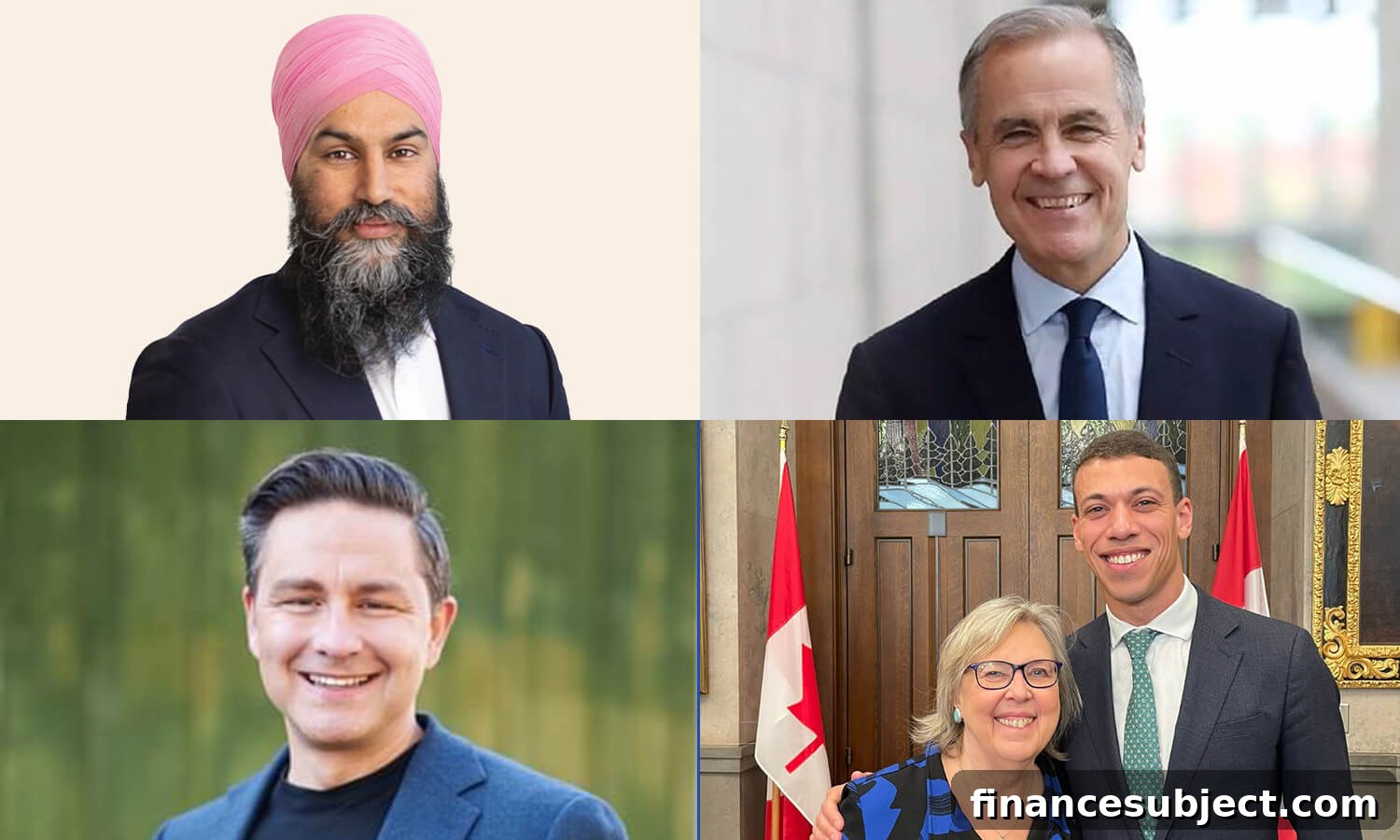
Canada heads to the polls on Monday, April 28, and economic issues are at the forefront of this federal election. From trade and climate policy to housing affordability and household budgets, the major parties are centering their campaigns on the financial concerns of everyday Canadians. Below is a clear, updated summary of the key campaign promises that could affect your finances, organized by major policy area. This article will be revised as parties make further announcements—check back for updates.
Canadian issues: Income taxes
Income-tax changes are a major focus across party platforms. The Liberal Party proposes a one-percentage-point reduction in the lowest federal tax rate, lowering it to 14% for the first bracket (income below $57,375 in 2025), which the party estimates would save about $400 per filer annually.
The Conservative Party, led by Pierre Poilievre, has pledged a deeper cut to the bottom federal tax rate, aiming to drop it from 15% to 12.75%. Conservative estimates put the average yearly tax savings at roughly $900 for an individual taxpayer and about $1,800 for a two-income family.
Conservatives would also raise the tax-free earnings threshold for working seniors to $34,000 (currently near $24,000) and expand the travel tax deduction available to trades workers beyond the present $4,000 cap.
The New Democratic Party (NDP) proposes to ensure Canadians earning $19,500 or less pay no federal income tax. At the same time, the party has announced plans to reduce the basic personal amount for people in the top two tax brackets to $13,500; currently, the basic personal amount sits at $15,705 for 2024 and is projected to reach $16,129 in 2025. The NDP also plans to double the Canada Disability Benefit from $2,400 to $4,800 and has pledged to reinstate a higher capital-gains inclusion rate (67%) on gains above $250,000 that had been proposed in the 2024 federal budget.
The Green Party proposes raising the basic personal amount substantially, suggesting a threshold of $40,000, which it argues would return up to several thousand dollars to taxpayers at that income level.
Also read
Income Tax Guide for Canadians
Deadlines, tax tips and more
Canadian issues: Housing
Housing remains a heated topic. The Liberal government has moved to eliminate the GST for first-time buyers purchasing new homes priced under $1 million. The Conservatives would extend a similar GST waiver to all buyers of new homes priced below $1.3 million.
The NDP proposes supporting low-interest mortgages for first-time buyers and has made broader tenant protections a campaign priority. Its platform includes national rent control measures, making federal housing grants to provinces contingent on tenant safeguards, and a renters’ bill of rights designed to prohibit renovictions and fixed-term leases in order to strengthen renter protections.
Rent control policies vary by province and municipality and are contested among economists and developers, who argue that strict controls can reduce incentives for building new rental housing and for maintaining existing rental stock.
Canadian issues: Inflation
The NDP has proposed emergency price caps on select grocery staples—items such as pasta, frozen vegetables and baby formula—and stronger regulation of the grocery sector, along with higher taxes on grocery-chain profits. The party also wants to permanently remove GST from a range of essential items, including certain grocery-store meals, diapers and strollers, and aims to exempt basic phone, internet and heating bills from GST.
Rankings
Canada’s best credit cards for groceries
Canadian issues: Retirement
On retirement policy, the Conservatives propose increasing the age at which registered retirement savings plans (RRSPs) must be converted to registered retirement income funds (RRIFs) or annuities from 71 to 73, while leaving public retirement ages for programs such as Old Age Security (OAS), Canada Pension Plan (CPP) and the Guaranteed Income Supplement (GIS) unchanged at 65.
The NDP has pledged to raise the GIS for low-income seniors but has not provided a specific amount. The Liberals have announced temporary measures to ease pressure on retirees facing market volatility: a one-year reduction in required RRIF minimum withdrawals (a 25% cut for the year, lowering the minimum to roughly 3% from 4%) and a 5% increase to GIS payments for 2025 only, intended to provide short-term support.
Rankings
Compare the best RRSP rates in Canada
Canadian issues: Investing
The Conservative platform includes proposals to encourage investment in Canadian equities by increasing the TFSA contribution limit by $5,000 for funds invested in Canadian stocks. The party also offers a temporary capital gains tax holiday from July 2025 through December 2026 for gains reinvested in Canada. These measures aim to shift more investment toward domestic companies, though practical complications can arise because some firms that are Canadian by head office have significant operations or listings abroad.
Canadian issues: Employment
Liberal proposals focus on improving interprovincial trade and labour mobility, including greater recognition of professional credentials across provinces. The Liberals would also introduce a federal apprenticeship grant of up to $8,000 for registered apprentices entering the trades.
Conservatives seek to renew and extend apprenticeship supports, including a continuation of an existing $4,000 apprenticeship grant and expansion of union training programs. They also propose a Travelling Tradesworkers Fairness Act to allow tradesworkers to write off expenses like food, transportation and accommodation when working away from home.
Canadian issues: Families
The Liberals plan to expand federal support for the $10-a-day child-care framework, aiming to create 100,000 additional spaces by 2031. They have also proposed a Canada Strong pass to encourage domestic travel by offering free access to national museums and VIA Rail for children under 18 travelling with family, and discounts for young adults aged 18 to 24.
Canadian issues: Carbon tax
The Liberal government discontinued the federal consumer carbon price as of April 1, which led to lower fuel prices in many regions, including British Columbia where the provincial carbon tax was also withdrawn. The associated carbon rebate payments will conclude with one final distribution in April for those eligible. The Conservative campaign has long pushed to eliminate the tax entirely.
Canadian issues: Health care
The NDP has pledged to pursue full national pharmacare coverage within four years, starting with the 100 most commonly prescribed medications—representing roughly half of all prescriptions—at an estimated cost of about $3.5 billion per year. The party frames pharmacare as the final step toward a fully comprehensive universal health-care system for Canadians of working age and their families.
Newsletter
Get free MoneySense financial tips, news & advice in your inbox.
Read more economic news
- Canada’s unemployment rate, including breakdowns by province and city
- How Canadian companies are handling supply-chain challenges after U.S. tariffs
- When Canadians can expect to see savings from the end of the carbon price, depending on purchases
- How young investors can respond to stock-market volatility