
High-Yield Savings Account vs Traditional: Which Pays More?
If you've been parking your money in a traditional bank account, you may be leaving hundreds of dollars on the table every year. The difference between a high-yield savings account and a standard savings account has never been more dramatic — and understanding that gap is one of the simplest financial upgrades you can make. This article breaks down how each account type works, what the real numbers look like, and how to decide which option fits your situation best.
What Is a High-Yield Savings Account?
A high-yield savings account is a deposit account that pays a significantly higher annual percentage yield (APY) than a traditional savings account. These accounts are most commonly offered by online banks, credit unions, and fintech platforms that operate with lower overhead than brick-and-mortar institutions — savings they pass along to customers in the form of better interest rates.
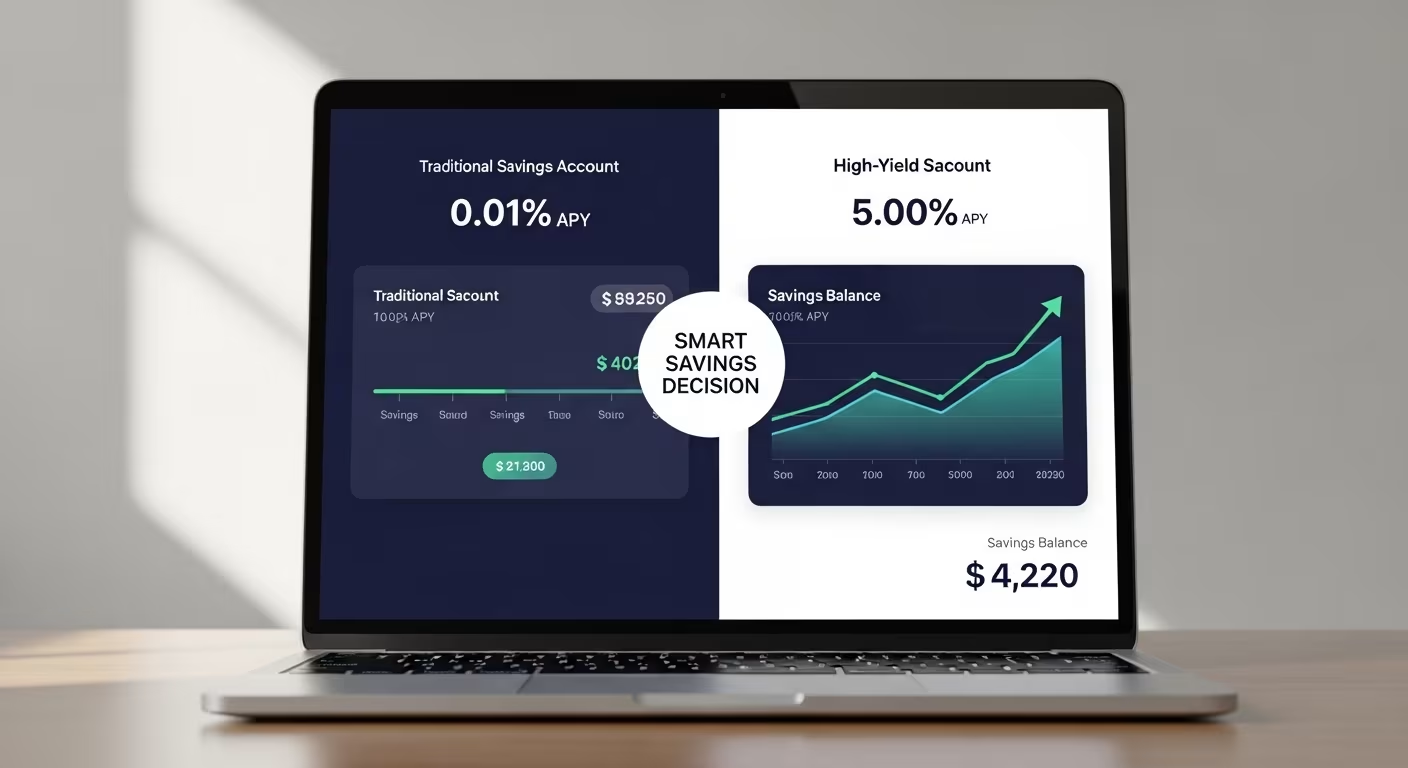
As of mid-2025, the national average APY on a traditional savings account sits at around 0.45%, according to the FDIC. High-yield savings accounts, by contrast, routinely offer APYs between 4.50% and 5.25% depending on the institution and prevailing federal funds rate conditions. That's a gap of more than ten times on your money's earning power.
High-yield savings accounts are almost always FDIC-insured (or NCUA-insured at credit unions) up to $250,000 per depositor, per institution. This means they carry the same federal protection as your neighborhood bank's savings account. The mechanics are identical: you deposit money, it earns interest, you can withdraw funds when needed. The only meaningful difference is how much the account pays you.
These accounts are not investment accounts. They don't expose your principal to market risk. The rate can fluctuate — and it will move in response to Federal Reserve decisions — but you will never log in to find your balance lower than what you deposited, absent any fees.
How Traditional Savings Accounts Work
Traditional savings accounts are offered by conventional banks — large national institutions, regional banks, and community banks with physical branch networks. The rates on these accounts have historically been low because the banks' cost of doing business is high, and competition for deposits was limited when consumers didn't have easy access to online alternatives.
The federal funds rate influences what banks pay on savings deposits, but traditional banks don't have to pass that along competitively. Many major banks kept their savings rates near 0.01% even when the Fed raised its benchmark rate aggressively between 2022 and 2024. That means customers who stayed loyal to their traditional savings accounts watched inflation erode their purchasing power while their money earned almost nothing.
Traditional savings accounts do offer some advantages that matter to certain customers. They often come bundled with checking accounts, making transfers instantaneous. Branch access allows for cash deposits and in-person service. Some people value the relationship banking experience, especially for complex financial needs. But if the goal is simply to earn the most on idle cash, the traditional savings account falls significantly short.
The Math: What the Rate Difference Actually Means
Let's run the numbers concretely. Assume you have $10,000 in savings and you're choosing between a traditional savings account at 0.45% APY and a high-yield savings account at 4.75% APY.
After one year:
- Traditional account: $10,045 (earned $45)
- High-yield account: $10,475 (earned $475)
The difference is $430 — just from choosing the right account type. Scale that to $25,000 in emergency fund savings and the gap grows to more than $1,000 per year. Over five years with compounding, the numbers become even more dramatic.
This isn't speculative investing. It's the same FDIC-insured money sitting in a slightly different account, earning meaningfully more. The effort required to open a high-yield savings account online is typically less than 15 minutes. That's perhaps the best return-on-time investment available in personal finance today.
Interest Rate Sensitivity: What Moves the Needle
High-yield savings account rates are variable. They move in response to the federal funds rate set by the Federal Reserve. When the Fed raises rates — as it did sharply in 2022 and 2023 — high-yield savings account rates tend to rise quickly. When the Fed cuts rates, those same accounts adjust downward.
Traditional savings accounts also have variable rates, but they tend to move more slowly upward and more quickly downward. In other words, when rates rise, big banks are slow to reward depositors. When rates fall, they adjust quickly. High-yield accounts at online banks are more directly tied to the benchmark rate in both directions.
This means the spread between the two account types can shift over time. During low-rate environments, the absolute dollar difference shrinks — but the proportional advantage of high-yield accounts typically persists. During high-rate environments like 2023-2024, the dollar gap was substantial enough that millions of Americans moved their emergency funds and short-term savings to take advantage.
The key insight: even if rates fall, a high-yield savings account almost always remains the better option for idle cash versus a traditional savings account at the same rate environment. The structural advantage is durable across most market conditions.
Who Should Use a High-Yield Savings Account
High-yield savings accounts are ideal for anyone who holds cash they don't need immediately but want available within a few days. Common use cases include:
Emergency funds. Most financial planners recommend holding three to six months of living expenses in a liquid, accessible account. A high-yield savings account lets that money earn meaningful interest while remaining available for unexpected expenses. Earning 4.5% on a $20,000 emergency fund adds up to $900 per year — money you'd otherwise be leaving behind entirely.
Short-term savings goals. If you're saving for a home down payment, a vehicle purchase, a wedding, or any goal with a time horizon under three years, a high-yield savings account makes more sense than the stock market (too volatile for short timeframes) and more sense than a traditional savings account (too low a return for the same risk).
Cash management between investments. Investors who keep a cash position between deployed capital should hold it in a high-yield account rather than letting it sit idle in a brokerage's default cash sweep, which often pays very little.
Sinking funds. Irregular expenses like annual insurance premiums, property taxes, or holiday spending can be planned for in advance using designated sinking fund accounts. High-yield options let that money grow while you accumulate it month by month.
Comparing Top High-Yield Savings Accounts
When evaluating high-yield savings accounts, the APY is the starting point but not the only factor. Other considerations include:
Minimum balance requirements. Many high-yield accounts have no minimum balance requirement, but some require a minimum deposit to open or to earn the advertised rate. Read the fine print before committing.
Fees. Monthly maintenance fees can negate interest earnings. The best high-yield savings accounts charge no monthly fees whatsoever.
Withdrawal limits. Federal Regulation D, which capped savings account withdrawals at six per month, was suspended in 2020 — but some banks still enforce their own limits. Check your bank's policy if you expect frequent transfers between accounts.
Transfer speed. Transfers between an online high-yield savings account and your primary checking account typically take one to three business days. Some institutions offer faster transfers. If same-day access to funds is critical, factor in transfer times when choosing a provider.
FDIC or NCUA insurance. Confirm the institution is insured before depositing. Nearly all legitimate banks and credit unions are covered, but fintech apps that partner with banks may have pass-through coverage — verify the details carefully before depositing significant sums.
App and digital experience. If you're banking primarily online, the mobile app and website matter for day-to-day usability. Read user reviews and test the account opening process before committing significant balances.
Reputable sources for comparing current rates include Bankrate's savings rate comparison tool and the FDIC's BankFind database for institution verification.
Traditional Savings Accounts: When They Still Make Sense
Traditional savings accounts aren't entirely without merit in specific circumstances. If you bank with an institution that offers relationship perks — fee waivers, preferred loan rates, or personalized service that you actively use — the convenience of keeping savings at the same bank as your checking account may be worth the trade-off. The key word is "actively." If you're not using those perks, you're paying for them with lower interest every month.
For people who regularly deposit cash, a traditional bank with physical branches may be necessary, since most online banks don't accept cash deposits. Cash depositors can use a practical workaround: keep a low-balance checking account at a traditional bank for cash deposits, then transfer the bulk of savings to a high-yield account.
Some customers also simply prefer dealing with a local institution they know and trust — a community bank or credit union — and some of those institutions offer competitive rates. Always check your local credit union's savings rates before assuming that "online only" is required to get a strong return.
Tax Implications of Savings Account Interest
Interest earned in both traditional and high-yield savings accounts is taxable as ordinary income at the federal level and typically at the state level as well. Your bank will issue a 1099-INT form if you earn $10 or more in interest during the tax year.
The higher your APY and balance, the more interest income you'll report. This is a good problem to have — earning more always beats earning less, even after taxes. But it's worth factoring into your annual tax planning, especially if you hold large balances in high-yield accounts.
Interest earned in a savings account is not subject to capital gains treatment. It's taxed as ordinary income, which may be at a higher rate depending on your bracket. Some people explore I Bonds, Treasury bills, or money market funds as alternatives that may offer state-tax advantages — but those come with their own tradeoffs in liquidity and complexity that don't suit every situation.
Making the Switch: What to Expect
Opening a high-yield savings account online takes roughly 10 to 15 minutes. You'll need your Social Security number, a government-issued ID, and your current bank account information for the initial transfer. Most institutions allow you to open an account with as little as $1.
After opening, initiate a transfer from your existing bank. The funds typically arrive within one to three business days. Once confirmed, you can set up recurring transfers to automate your savings — most high-yield accounts support this feature directly in the app or online portal without any additional fees.
There's no need to close your traditional savings account if you find it useful for any reason. Many people keep a small float in a traditional account for convenience while moving the bulk of their savings to a high-yield account for better returns. This hybrid approach is practical and effective for most people.
Avoiding Common Mistakes
Switching to a high-yield savings account is straightforward, but a few common mistakes are worth avoiding before you get started.
Don't confuse marketing language with actual FDIC protection. Some accounts advertise "up to" a certain APY that requires a minimum balance or specific activity to unlock — always verify the conditions for earning the advertised rate in the fine print.
Avoid holding too much in any single institution. FDIC insurance covers $250,000 per depositor per institution. If you're holding more than that in savings, spread it across multiple institutions to maintain full federal protection on all your deposits.
Don't treat your high-yield account as a checking account. Frequent transfers can complicate your tax reporting and may trigger bank-imposed transaction limits that restrict your account activity.
Bottom Line
The choice between a high-yield savings account and a traditional savings account isn't a close call for most people. If you're holding cash that you won't need for at least a few days, a high-yield account pays dramatically more with zero additional risk. The FDIC insurance, the liquidity, the ease of use — all of those features are the same. The interest rate is simply better, often by a factor of ten or more.
The opportunity cost of staying in a traditional savings account is real and quantifiable. On $15,000 in savings, the difference between 0.45% and 4.75% is roughly $645 per year. That's money that compounds. Over five years, you'd accumulate a meaningful sum just by choosing the right account type at the outset.
Open a high-yield account, transfer your emergency fund and short-term savings, and let the interest work for you. It's one of the few financial optimizations that requires almost no ongoing effort and pays you for years to come.
None of this is financial advice. Your situation depends on variables this article can't see — taxes, risk tolerance, time horizon, dependents. A fiduciary advisor can model your specific case.
Comments (0)
No comments yet. Be the first to share your thoughts!
Leave a Comment