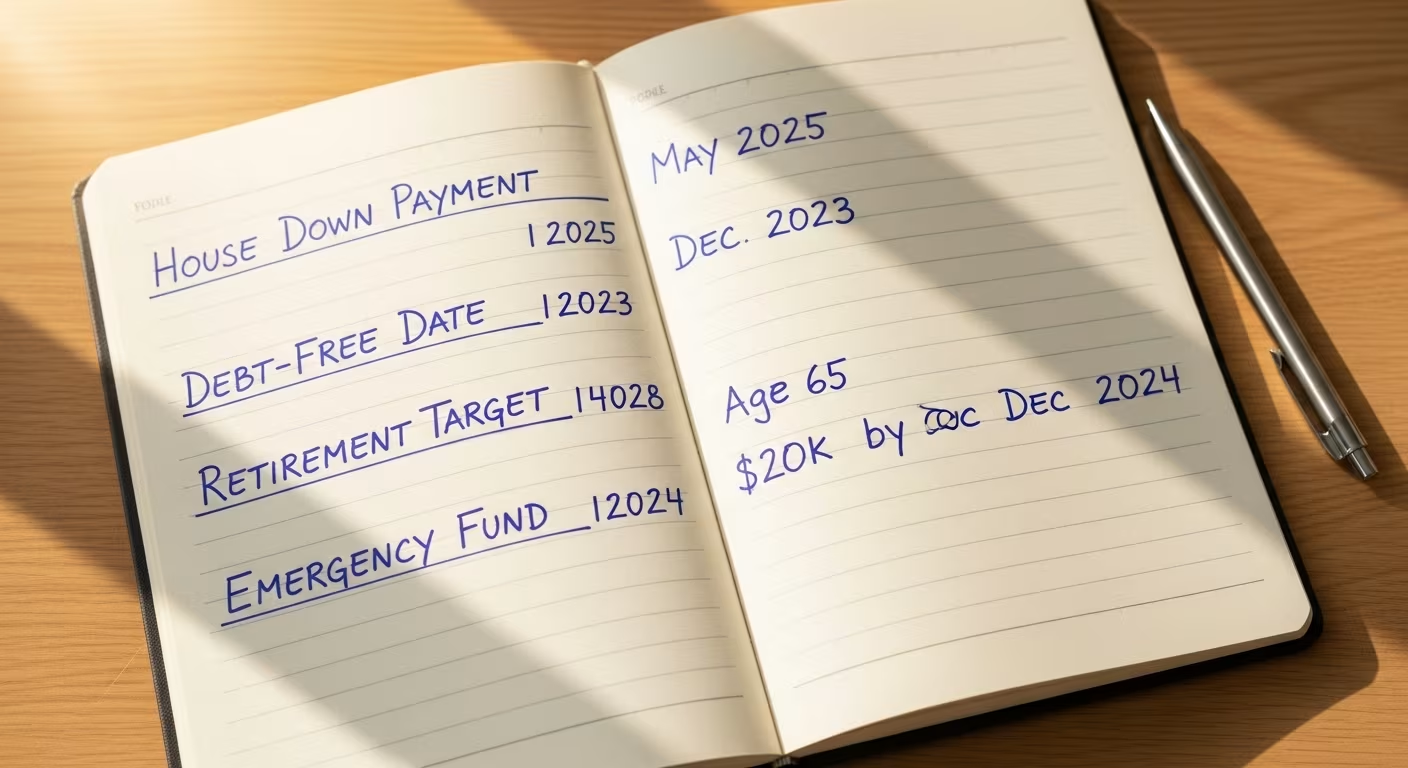
Setting financial goals is easy. Achieving them is hard. Most people set vague intentions ("save more money") rather than actionable goals, then wonder why they fail. Effective financial goals are specific, measurable, and connected to deeper motivations. Here's how to set goals that actually lead to results.
Why Financial Goals Fail
Understanding common failure points helps you avoid them:
Too vague: "Save more money" isn't a goal—it's a wish. How much? By when? For what?
Too ambitious: "Save $50,000 this year" on a $60,000 salary isn't realistic.
No emotional connection: Goals without meaning behind them lack staying power.
No tracking system: What gets measured gets managed. Untracked goals fade.
No plan: A goal without action steps is just a dream.
No flexibility: Life changes; rigid goals break rather than bend.
The SMART Framework for Financial Goals
SMART goals are:
Specific: Exactly what will you accomplish?
- Weak: "Pay off debt"
- Strong: "Pay off $8,000 credit card balance"
Measurable: How will you track progress?
- Weak: "Save for vacation"
- Strong: "Save $3,000 for Hawaii trip"
Achievable: Is this realistic given your income and expenses?
- Weak: "Become a millionaire this year"
- Strong: "Increase net worth by $15,000 this year"
Relevant: Does this goal matter to you personally?
- Weak: "Save 20% because experts say to"
- Strong: "Save 20% because I want to retire at 55"
Time-bound: When will you achieve this?
- Weak: "Build an emergency fund someday"
- Strong: "Save $10,000 emergency fund by December 31, 2026"
Three Time Horizons for Financial Goals
Short-Term Goals (Under 1 Year)
These are immediate priorities. Examples:
- Build $1,000 starter emergency fund
- Pay off $3,000 credit card
- Save $2,000 for vacation
- Reduce dining-out spending by 50%
- Create and follow a monthly budget
Strategy: Fund these goals first. Keep money in a high-yield savings account (4-5% APY in 2026) for easy access.
Medium-Term Goals (1-5 Years)
These require sustained effort. Examples:
- Pay off $25,000 in student loans
- Save $40,000 for house down payment
- Build 6-month emergency fund ($24,000)
- Save $10,000 for wedding
- Buy a car with cash
Strategy: Use dedicated savings accounts for each goal. Consider Series I Bonds or CDs for guaranteed returns with some inflation protection.
Long-Term Goals (5+ Years)
These benefit from investment growth. Examples:
- Save $1,000,000 for retirement
- Pay off mortgage early
- Fund children's college education
- Build wealth for financial independence
- Leave inheritance for family
Strategy: Invest in diversified portfolios. Max out tax-advantaged accounts (401(k) limit $24,500 in 2026, IRA limit $7,500). Accept market volatility for higher expected returns.
Finding Your "Why"
Goals connected to values stick. Abstract goals ("save $100,000") are weaker than emotional ones ("have enough saved that I never worry about money again").
For each goal, ask:
- Why does this matter to me?
- How will achieving this change my life?
- What's the cost of not achieving this?
- Who else benefits from my success?
Example transformation:
- Surface goal: "Save $50,000"
- Deeper why: "So I can quit my toxic job and find work I love without financial panic"
When motivation wavers, the deeper "why" sustains action.
Setting Your Priority Goals
You can't pursue everything simultaneously. Prioritize:
Step 1: List Everything
Write every financial goal you have—small to massive. Don't filter yet.
Step 2: Categorize by Timeframe
Sort into short-term, medium-term, and long-term buckets.
Step 3: Rank by Importance
Within each category, rank goals by significance to your life.
Step 4: Identify Dependencies
Some goals must precede others. Emergency fund typically comes before investing. Credit card payoff usually precedes house down payment saving.
Step 5: Choose Your Current Focus
Select:
- 1-2 short-term goals
- 1-2 medium-term goals
- 1 long-term goal
Focused attention beats scattered effort.
Creating Action Plans
Every goal needs a plan. Include:
Monthly target: How much must you save/pay monthly?
Funding source: Where does the money come from?
Automation: How will you automate contributions?
Tracking method: How will you monitor progress?
Example action plan:
Goal: Save $6,000 emergency fund by December 2026
Monthly target: $500/month for 12 months
Funding source: Reduce discretionary spending by $300; add $200 from side hustle income
Automation: Automatic transfer of $500 on the 1st of each month to "Emergency Fund" savings account
Tracking: Spreadsheet updated monthly; visual chart on refrigerator
Tracking Progress
Choose a tracking method that works for you:
Spreadsheet: Create columns for goal, target, current amount, percentage complete, projected completion date.
Budgeting apps: YNAB, Mint, and others let you set and track goals within the app.
Visual trackers: Print thermometer-style charts and color in progress.
Simple notes: Update a notes app monthly with current balances.
Frequency: Review goals monthly at minimum. Weekly is better for new goals or tight budgets.
Adjusting Goals Over Time
Life changes. Goals should adapt.
When to adjust:
- Income increases or decreases significantly
- Major life events (marriage, baby, job loss)
- Goal becomes unrealistic or too easy
- Priorities shift
When NOT to adjust:
- When motivation temporarily dips
- When you want to justify off-budget spending
- When progress feels slow (it often is)
Be honest about whether adjustments are necessary or convenient.
Goal-Setting for Common Situations
Just Starting Out (Early Career)
Priority order:
- $1,000 starter emergency fund
- Employer 401(k) match (free money)
- Pay off high-interest debt
- Build full emergency fund (3-6 months)
- Max out retirement accounts
Paying Off Debt
Set both payoff and savings goals:
- "Pay off $15,000 credit card debt by December 2027"
- "Maintain $2,000 emergency fund during payoff"
Don't sacrifice all savings for debt payoff—one emergency can undo progress.
Saving for Major Purchase
Calculate the timeline backward:
- House down payment: $50,000 needed in 5 years = $833/month
- New car: $20,000 needed in 2 years = $833/month
- Wedding: $25,000 needed in 18 months = $1,389/month
If the math doesn't work, extend timeline, reduce goal, or increase income.
Approaching Retirement
Focus intensifies:
- Maximize 401(k) contributions ($24,500 + $8,000 catch-up if 50+ in 2026)
- Project retirement income from all sources
- Estimate expenses and healthcare costs
- Set specific retirement date goal
Accountability Systems
External accountability increases success rates.
Options:
- Share goals with spouse/partner
- Find an accountability partner
- Join financial communities (Reddit's r/personalfinance, financial Facebook groups)
- Work with a financial advisor
- Tell friends and family
Public commitment makes abandonment harder.
Celebrating Milestones
Long-term goals need intermediate celebrations to maintain motivation.
Example milestones for $50,000 down payment goal:
- $10,000 saved: Nice dinner out
- $25,000 saved: Weekend getaway
- $40,000 saved: New [small want]
- $50,000 saved: Start house hunting!
Celebrations should be meaningful but not budget-destroying.
Common Goals with Specific Targets
Emergency Fund
- Minimum: $1,000 starter fund
- Standard: 3-6 months expenses
- Conservative: 6-12 months if self-employed or single income
Retirement Savings
- Minimum: Employer match percentage
- Standard: 15% of gross income
- Aggressive: 25%+ for early retirement
House Down Payment
- Minimum: 3-5% (though you'll pay PMI)
- Standard: 20% to avoid PMI
- Ideal: 20% + closing costs + emergency fund + moving expenses
Debt Payoff
- Priority 1: Any debt over 7% interest
- Priority 2: Car loans and personal loans
- Priority 3: Student loans and mortgage (lower rates)
The SMART Goal Framework for Finances
Vague goals produce vague results. The SMART framework transforms aspirations into actionable plans:
Specific: Not "save more money" but "save $10,000 for a house down payment" Measurable: Track progress monthly — $833/month toward your $10,000 goal Achievable: Ensure the math works with your current income and expenses Relevant: The goal should align with your values and life plans Time-bound: "By December 2027" creates urgency and accountability
Goal Stacking: The Priority Framework
Most people have multiple financial goals competing for limited dollars. The priority stack prevents paralysis:
Layer 1 — Foundation (simultaneous):
- $1,000 starter emergency fund
- Minimum payments on all debts
- Employer 401(k) match (this is free money — never leave it on the table)
Layer 2 — Security:
- Pay off high-interest debt (anything above 7%)
- Build full emergency fund (3-6 months expenses)
Layer 3 — Growth:
- Max out tax-advantaged accounts (401(k) to $24,500, IRA to $7,000 in 2026)
- Save for specific goals (house, car, education)
Layer 4 — Wealth:
- Taxable investment accounts
- Real estate investment
- Business building
Working multiple layers simultaneously is less efficient than focusing on one at a time. Exception: always capture the employer match regardless of which layer you are on.
The 1-5-10 Year Vision
Write down three financial goals for each time horizon:
1-year goals (urgent, specific): Build $5,000 emergency fund. Pay off $3,000 credit card. Save $2,000 for vacation.
5-year goals (medium-term, directional): Save $50,000 house down payment. Become completely debt-free. Build $100,000 investment portfolio.
10-year goals (long-term, aspirational): Reach $500,000 net worth. Own a home outright or with minimal mortgage. Have 1 year of expenses in liquid savings.
Post these where you see them daily. Goals you forget about are goals you abandon. Review and update every quarter.
Accountability Systems That Work
Goals without accountability are wishes. Build accountability into your financial goals:
Accountability partner: Share your top three financial goals with one trusted person. Schedule monthly check-ins. Research shows that people who share goals with an accountability partner are 65% more likely to achieve them.
Visual progress tracking: Use a physical chart, thermometer, or jar to track savings progress visually. Place it somewhere you see daily. The visual reminder keeps the goal present in your mind.
Milestone rewards: Set milestones at 25%, 50%, and 75% of your goal. Reward each milestone with a small, budget-approved treat. This creates positive reinforcement loops that sustain motivation through the long middle period when progress feels slow.
Automate the boring parts: Willpower is finite. Automate savings transfers, bill payments, and investment contributions. Reserve your limited willpower for the decisions that actually require human judgment — like whether to accept a new expense or say no.
The compound effect of small goals: Do not underestimate small financial goals. Saving $200/month for 5 years at 4.5% APY in a high-yield savings account produces approximately $13,300. That same $200/month invested in index funds averaging 10% annually produces approximately $15,500. Small, consistent contributions leveraged by time and compound interest produce extraordinary results.
Taking Action Today
- This hour: Write down every financial goal you have
- Today: Prioritize and select 2-3 focus goals
- This week: Create SMART goal statements and action plans
- This month: Set up tracking and automation
- Ongoing: Review progress monthly and adjust as needed
The difference between financial dreamers and financial achievers is simple: achievers write specific goals, create concrete plans, track progress religiously, and adjust without abandoning. Start today—your future self will thank you.
Comments (0)
No comments yet. Be the first to share your thoughts!
Leave a Comment