
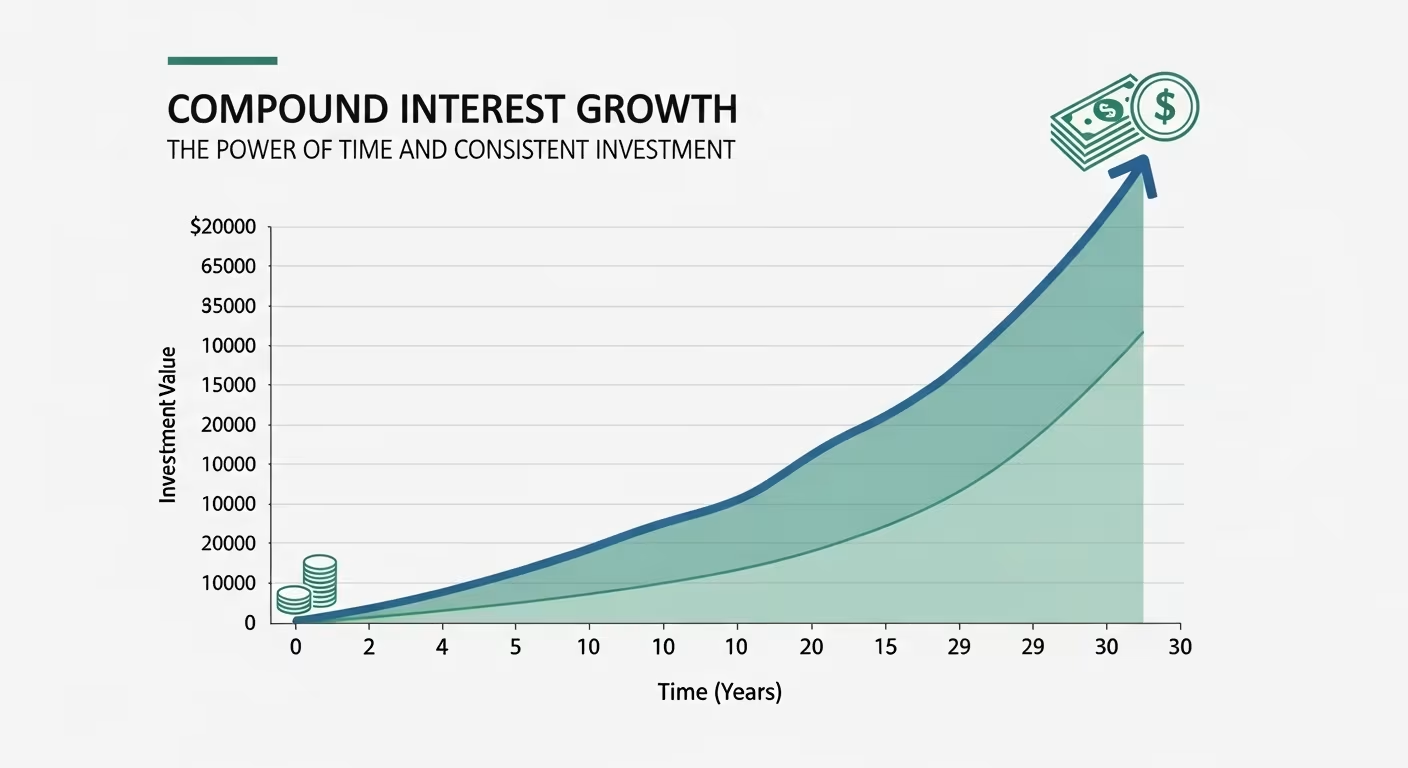
Compound Interest Explained: How It Builds Wealth Over Time
Compound interest is one of the most powerful forces in personal finance — and one of the most misunderstood. Whether you're saving for retirement, paying off debt, or trying to understand why your credit card balance seems to grow overnight, compound interest is the mechanism at work. Understanding how it functions, why it accelerates over time, and how to harness it early will fundamentally change how you think about money.
What Is Compound Interest?
Compound interest is interest calculated on both your original principal and the accumulated interest from previous periods. In other words, your interest earns interest. This is fundamentally different from simple interest, where you earn a fixed return on only your original deposit.
Here's the simplest way to see the difference: suppose you deposit $10,000 at a 7% annual return.
- Simple interest: You earn $700 every year on your original $10,000. After 30 years, you have $31,000 ($10,000 principal + $21,000 in interest).
- Compound interest: In year one you earn $700, giving you $10,700. In year two you earn 7% on $10,700 — that's $749. In year three, 7% on $11,449 — that's $801. After 30 years, you have approximately $76,123.
Same starting amount. Same interest rate. But compound interest produces more than twice the result of simple interest over 30 years. The difference becomes more dramatic the longer the time horizon extends.
The Rule of 72: A Mental Model for Doubling
The Rule of 72 is a quick formula that tells you roughly how long it takes for money to double at a given interest rate. Divide 72 by your annual return, and the result is approximately how many years your money takes to double.
- At 6% annual return: 72 ÷ 6 = 12 years to double
- At 8% annual return: 72 ÷ 8 = 9 years to double
- At 10% annual return: 72 ÷ 10 = 7.2 years to double
- At 4% (a high-yield savings account): 72 ÷ 4 = 18 years to double
This mental model reveals why the stock market has historically been such a powerful long-term wealth builder. The US stock market, as measured by the S&P 500, has produced average annual returns of roughly 10% before inflation over the long run — meaning money invested in a broad index fund historically doubled roughly every 7 years.
The Rule of 72 also works in reverse for debt. At 20% APR (typical for credit cards), your debt balance doubles in about 3.6 years if you make no payments. That's the same compounding engine working against you.
Why Time Is the Most Powerful Variable
No factor affects the outcome of compound interest more than time. Not your rate of return. Not the amount you invest. Time.
Consider two investors: Maya and David.
- Maya starts investing $300 per month at age 25 and stops at age 35 — just 10 years of contributions, totaling $36,000. She then leaves the money alone until age 65, earning an average of 8% annually.
- David starts investing $300 per month at age 35 and contributes every year until age 65 — 30 years of contributions, totaling $108,000. He also earns 8% annually.
At 65, Maya has approximately $642,000. David has approximately $440,000. Maya contributed only one-third as much money as David, yet she ends up with nearly 46% more — all because she started 10 years earlier.
This is not a hypothetical designed to deceive. It's the mathematical reality of compound interest. The early years of investment don't feel like much — $300 a month barely seems worth discussing. But the compounding that happens in the final decades is driven entirely by what was planted in those early years.
How Compound Interest Works in Different Accounts
Compound interest shows up across virtually every financial product, but the mechanics vary.
Savings accounts and CDs. Banks compound interest daily, monthly, or annually depending on the account. A savings account compounding daily will produce slightly more than one compounding monthly at the same stated APY. When comparing savings products, focus on APY (Annual Percentage Yield) rather than APR — APY already accounts for the compounding frequency.
Investment accounts. In stock market investments, compounding doesn't happen through a stated interest rate. Instead, it happens through price appreciation and dividend reinvestment. When you reinvest dividends — either manually or automatically through a DRIP (Dividend Reinvestment Plan) — you buy more shares, which generate more dividends, which buy more shares. The mechanism is the same as interest compounding, even if the name is different.
Retirement accounts. A 401(k) or IRA compounds in the same way as a taxable investment account, but with a crucial advantage: you don't pay taxes on gains as they occur. In a traditional 401(k), you pay no tax until withdrawal. In a Roth IRA, you pay no tax ever on qualified withdrawals. This tax-deferred or tax-free compounding dramatically accelerates wealth accumulation compared to a taxable account with the same nominal return.
Debt. Credit cards, auto loans, mortgages, and student loans all use compounding against you. A credit card balance of $5,000 at 22% APR compounds monthly. If you make only minimum payments, the math is brutal — you can pay thousands of dollars in interest while the balance barely moves. This is why eliminating high-interest debt is the mathematical equivalent of earning a guaranteed return equal to the debt's interest rate.
The Impact of Compounding Frequency
Interest can compound annually, semi-annually, quarterly, monthly, daily, or even continuously. More frequent compounding produces slightly higher effective returns, even at the same stated rate.
At a 6% annual rate:
- Compounded annually: $10,000 grows to $10,600 after one year
- Compounded monthly: $10,000 grows to $10,616.78 after one year
- Compounded daily: $10,000 grows to $10,618.31 after one year
The differences are small in year one but accumulate meaningfully over decades. This is why online savings accounts that advertise "daily compounding" are marginally better than those that compound monthly, assuming the same APY.
When comparing financial products, use APY as your standard benchmark — it normalizes for compounding frequency and lets you make apples-to-apples comparisons.
Inflation: The Compound Interest Working Against You
Just as compound interest grows your wealth, inflation compounds the erosion of your purchasing power. At 3% annual inflation, the purchasing power of $1,000 falls to roughly $412 over 30 years. At 4% inflation, it falls to $308.
This is why cash savings accounts — even at competitive rates — are not sufficient for long-term wealth building. If inflation is running at 3% and your savings account pays 2%, your real return is negative 1%. You're losing purchasing power while nominally "earning" interest.
The practical implication: money you won't need for 10 or more years should generally be invested in assets (equities, real estate) that historically outpace inflation over long periods — not kept in savings accounts, regardless of how safe they feel.
Behavioral Mistakes That Kill Compound Interest
Understanding compound interest is one thing. Letting it actually work for you requires avoiding several common behavioral traps.
Stopping and starting. Every year you pause investing is a year of compounding you never recover. During market downturns, people panic and sell — locking in losses and missing the eventual recovery. The math of compounding depends on staying invested through volatility.
Spending dividends instead of reinvesting. If your brokerage account is set to pay dividends as cash rather than automatically reinvest them, you're short-circuiting the compounding mechanism. Check your settings and enable DRIP (dividend reinvestment) unless you're in retirement and deliberately drawing down.
Waiting for the "right time" to invest. Market timing — waiting for prices to drop before investing — is statistically inferior to consistent investment (dollar-cost averaging) for most people. The cost of being out of the market while waiting for a better entry point is years of compounding forgone.
Paying high fees. An actively managed mutual fund charging 1.2% annually versus an index fund charging 0.03% seems like a small difference. Over 30 years on a $100,000 investment returning 8% gross, the high-fee fund leaves you with roughly $574,000. The low-fee fund leaves you with approximately $906,000. The 1.17% annual fee difference costs you more than $330,000 over 30 years. Fees compound just as returns do.
How to Maximize Compound Interest in Practice
The principles for harnessing compound interest are few and simple:
Start as early as possible. Every year of delay has an irreversible cost. Even small amounts invested young outperform large amounts invested late.
Invest consistently. Automate monthly contributions to your retirement and investment accounts. Dollar-cost averaging — investing a fixed amount regularly — removes the market-timing temptation and ensures you're always compounding.
Minimize fees. Choose low-cost index funds. At Vanguard, Fidelity, or Schwab, total market index funds are available with expense ratios below 0.05%. This is not a minor optimization — it's worth hundreds of thousands of dollars over a working lifetime.
Reinvest all dividends and distributions. Enable automatic reinvestment in every account unless you're deliberately drawing income.
Avoid selling during downturns. Market crashes are temporary interruptions in a long-term compounding trajectory. Selling locks in losses and eliminates future compounding on that capital.
Eliminate high-interest debt. Paying off a 20% credit card is mathematically identical to earning a guaranteed 20% return. No investment reliably beats that. Eliminate debt that compounds against you before aggressively building investments.
Compound Interest and Retirement: The Long Game
The most important application of compound interest for most people is retirement savings. The numbers are stark: someone who invests $500 per month from age 25 to 65 at an 8% average annual return accumulates approximately $1.75 million. Someone who waits until 35 and invests the same monthly amount accumulates approximately $745,000 — less than half, despite contributing for only 10 fewer years.
Maximizing your 401(k) contributions early in your career is not just about tax savings — it's about giving compound interest maximum runway. The IRS updates contribution limits annually; current figures are available at https://www.irs.gov/retirement-plans/plan-participant-employee/retirement-topics-401k-and-profit-sharing-plan-contribution-limits.
Target-date retirement funds — available in most 401(k) plans — automatically maintain a diversified, age-appropriate allocation and reinvest all dividends. For most people, they're the simplest way to let compound interest work without ongoing management decisions.
Teaching Compound Interest: The Earlier, the Better
If you have children or young adults in your life, few financial lessons are more valuable than demonstrating compound interest visually. The math is simple enough for a teenager to understand, and the message — that starting young is worth more than earning more later — is one of the most practically useful things a young person can internalize.
A $2,000 Roth IRA contribution at age 18, left untouched, grows to approximately $85,000 by age 65 at 8% annual returns. The same $2,000 invested at age 38 grows to only $20,000. The same dollar amount, invested 20 years earlier, produces more than four times the result. No other single financial lesson has more direct impact on long-term wealth than understanding this reality early and acting on it.
The Compound Effect Across Your Entire Financial Life
Compound interest is not limited to investment accounts. The same exponential logic applies to skills, habits, and knowledge. A small improvement in your financial literacy — understanding fees, tax efficiency, or the impact of starting early — compounds across every financial decision you make for the rest of your life.
The person who learns about compound interest at 25 and acts on it is not just richer at 65 than someone who learns at 45. They make better decisions at every stage: they don't pay 22% credit card interest for years, they don't cash out retirement accounts in their 30s, they don't buy annuities with high surrender charges in their 50s. The knowledge compounds just as the money does.
This is why financial education has a higher ROI than almost any other investment you can make in your 20s and 30s. Understanding how compound interest works — truly understanding it, not just nodding at the concept — changes the calculus of every financial trade-off you will face. Start early. Stay invested. Let time do the work.
For further reading on compound interest mechanics, the SEC's investor education resources at https://www.investor.gov/additional-resources/information/youth/teachers-classroom-resources/what-compound-interest offer straightforward explanations with interactive calculators.
None of this is financial advice. Your situation depends on variables this article can't see — taxes, risk tolerance, time horizon, dependents. A fiduciary advisor can model your specific case.
Comments (0)
No comments yet. Be the first to share your thoughts!
Leave a Comment