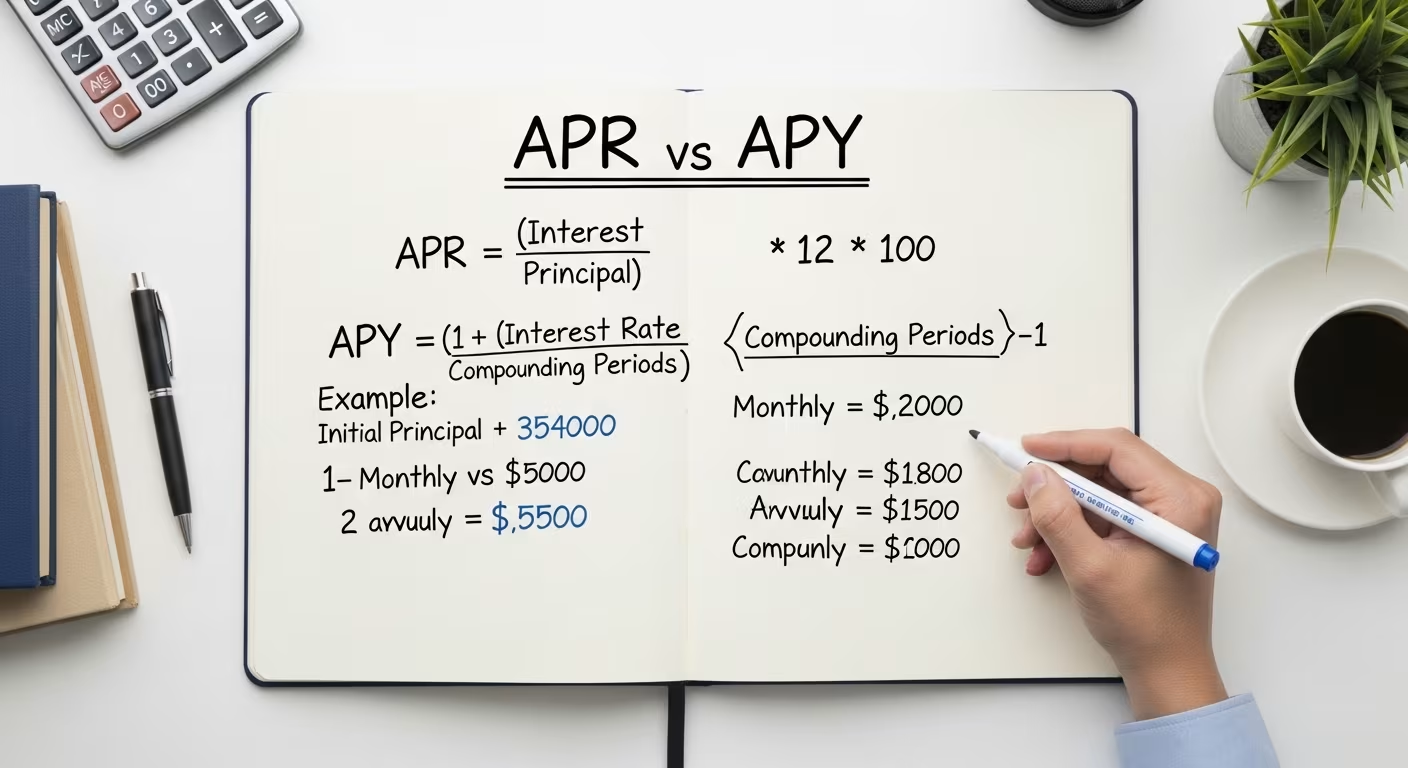
APR and APY are two acronyms that significantly impact your finances—yet most people confuse them or ignore them entirely. Understanding the difference helps you compare loans accurately, choose better savings accounts, and make smarter financial decisions. Here's what you need to know.
For card terms and consumer protections, the CFPB credit cards guide is the official plain-English reference.
The Basics
APR: Annual Percentage Rate
APR represents the yearly cost of borrowing money, expressed as a percentage. It includes the interest rate plus certain fees associated with the loan.
Where you see APR: Credit cards, mortgages, auto loans, personal loans.
Example: A credit card with 23.77% APR charges approximately 23.77% of your balance in interest annually (though compounding affects the actual cost).
APY: Annual Percentage Yield
APY represents the actual rate of return on savings or investments over one year, including the effect of compound interest.
Where you see APY: Savings accounts, CDs, money market accounts.
Example: A savings account with 4.50% APY means $10,000 deposited for one year earns $450 (assuming no deposits or withdrawals).
The Key Difference: Compounding
The fundamental difference is how compounding is handled.
APR does not account for compounding within the year. It's a simple rate.
APY includes the effect of compounding—interest earning interest.
Why This Matters
For borrowers: The stated APR understates the true annual cost if interest compounds monthly or daily.
For savers: APY accurately represents what you'll earn because it includes compounding.
Compounding Explained
How Compounding Works
Interest can compound at different frequencies:
- Annually (once per year)
- Quarterly (four times per year)
- Monthly (twelve times per year)
- Daily (365 times per year)
More frequent compounding = higher effective rate.
Example: $10,000 at 4% for One Year
| Compounding Frequency | Balance After 1 Year |
|---|---|
| Annually | $10,400.00 |
| Quarterly | $10,406.04 |
| Monthly | $10,407.42 |
| Daily | $10,408.08 |
The stated rate is 4% in all cases, but actual earnings vary based on compounding frequency.
The Formula
Formula: APY = (1 + r/n)^n - 1
Where:
- r = stated annual interest rate
- n = number of compounding periods per year
Example: 4% rate compounded monthly APY = (1 + 0.04/12)^12 - 1 = 4.074%
The 4.074% APY reflects the actual return after monthly compounding.
APR in Detail
What APR Includes
For most consumer loans, APR includes:
- Base interest rate
- Certain lender fees
- Points (if applicable)
- Some closing costs
What APR May Not Include
Depending on loan type:
- Title insurance
- Appraisal fees
- Attorney fees
- Property taxes
- Homeowner's insurance
This is why actual borrowing costs can exceed the stated APR.
Credit Card APR
Credit cards typically quote APR, but interest compounds daily. A 23.77% APR actually results in approximately 26.6% APY due to daily compounding.
Calculation: (1 + 0.2377/365)^365 - 1 = 26.6%
This is why credit card debt grows faster than the APR suggests.
Different APR Types
Purchase APR: Rate for regular purchases Balance Transfer APR: Rate for transferred balances (often promotional) Cash Advance APR: Rate for cash withdrawals (usually higher) Penalty APR: Elevated rate triggered by late payments
A single credit card may have multiple APRs depending on transaction type.
APY in Detail
What APY Tells You
APY shows the actual return on your deposit after one year, including all compounding. It allows direct comparison between accounts with different compounding frequencies.
Comparing Savings Accounts
| Bank | Stated Rate | Compounding | APY |
|---|---|---|---|
| Bank A | 4.40% | Monthly | 4.49% |
| Bank B | 4.45% | Quarterly | 4.53% |
| Bank C | 4.50% | Daily | 4.60% |
Bank C has the highest APY despite Bank B having a higher stated quarterly rate. APY makes comparison easy.
High-Yield Savings in 2026
Top high-yield savings accounts offer 4-5% APY in 2026, compared to the national average of approximately 0.39% APY. On $20,000:
| Account Type | APY | Annual Earnings |
|---|---|---|
| Traditional savings | 0.39% | $78 |
| High-yield savings | 4.50% | $900 |
| Difference | $822 |
APY makes this comparison clear and accurate.
Common Confusion
"APR" vs. "Interest Rate"
For mortgages, you'll see both:
- Interest rate: The base rate charged on the loan
- APR: Interest rate plus certain fees, expressed annually
APR is typically higher than interest rate because it includes fees. Use APR to compare mortgage offers.
Why APR Is Used for Loans
Regulators require APR disclosure because it provides a standardized way to compare loan costs. However, it's not perfect—some fees may not be included, and compounding effects aren't fully captured.
Why APY Is Used for Savings
APY accurately reflects actual returns, making it the best tool for comparing savings options. All compounding effects are included.
Making Better Decisions
When Comparing Loans
- Compare APR, not just interest rate
- Understand that credit card APR understates true cost (daily compounding)
- Review what's included/excluded from APR
- Ask for loan estimates showing total cost of borrowing
When Comparing Savings Accounts
- Compare APY directly
- Higher APY = more earnings (all else equal)
- Confirm APY is current (rates change)
- Check for minimum balance requirements that might affect effective yield
Credit Card Strategy
The best strategy is paying in full monthly, making APR irrelevant. If you carry a balance:
- Understand that 23.77% APR effectively costs ~26.6% annually
- Prioritize paying off high-APR debt
- Consider 0% APR balance transfer offers (watch transfer fees and promotional period end)
Real-World Applications
Scenario 1: Choosing a Savings Account
Option A: 4.25% APY, no fees, no minimum Option B: 4.45% APY, $5/month fee if balance under $10,000
On $8,000 balance:
- Option A: $340/year earnings
- Option B: $356 earnings - $60 fees = $296 net
Option A wins despite lower APY because of fees.
Scenario 2: Comparing Mortgages
Lender A: 6.75% interest rate, 6.95% APR Lender B: 6.85% interest rate, 6.90% APR
Lender B has lower APR despite higher interest rate because of lower fees. On a $400,000 mortgage, this difference matters significantly.
Scenario 3: Understanding Credit Card Cost
Carrying $8,000 balance at 23.77% APR:
- Simple interest calculation: $8,000 × 0.2377 = $1,902/year
- Actual cost with daily compounding: $8,000 × 0.266 = ~$2,128/year
The difference of $226 comes from compounding—interest charged on interest.
Quick Reference
| Term | Full Name | Used For | Includes Compounding? |
|---|---|---|---|
| APR | Annual Percentage Rate | Loans, credit cards | No |
| APY | Annual Percentage Yield | Savings, CDs | Yes |
For borrowers: Look at APR, but understand actual cost may be higher due to compounding.
For savers: Compare APY directly—it shows exactly what you'll earn.
APR vs. APY: Real-World Cost Differences
The difference between APR and APY might seem academic until you see the dollar impact:
Credit Card Example A $5,000 balance at 23.77% APR (2026 average) with daily compounding:
- APR (stated rate): 23.77%
- APY (effective rate): 26.82%
- Annual interest cost: $1,341 (not $1,189 as APR implies)
- Extra cost from compounding: $152/year
Over 3 years of carrying that balance (paying minimums), the difference between APR and APY costs you an additional $456.
Savings Account Example $25,000 in a high-yield savings account at 5.00% APY with daily compounding:
- APY (what you actually earn): 5.00%
- APR (before compounding): 4.88%
- Annual earnings at APY: $1,250
- Annual earnings at APR: $1,220
- Bonus from compounding: $30/year
With savings, compounding works for you. With debt, it works against you.
Mortgage Example A $350,000 mortgage at 6.75% APR with monthly compounding:
- APR: 6.75%
- APY (effective rate): 6.96%
- Monthly payment: $2,270
- Total interest over 30 years: $467,200
If that same loan were quoted as APY (6.96%), it would look more expensive—which is exactly why lenders use APR. They are legally required to disclose APR under the Truth in Lending Act (TILA), but APR understates the true cost of borrowing.
The Compounding Frequency Factor
How often interest compounds significantly affects your effective rate:
| Compounding Frequency | 5% APR Becomes This APY |
|---|---|
| Annually | 5.000% |
| Semi-annually | 5.063% |
| Quarterly | 5.095% |
| Monthly | 5.116% |
| Daily | 5.127% |
| Continuously | 5.127% |
For savers: More frequent compounding = higher effective return. Choose accounts with daily compounding. For borrowers: More frequent compounding = higher effective cost. Understand how your lender compounds before signing.
Quick Decision Framework
| Situation | Look At | Why |
|---|---|---|
| Comparing savings accounts | APY | Shows actual earnings including compounding |
| Comparing loans/mortgages | APR | Standard disclosure metric (but understand it understates true cost) |
| Credit cards | APR (but know APY is higher) | APR is how cards are marketed; APY is what you actually pay |
| CDs | APY | Shows real return; compare directly |
| Student loans | APR | Federal loans use simple interest, so APR = effective rate |
Key Takeaways
- APR understates borrowing costs when interest compounds frequently (like daily on credit cards)
- APY accurately represents savings returns because compounding is included
- Compare APR to APR when evaluating loans
- Compare APY to APY when evaluating savings accounts
- Higher APY is always better for savings (assuming same features)
- Lower APR is always better for borrowing (assuming same terms)
- The difference between 0.39% and 4.50% APY on savings is hundreds of dollars annually—don't ignore it
Understanding these two acronyms empowers you to make better financial decisions, whether you're shopping for a mortgage, comparing savings accounts, or understanding the true cost of credit card debt. The math matters, and now you understand it.
Common APR/APY Mistakes to Avoid
Mistake 1: Comparing APR to APY. Comparing a savings account at 5.00% APY to a loan at 5.00% APR is not apples-to-apples. The savings account effectively earns 5.00% (APY already includes compounding). The loan effectively costs more than 5.00% (APR does not include compounding).
Mistake 2: Ignoring introductory rates. A credit card offering 0% APR for 18 months jumps to 23.77% after the promo. If you have not paid off the balance by then, the interest hit is significant. Some cards even apply retroactive interest on the remaining balance.
Mistake 3: Confusing fixed and variable APR. Most credit cards have variable APR tied to the prime rate. When the Federal Reserve raises rates, your credit card APR increases automatically—often within one billing cycle.
Mistake 4: Not checking compounding frequency. Two savings accounts can both advertise 5.00% APR but yield different APY amounts depending on whether they compound daily, monthly, or quarterly. Always compare APY, not APR, for savings products.
Understanding APR and APY is not just financial literacy—it is financial self-defense. Every loan you take, every savings account you open, and every credit card you carry involves these numbers. Knowing how to read them puts you in control of your money instead of the other way around.
Comments (0)
No comments yet. Be the first to share your thoughts!
Leave a Comment