
The Vanguard Growth ETF Portfolio (VGRO) has been a core option for many Canadian DIY investors since its launch in January 2018. As one of the first Canadian asset-allocation exchange-traded funds, VGRO offers a ready-made split of global equities and fixed income designed for investors who want a growth tilt without managing individual funds.
For a 0.24% management expense ratio (MER), VGRO targets roughly 80% global stocks and 20% bonds, rebalanced periodically and structured with a Canadian home bias to improve tax efficiency and reduce currency risk. Although it is growth-oriented, VGRO also distributes quarterly dividends. Its success has inspired several lower-cost alternatives from other issuers.
VGRO holdings
Major underlying ETFs and allocations:
- Vanguard U.S. Total Market Index ETF — 35.14%
- Vanguard FTSE Canada All Cap Index ETF — 24.65%
- Vanguard FTSE Developed All Cap ex North America Index ETF — 14.44%
- Vanguard Canadian Aggregate Bond Index ETF — 11.83%
- Vanguard FTSE Emerging Markets All Cap Index ETF — 5.47%
- Vanguard Global ex-U.S. Aggregate Bond Index ETF (CAD-hedged) — 4.23%
- Vanguard U.S. Aggregate Bond Index ETF (CAD-hedged) — 4.21%
As of April 30, 2025
VGRO and similar balanced ETFs are convenient, but not immune to market shocks. In 2022, VGRO’s price fell 11.19%, a larger decline than Vanguard’s all-equity counterpart, the Vanguard All-Equity ETF Portfolio (VEQT). That unusual outcome highlights an important risk: when interest rates rise sharply, the bond sleeve meant to cushion equity losses can decline at the same time as stocks.
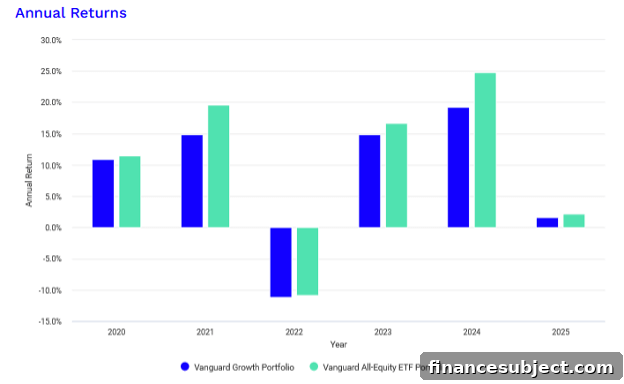
VGRO’s bond holdings have an average duration of about 6.8 years, which makes them sensitive to rate moves: all else equal, a 1% increase in yields could imply roughly a 6.8% decline in the bond component’s price. In 2022, rising rates combined with an equity downturn, magnifying the portfolio’s drawdown.
If you worry about a repeat of simultaneous stock-and-bond declines, there are practical ways to shore up a VGRO-based allocation. Below are two TSX-listed ETF ideas that can complement VGRO, along with trade-offs and considerations for each.
Holding cash along with VGRO
Cash or ultra-short-term Treasury exposures can play an important stabilizing role. With the Bank of Canada maintaining elevated policy rates in recent years, keeping a portion of a portfolio in cash alternatives provides yield without significant equity or long-duration interest-rate risk. Cash preserves capital and can act as a counterweight when both stocks and bonds fall together.
Instead of leaving funds idle in a brokerage account, consider an ultra-short ETF such as the Global X 0–3 Month T-Bill ETF (CBIL). It invests in very short-term federal treasury bills and generally tracks short-term policy rates after fees. With a low MER and high liquidity, CBIL typically shows minimal price volatility and a narrow bid-ask spread.
The ETF’s price pattern is straightforward: modest upward movement as bills accrue value, then a small dip on the ex-dividend date when distributions are paid—creating a predictable, low-volatility profile. A modest allocation—10% for many investors—can provide a cash buffer, though the main benefit is psychological: it keeps a portion of the portfolio stable and available for rebalancing or buying opportunities during market stress.
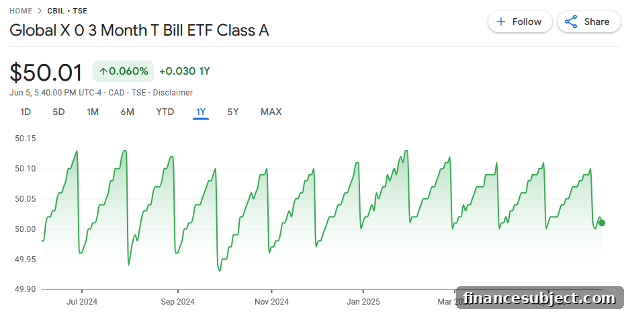
Expect modest returns from such an ETF—it’s not designed for large gains but for capital preservation and liquidity. Adjust the allocation based on your risk tolerance and investment time horizon.
Include an alternative asset when buying VGRO
An effective second complement to VGRO is an alternative asset that doesn’t correlate strongly with stocks or bonds. Gold is a classic example. It is not a productive asset—meaning it doesn’t generate interest or dividends—but it often behaves differently from equities and fixed income, reacting to factors like central bank buying, geopolitical risk, inflation expectations, and supply-demand dynamics.
Measured over recent months, gold’s correlation with the global stocks and bonds in VGRO has been low (around 0.09), indicating it tends to move independently. That low correlation is valuable: a small allocation to gold can materially reduce portfolio volatility and improve risk-adjusted returns without requiring a large position.
VGRO versus GOLD monthly correlation
| Ticker | Asset name | VGRO | GOLD |
|---|---|---|---|
| VGRO:CA | Vanguard Growth Portfolio | 1.00 | 0.09 |
| GOLD | Gold Price Index | 0.09 | 1.00 |
Backtests over recent years show that adding a modest gold allocation can improve outcomes. For example, a hypothetical 90/10 split of VGRO plus gold from January 2019 to May 2025 would have produced slightly higher returns with lower volatility and improved risk-adjusted measures.
VGRO versus VGRO + 10% gold
| Metric | VGRO | 90% VGRO + 10% Gold |
|---|---|---|
| Start balance | $10,000 | $10,000 |
| End balance | $18,524 | $19,231 |
| Annualized return (CAGR) | 10.08% | 10.73% |
| Standard deviation | 11.21% | 10.24% |
| Best year | 19.30% | 19.92% |
| Worst year | -11.19% | -10.02% |
| Maximum drawdown | -16.08% | -15.21% |
| Sharpe ratio | 0.71 | 0.83 |
| Sortino ratio | 1.10 | 1.30 |
If you decide to add physical-backed gold exposure, one option in the Canadian market is the BMO Gold Bullion ETF (ZGLD), which holds physical bullion and has a competitive MER for that structure. Remember that gold does not produce income, so it functions best as a diversifier rather than a growth or income engine. To capture its benefits, rebalance periodically—annually or quarterly—to keep allocations on target.
Should you add other ETFs to VGRO?
Where once diversification beyond stocks and bonds was costly or impractical, the Canadian ETF landscape now offers low-cost, liquid alternatives. Holding a mix of cash-like instruments, metals such as gold, and traditional equities and bonds allows you to diversify “your diversifiers.” When stocks stumble, bonds usually help; when bonds struggle, gold can offset losses; and when all risk assets fall, short-term cash or Treasury exposures provide stability and optionality.
The most important factor is discipline. If you add ETFs to a VGRO core, choose low-cost, liquid funds and set clear target weights with a rebalancing schedule. Regular rebalancing enforces discipline and harvests the diversification benefits without letting emotions drive decisions.
Finally, if your preferred approach remains simple—“VGRO and chill”—that is a valid strategy. For many investors, consistency and simplicity outpace complexity over the long term.