
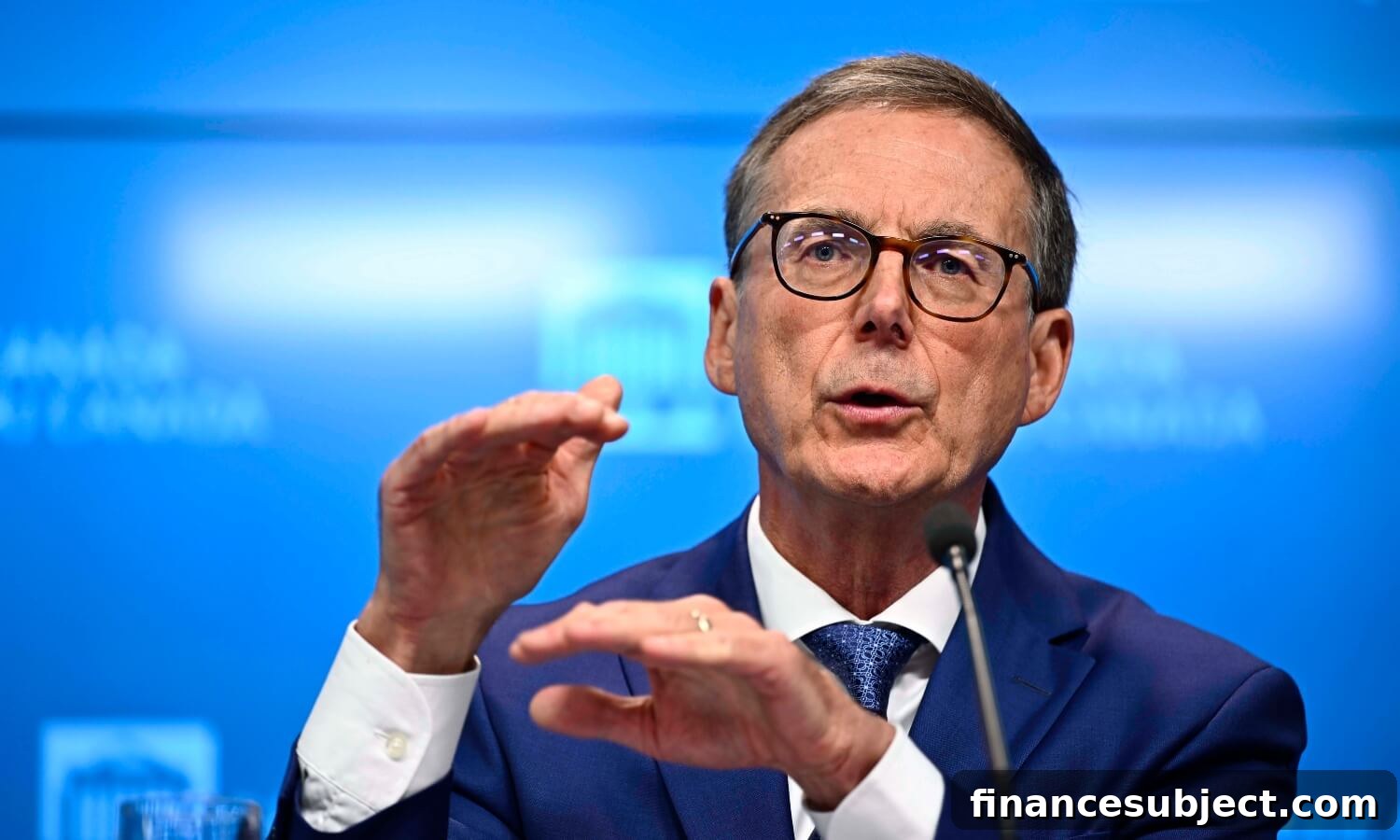
The Bank of Canada left its benchmark interest rate unchanged on Wednesday, keeping the policy rate at 2.75% as it waits for clearer signals about how growing global trade uncertainty will affect the Canadian economy. This is the first time the central bank has paused after seven consecutive cuts since June, reflecting heightened caution amid volatile international trade developments.
Holding steady at 2.75%
The decision to hold the rate came against the backdrop of an evolving trade conflict originating in the United States. Governor Tiff Macklem stressed that the disruption to global trade and the uncertain outlook from recent U.S. trade announcements were central to the Bank’s deliberations.
In prepared remarks, he noted that the sharp shift toward protectionist trade policy and the uneven way those policies have been communicated have amplified uncertainty, unsettled financial markets and clouded global growth prospects. The Bank remains unsure which tariffs will be imposed, whether measures will be scaled back or escalated, and how long elevated trade tensions will persist.
What would prompt a Bank of Canada rate increase?
The Bank raises its policy rate when it judges inflation is likely to accelerate and lowers the rate to support economic activity when growth needs stimulus. At present, both inflationary and weak-growth risks are present because of the uncertain path of trade relations. That mix of risks contributed to the Bank’s decision to pause and gather more information.
Governor Macklem explained that the governing council opted to keep the policy rate steady while it gains greater clarity about the likely path and impact of U.S. tariffs on Canada’s economy, including how quickly higher costs would be passed through to consumers and how trade measures would affect demand for Canadian exports.

Interest rate: 3.25%

Interest rate: 3.50%

Beyond GICs, a safe and flexible way to grow your savings is a high-interest savings account. Consider the top savings options available.
MoneySense is an award-winning personal finance magazine that has been helping Canadians navigate money matters since 1999. Our editorial team of trained journalists collaborates with respected finance experts to compare products across major banks, credit unions and issuers, assisting readers in finding suitable financial solutions.
Why the hold?
Alongside the rate decision, the Bank released two alternative economic scenarios to illustrate the range of possible outcomes for Canada under different trade developments. The dual forecasts explain why the Bank chose a cautious stance rather than tightening or loosening policy immediately.
- In the first scenario, trade tensions subside relatively quickly. Tariffs and threats are resolved without prolonged disruption, economic activity slows but avoids severe damage, and inflation eases to about 1.5% for much of the coming year—partly reflecting recent policy changes—before moving back toward the Bank’s 2% goal.
- The second scenario envisions a prolonged global trade conflict that significantly disrupts trade flows and confidence, pushing Canada into a deeper downturn. Under this projection, trade measures reduce demand for Canadian exports and lead to broader economic contraction.
The more severe projection assumes substantial, sustained tariffs on Canadian goods—higher duties on motor vehicles and parts, and wider import restrictions—that prompt retaliatory measures. That outcome would reduce Canada’s real GDP for several quarters and could permanently lower potential output and average living standards. It would also complicate the Bank’s efforts to manage inflation, with headline inflation rising above the target in the medium term.
The Bank emphasized these scenarios are illustrative snapshots, not predictions of a single outcome. The governing council used this risk-focused framework to guide its decision to hold the policy rate, choosing a course intended to remain appropriate whether the mild or more severe scenario materializes.
How is the economy right now?
So far, early tariff announcements and trade threats have weakened business and consumer confidence in Canada. Some manufacturing firms have reduced staff or adjusted production plans in response to rising trade frictions. At the same time, headline inflation cooled to around 2.3% in March, helped in part by lower gasoline prices and softer travel demand resulting from cross-border uncertainty.
The Bank signalled it will “proceed carefully” in setting future policy. Officials will monitor several key indicators, including the extent to which tariffs reduce demand for Canadian exports, how much businesses and households trim spending, the speed at which higher costs are passed through to consumer prices, and the evolution of inflation expectations.
Rankings
Compare the best TFSA rates in Canada
Read more about personal finance news:
- Does buying GICs still make sense after the recent rate cuts?
- HISAs vs. bonds and GICs: Where should Canadians hold their cash?
- Find the best mortgage rates in Canada
- How Canada’s inflation rate is affecting your finances