

The first quarter of 2025 surprised many investors who expected a clear “Trump trade.” Instead of a smooth rally, markets faced volatility as tariff threats and policy uncertainty around trade with partners such as Canada and Mexico unsettled investors.
Through March 17, the S&P 500 was down 3.8% year-to-date, and the tech-heavy Nasdaq 100 had fallen 6.5%—a reminder that equity risk can reassert itself quickly.
With stocks struggling, many investors consider bond exchange traded funds (ETFs) for diversification and lower volatility. A commonly recommended option is the BMO Aggregate Bond Index ETF (ZAG), a broadly diversified fund with a low 0.09% management expense ratio (MER). But broad bond ETFs are not necessarily risk-free: they carry credit and liquidity risks that are often overlooked when bonds are bundled into a single ETF.
Below I explain how aggregate bond ETFs like ZAG can behave under stress, why that matters for portfolio safety, and an alternative approach that reduces exposure to corporate-credit risk while still providing diversification and drawdown protection.
Tools
MoneySense’s ETF Screener Tool
Understanding credit risk with bond ETFs
All bonds carry credit risk—the possibility the issuer fails to make payments. Credit quality is typically classified into two main groups:
- Investment-grade bonds (rated BBB and above)
- Non-investment-grade bonds (also called junk or high-yield bonds)
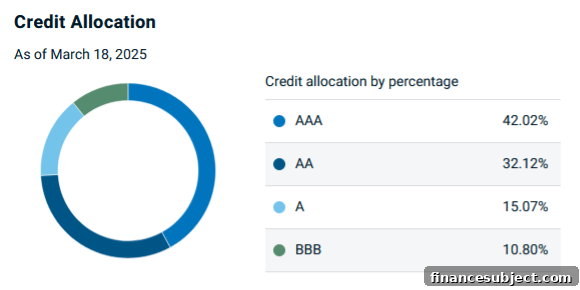
AAA is the highest rating and generally indicates the most creditworthy issuers, while BBB marks the lowest tier of investment grade. Aggregate bond ETFs such as ZAG target an overall portfolio made up of investment-grade holdings, often including federal, provincial and corporate bonds.
ZAG, for example, tracks the FTSE Canada Universe Bond Index and has a sizable allocation to corporate bonds—many rated BBB. While this raises yield relative to government-only funds, it also introduces greater credit and liquidity risk during market stress.
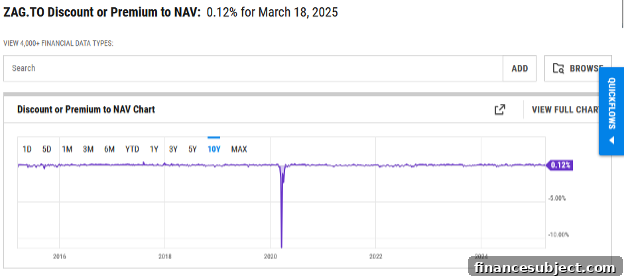
Even well-rated corporate bonds can lose value and become hard to trade in turbulent markets. That’s important because ETFs rely on market participants—authorized participants (APs)—to create and redeem shares by exchanging ETF units for the underlying bonds. When corporate bond markets are illiquid, that mechanism can break down and lead to large deviations between an ETF’s market price and its net asset value (NAV).
In March 2020, during the COVID-19 market panic, corporate bond liquidity deteriorated sharply. Social media and investor forums reflected panic as ETFs with corporate exposure moved dramatically and, for a time, traded at steep discounts to NAV.
Why some bond funds plunged
ETFs typically use an in-kind creation/redemption process to align market price with NAV. APs assemble or disassemble the underlying basket—often corporate and government bonds—to meet investor demand. When the underlying instruments are thinly traded, APs struggle to source or offload holdings at fair prices. The result: an ETF’s market price may swing far from its NAV and can trade at deep discounts.
During the height of the March 2020 sell-off, ZAG’s market price traded as much as 11.3% below NAV. If you were relying on ZAG as a low-risk safe haven and needed to sell quickly to rebalance into equities, you could have been forced to accept a steep loss just to exit. The discount reversed within days after large-scale policy intervention and stimulus stabilized markets, but that episode highlights how quickly supposedly “safe” bond funds can lose liquidity when market conditions deteriorate.
Because future crises may unfold differently and government responses are not guaranteed, it’s prudent to consider whether a broad aggregate bond ETF is the right choice for core bond exposure in a diversified portfolio.
Rankings
The best ETFs in Canada
How to avoid a bond-market freeze
One practical response is to favor government-only bond ETFs for the portfolio sleeve that’s meant to provide safety and rebalancing ballast. For U.S.-dollar-centric investors that often means U.S. Treasuries. For Canadian-dollar investors, an example is the iShares Core Canadian Government Bond Index ETF (XGB), which tracks the FTSE Canada All Government Bond Index and holds only federal and provincial bonds—no corporate exposure.
XGB carries a modest MER (0.12%) and, while it typically yields less than a broad aggregate fund like ZAG, it offers higher liquidity and lower credit risk. If your primary goal for bond allocation is diversification and reducing portfolio drawdown rather than maximizing income, government-only exposure can be more appropriate.
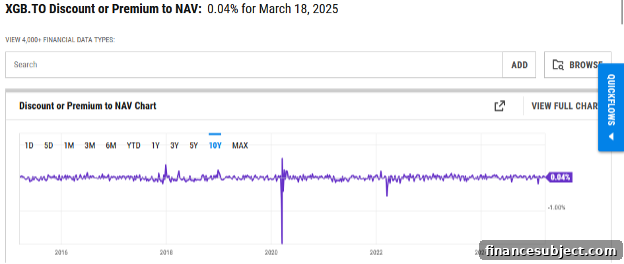
In March 2020, XGB’s maximum discount to NAV was limited to about -2%—substantially smaller than ZAG’s -11.3%—which made a meaningful difference for investors who needed to sell into market stress to rebalance.
Backtests comparing a 60/40 split between the iShares S&P/TSX 60 Index ETF (XIU) and XGB, rebalanced quarterly, with a 60/40 XIU/ZAG portfolio show very similar total and risk-adjusted returns. The government-only mix, however, achieves this with materially less credit risk, which may be preferable for investors who prioritize capital preservation and stable rebalancing mechanics.
Portfolio performance statistics
| Metrics | 60/40 XIU/XGB | 60/40 XIU ZAG |
|---|---|---|
| Start balance | $10,000 | $10,000 |
| End balance | $19,179 | $19,536 |
| Annualized return (CAGR) | 7.36% | 7.58% |
| Standard deviation | 8.68% | 8.88% |
| Best year return | 15.37% | 15.69% |
| Worst year return | -8.53% | -8.26% |
| Maximum drawdown | -12.04% | -13.07% |
| Sharpe ratio | 0.62 | 0.64 |
| Sortino ratio | 0.95 | 0.96 |
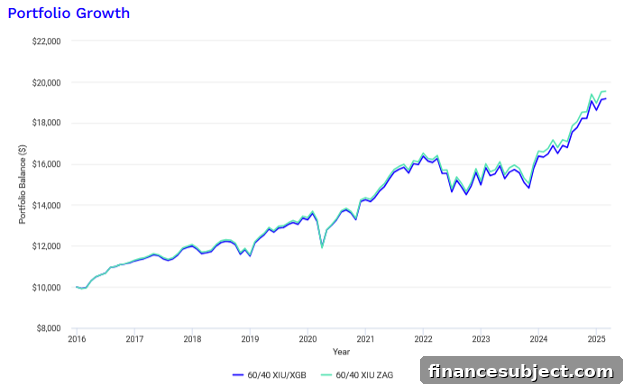
If you view bonds primarily as a safe, liquid buffer to smooth portfolio volatility and enable disciplined rebalancing, deliberately avoiding corporate-credit exposure for that sleeve makes sense. Corporate bonds can be attractive for income-focused investors, but for total-return investors who want reliable ballast, government-only bond ETFs are often the more prudent choice.
Newsletter
Get free MoneySense financial tips, news & advice in your inbox.
Read more about ETF investing:
- How to stay invested in U.S. stocks without the tech overweight
- ETF strategies to help Canadian investors combat a weak loonie
- Questrade trading fees: Good news for Canadian investors
- Buying China ETFs in Canada: Is it worth it?