
Gildan Activewear reports $132.3M Q4 profit, raises dividend 10%
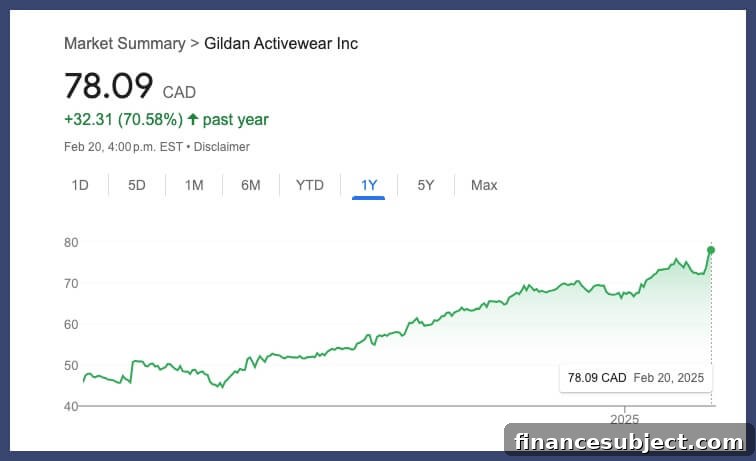
Gildan Activewear (TSE: GIL)
All figures in U.S. dollars.
- Q4 profit: $132.3 million, or $0.86 per diluted share, down from $153.3 million, or $0.89 per diluted share, a year earlier.
- Net sales: $821.5 million, up from $782.7 million a year earlier.
Gildan Activewear Inc. reported a fourth-quarter profit of $132.3 million and announced a 10% increase in its quarterly dividend. The company said it will pay $0.226 per share, up from $0.205 per share previously. Gildan, which reports in U.S. dollars, earned $0.86 per diluted share for the quarter ended Dec. 29, compared with $0.89 per diluted share in the prior year.
Net sales rose to $821.5 million from $782.7 million a year earlier. On an adjusted basis, Gildan reported $0.83 of adjusted diluted earnings per share, up from an adjusted $0.75 a year earlier, reflecting improved margin management despite lower GAAP profit.
CEO Glenn Chamandy said the company continues to strengthen its position as a low-cost, large-scale, vertically integrated manufacturer with an emphasis on sustainability. Management said these strengths enhance Gildan’s competitive advantage and position the company for ongoing growth.
Looking ahead, Gildan forecast mid-single-digit revenue growth for 2025 and expects adjusted diluted earnings per share in a range of $3.38 to $3.58, implying an increase of roughly 13% to 19% versus the prior year.
Gildan also announced several senior leadership changes. Chuck Ward, currently president of sales, marketing and distribution, will become executive vice-president and chief operating officer effective March 1. Rhodri Harries, the company’s chief financial and administrative officer and executive vice-president, will retire on Jan. 1, 2026. Luca Barile, CFO of sales, marketing and distribution, will succeed Harries as executive vice-president and chief financial officer on March 1, while Harries will retain the chief administrative officer role until his retirement.
Loblaw takes PC Optimum charge in Q4 as more customers redeem loyalty points
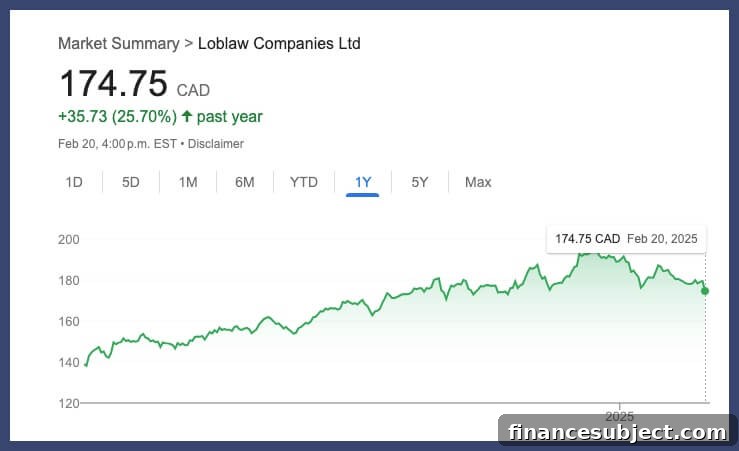
Loblaw Companies Ltd. (TSE: L)
- Q4 net earnings: $462 million, or $1.52 per diluted share, down from $541 million, or $1.72 per diluted share, a year earlier.
- Revenue: $14.9 billion, up from $14.5 billion a year earlier.
Loblaw Companies Ltd. reported fourth-quarter results impacted by higher redemptions in its PC Optimum loyalty program. The company noted more than $1 billion worth of points were redeemed across 2024, with over 17 million active Optimum users. To reflect increased redemptions, Loblaw took a non-cash charge of $129 million in the quarter, which reduced year-over-year net earnings.
For the quarter ended Dec. 28, net earnings available to common shareholders were $462 million, or $1.52 per diluted share, down from $541 million a year earlier. On an adjusted basis, Loblaw reported $2.20 of adjusted diluted earnings per share, up from an adjusted $2.00 a year earlier. Revenue rose to $14.9 billion as food retail same-store sales increased 2.5%; excluding the timing impact of Thanksgiving, food retail same-store sales were up about 1.5%.
Chief Financial Officer Richard Dufresne said the company increased the liability for outstanding Optimum points because it expects more customers to redeem points going forward, reflecting strong engagement with the loyalty program. Loblaw views higher participation positively, noting the program’s popularity demonstrates consumer preference and drives sales.
Loblaw is preparing for possible trade disruptions and tariff risks between Canada and the United States by promoting Canadian-made products in stores and adding features to its loyalty app to help shoppers find domestic products. CEO Per Bank said early results show a meaningful uplift in sales for items identified as prepared in Canada.
The company also discussed the potential impact of tariffs on U.S.-sourced products. Less than 10% of Loblaw’s supply comes from the U.S., with much of that being produce—an area where Canada relies on imports in winter months. Bank said tariffs on produce would pose the most significant challenge, and while Loblaw has plans to mitigate some impacts, replacing produce is difficult. For other categories, the company can lean more on private-label brands such as No Name and President’s Choice, which are produced in Canada and could gain share if U.S. imports become more expensive.
Dufresne added that a weaker Canadian dollar and higher supplier price requests are also creating inflationary pressure. Loblaw announced plans to invest $2.2 billion in 2025, opening approximately 80 new grocery and pharmacy stores—about 50 of them discount grocers—and adding around 100 pharmacy care clinics. The investment is part of a roughly $10 billion plan over five years. Loblaw also plans to begin phased operations at a new automated distribution centre in East Gwillimbury, Ontario, starting with frozen goods.
In 2024 the company opened 52 new stores and 78 new clinics. Drug retail same-store sales rose 1.3%, with pharmacy and health-care services up 6.3%, offset in part by a 3.1% drop in front-store sales. Following the results, Loblaw shares declined modestly on the Toronto Stock Exchange.
Walmart rolled through 2024, but uncertainty about consumers and tariffs seeps into year ahead
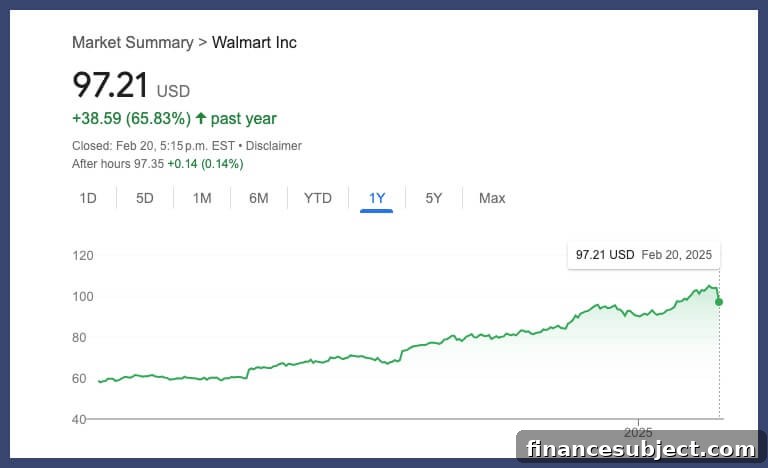
Walmart Inc. (NYSE: WMT)
All figures in U.S. dollars.
- Q4 earnings: $5.25 billion, or $0.65 per share, down from $5.49 billion, or $0.68 per share, a year earlier.
Walmart reported another year of strong sales and profit as shoppers continued to favor low prices, but management flagged growing uncertainty for 2025 driven by consumer caution and potential tariffs. The retailer’s guidance for the year was softer than analysts expected, prompting a notable stock reaction.
The company said it earned $5.25 billion, or $0.65 per share, in the quarter ended Jan. 31, compared with $5.49 billion, or $0.68 per share, a year earlier. Adjusted earnings per share were $0.66. Quarterly sales rose 4.1% to $180.55 billion, slightly above consensus on sales but with mixed messages for profit expectations. Comparable store sales in the U.S. increased 4.6% while global e-commerce grew 16%—both solid but showing some deceleration from prior quarters.
Walmart’s guidance for first-quarter earnings per share came in at $0.57 to $0.58, below analyst expectations. For the full year, the company forecast earnings per share of $2.50 to $2.60 and sales growth of 3% to 4%, forecasts that fell short of Wall Street projections. CFO John David Rainey said the guidance reflects a cautious view of the uncertain environment, including the potential impact of newly announced tariffs.
Rainey emphasized there is no clear change in shopper behavior tied directly to tariffs yet, but the company is preparing for possible cost pressures. Walmart is exploring alternate sourcing for some goods—such as microwave ovens—where tariffs on metals could raise costs, and acknowledged some price increases may be unavoidable. Two-thirds of Walmart’s merchandise is sourced in the U.S., with groceries accounting for roughly 60% of U.S. sales, which provides some natural insulation.
CEO Doug McMillon said Walmart’s momentum is driven by low prices, a growing assortment, and improvements in e-commerce and delivery speed. The retailer has attracted more market share, including among higher-income households, and has expanded offerings like its paid membership program to broaden appeal.
Despite solid results, economists warn that new tariff-driven price increases could reduce consumer spending, which would have broad implications given the consumer-driven nature of the U.S. economy. Recent government data showed a sharper-than-expected drop in January retail sales, underscoring the unpredictable near-term path for consumer demand.