
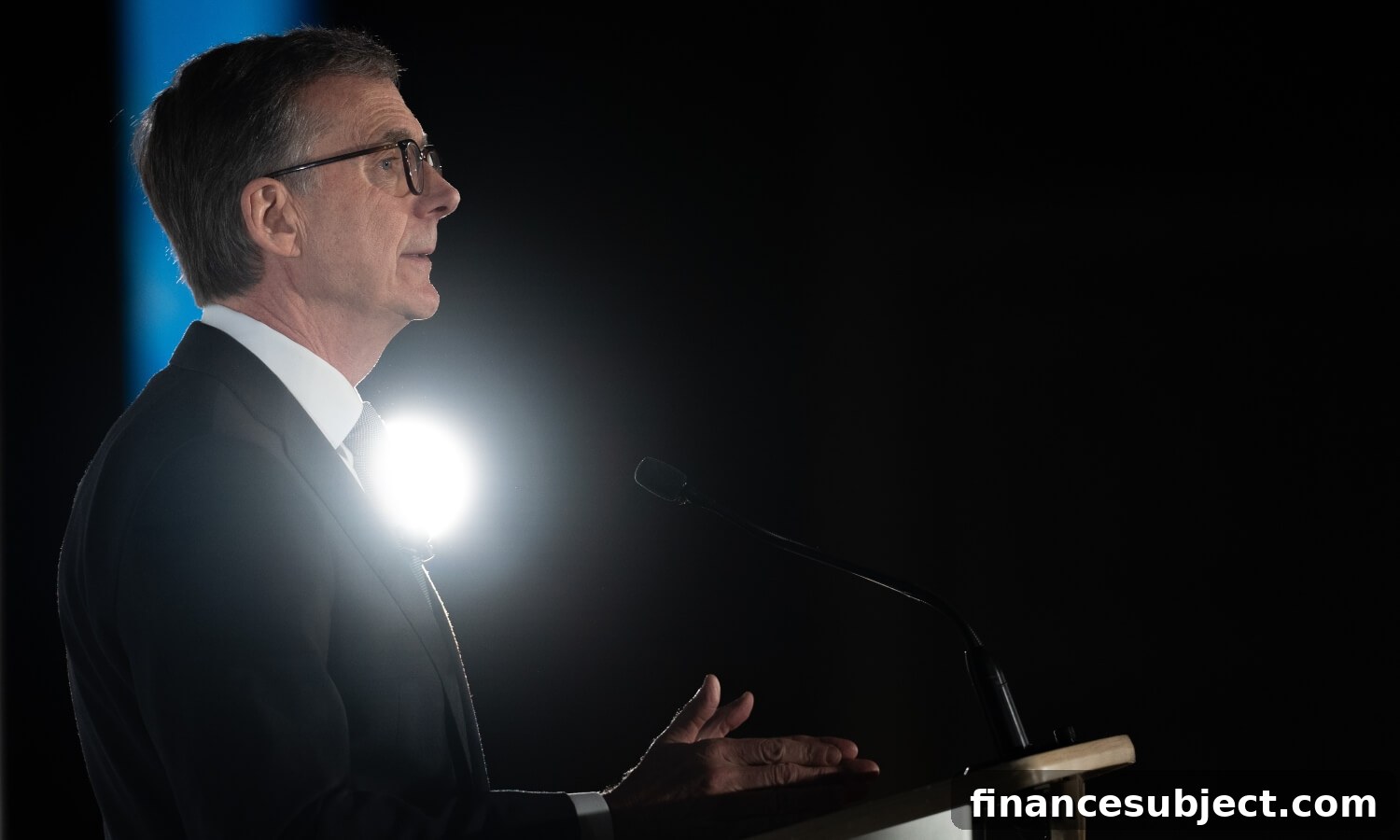
The prospect of U.S. tariffs is casting a shadow over the Bank of Canada’s outlook even as the central bank cut its policy rate by 25 basis points to 3%.
This marks the sixth consecutive rate reduction since June. The bank said inflation is hovering around its two per cent target and that economic activity is showing signs of picking up as earlier rate cuts work through the economy.
“There are signs economic activity is gaining momentum as past interest rate cuts work their way through the economy,” Bank of Canada governor Tiff Macklem said in prepared remarks on Wednesday.
Looming U.S. tariffs threaten Canada’s economic outlook
Canada’s economic outlook is clouded by the possibility of broad U.S. tariffs. U.S. President Donald Trump has threatened a 25% tariff across many goods imported from Canada, but timing and scope remain uncertain. His administration indicated tariffs could be announced as soon as Saturday, according to a press secretary, though details and implementation are still evolving.
At a Senate confirmation hearing, Howard Lutnick—Trump’s nominee for commerce secretary—said the administration might deploy tariffs in two stages: an initial move to address concerns along the border and a later, spring-stage effort intended to encourage manufacturing to return to the United States.
Given this risk, the Bank of Canada says it wants the domestic economy positioned to withstand a potential tariff shock because monetary policy has limited tools beyond adjusting interest rates.
The BoC’s role in a trade war
“Tariffs mean economies simply work less efficiently—we produce and earn less than without tariffs. Monetary policy cannot offset this,” Governor Macklem said.
He explained that while the bank can help the economy adapt, the policy interest rate is a single instrument and cannot simultaneously counteract weaker output and higher inflation if both pressures emerge.
Macklem told reporters the bank will weigh which pressures arrive first. If tariffs weaken activity and reduce inflation more quickly, monetary policy will likely support growth. Conversely, if inflationary effects materialize rapidly and are sizeable, the bank may need to focus on preventing persistent inflation.
Also read
Canada’s best dividend stocks
BoC revises Canada’s GDP forecast
In its January Monetary Policy Report, released alongside the rate decision, the Bank of Canada lowered its GDP projections. It now expects GDP growth of 1.8% in both 2025 and 2026, down from earlier estimates of 2.1% and 2.3% respectively. The revision reflects slower population growth and even a projected population decline in 2026 tied to new federal immigration targets, as well as a downgrade to business investment amid greater policy uncertainty.
Those forecasts assume the threatened U.S. tariffs are not imposed. If tariffs are enacted, the bank warned the outlook could deteriorate significantly.
“We don’t know the scope of retaliatory measures or what fiscal supports will be provided,” Macklem said. “Even when we learn more, it will be difficult to be precise about the economic impacts because we have little experience with tariffs of the magnitude being proposed.”
Stephen Brown, deputy chief North America economist at Capital Economics, said tariffs would deliver a severe blow. He noted the bank hinted it might refrain from using monetary easing if tariffs risked reigniting inflation, which would make further rate cuts less likely.
Four possible scenarios for 2025
The Bank of Canada modeled four scenarios to assess the economic impact if the U.S. imposed 25% tariffs and Canada retaliated with equivalent measures. Under the central “benchmark calibration,” the bank estimated a 2.4% hit to Canada’s GDP in the first year such tariffs take effect.
The benchmark assumes Canadian exports respond to price changes in line with historical patterns and that the tariff costs are fully passed through to consumer prices over three years. If tariffs were implemented this year, the shock could be sufficient to push Canada into a recession, given the bank’s projection of 1.8% GDP growth in 2025.
“The scenario we chose is a severe scenario. This is permanent. It’s not sort of a first shot to subsequent negotiation,” Macklem said.
In an alternative calibration where tariff costs are transmitted to consumer prices in half the time, the bank estimated inflation could rise by about 0.8% in the first year and about 1.3% in the second year.
Derek Holt, head of capital markets at Scotiabank, said that if tariffs never materialize, the bank appears finished with rate cuts for now after reaching 3%, noting the central bank’s tone suggests no appetite for more easing absent new shocks.
Are interest rates still too high?
Not everyone agrees the current policy rate is appropriate. Avery Shenfeld, chief economist at CIBC Capital Markets, argued rates remain “still too high” given softness in the labour market and easing inflation. He projects further cuts totalling three-quarters of a percentage point over time, especially if tariff risks weigh on confidence.
Shenfeld and the bank both view a trade war as likely to cause a temporary rise in inflation but a larger, persistent drag on growth that current projections do not fully incorporate.
In December the Bank of Canada signaled a gradual approach to cuts through 2025, contrasting with the rapid, large reductions at the end of 2024. Notably, the bank removed explicit forward guidance from its policy statement, a change that may reflect uncertainty about how to respond if significant tariffs are imposed or that the policy rate now sits within the bank’s estimated neutral range of 2.25% to 3.25%.
Text of the Bank of Canada’s latest interest rate decision
The Bank of Canada cut its key policy rate by 25 basis points on Wednesday, bringing it to 3%. Below is a concise summary of the central bank’s decision and outlook as presented in the January Monetary Policy Report.
The Bank reduced its overnight rate target to 3.00%, with the Bank Rate at 3.25% and the deposit rate at 2.95%. It also announced plans to end quantitative tightening and to restart modest asset purchases in early March so that the balance sheet stabilizes and then grows gradually in line with economic expansion.
Forecasts in the report carry above-average uncertainty because of the rapidly changing policy landscape, notably the threat of trade tariffs from the United States. Given the unpredictability of scope and duration, the report provides a baseline forecast assuming no new tariffs are imposed.
Globally, the report projects roughly three per cent growth over the next two years. U.S. growth has been revised up on stronger consumption, while the euro area faces subdued expansion and China’s recent policy measures are supporting near-term demand. Since October, financial conditions have diverged, with U.S. yields rising while Canadian yields have edged down and the Canadian dollar depreciating materially versus the U.S. dollar amid trade uncertainty. Oil prices have been somewhat higher than previously assumed.
In Canada, past rate cuts are starting to lift activity. Consumption and housing have strengthened, though business investment remains weak. Export prospects are supported by new oil and gas capacity. The labour market remains soft, with the unemployment rate at 6.7% in December; job growth has recently picked up after lagging labour force gains. Wage pressures, while persistent, are showing signs of easing.
The Bank projects GDP growth will strengthen in 2025 but, because of lower immigration targets and slower population growth, expects more moderate potential growth than earlier estimates. Following 1.3% growth in 2024, the Bank now forecasts 1.8% growth in both 2025 and 2026. CPI inflation is expected to remain around the two per cent target over the next two years, despite some volatility from temporary measures like the GST/HST suspension on certain products and still-elevated shelter inflation that is easing gradually.
Setting aside the tariff risk, upside and downside risks are reasonably balanced. However, a prolonged trade conflict would likely result in weaker GDP and higher prices in Canada. With inflation near target and excess supply in the economy, Governing Council reduced the policy rate by 25 basis points to 3.0%. The Bank will monitor developments closely and assess implications for activity, inflation, and monetary policy while maintaining its commitment to price stability.
Newsletter
Get free MoneySense financial tips, news & advice in your inbox.
More about the Canadian economy:
- GST holiday break: Is it good for Canada’s economy?
- Canada’s inflation rate ticks lower to 1.8% in December, partly due to GST break
- How Trump’s election win could affect interest rates in Canada
- Inflation is on target in Canada, so why is food (and other stuff) still so expensive?