

Recent policy decisions by the Bank of Canada and the U.S. Federal Reserve have had a pronounced effect on borrowing costs—and on currency markets. The Canadian dollar has weakened materially against the U.S. dollar as Canadian rates have eased relative to U.S. rates. Lower Canadian yields can drive capital outflows as investors seek higher returns elsewhere, while comparatively higher U.S. rates make dollar-denominated assets more attractive and lift the greenback. For Canadian investors, the consequence is straightforward: buying U.S. assets has become more expensive in Canadian-dollar terms.
Beyond brokerage commissions and trading spreads, currency moves mean you receive fewer U.S. dollars for each Canadian dollar you convert. Fortunately, exchange-traded funds (ETFs) provide efficient ways to manage or hedge this currency exposure. Below are practical ETF-based approaches that Canadian investors commonly use to protect against—or gain exposure to—movements in the CAD/USD exchange rate.
Rankings
The best ETFs in Canada
Unhedged U.S. equity ETFs
One of the simplest ways Canadian investors gain implicit protection against a falling loonie is by holding unhedged U.S. equity ETFs. These funds track U.S. indexes but are priced in Canadian dollars and do not use derivatives to neutralize currency movements. As a result, when the U.S. dollar strengthens versus the Canadian dollar, the Canadian-dollar price of an unhedged ETF rises in addition to any gains delivered by the underlying stocks.
Consider Vanguard S&P 500 Index ETF (VFV), a widely held option that tracks the U.S. S&P 500 through holdings denominated in U.S. dollars. VFV does not hedge currency exposure, so it benefits when the USD appreciates against the CAD. Over long periods when the USD has trended higher, unhedged versions like VFV have outperformed hedged counterparts—such as Vanguard S&P 500 Index ETF (CAD-hedged) (VSP)—because currency gains added to index returns.
Using a 10-year trailing example, when the U.S. dollar generally appreciated against the Canadian dollar, VFV’s total NAV return outpaced its hedged sibling. That illustrates how unhedged ETF holdings act as a passive currency hedge: if you already hold VFV or another unhedged U.S. ETF, you naturally participate in any appreciation of the USD versus CAD.
That benefit cuts both ways. Should the Canadian dollar strengthen, an unhedged U.S. ETF can lose additional value beyond the underlying index’s performance. Unhedged ETFs are therefore a straightforward but double-edged tool for managing currency risk.
Global X US Dollar Currency ETF (DLR)
For investors who want direct exposure to the U.S. dollar, the Global X US Dollar Currency ETF (DLR) is a practical instrument. DLR is commonly used in conjunction with Norbert’s Gambit-style journal transfers at Canadian brokerages to obtain U.S. dollars more cheaply. The typical process is to buy DLR (CAD-denominated), ask the broker to journal it to the USD-denominated equivalent (DLR.U), and then sell the USD units to obtain cash in U.S. dollars.
DLR can also work as a cash management or short-term USD exposure tool. Holding DLR is effectively a long position in the U.S. dollar with an income component: the ETF currently distributes a yield that tracks short-term, low-risk returns. At the same time, its market price fluctuates with the USD/CAD exchange rate. Think of DLR as a U.S.-dollar savings alternative that is traded like an ETF, but be mindful of its management expense ratio (MER), which is higher than many equity ETFs.
Because DLR’s performance combines the currency move and the ETF’s yield, investors should weigh the fee against expected benefits. If your goal is pure currency conversion, DLR may be a convenient method; if you need longer-term currency exposure, compare costs and alternatives before committing.
Tools
MoneySense’s ETF Screener Tool
Staying the course with investments
For long-term investors, short-term currency moves are often best ignored. Exchange rates swing above and below long-term averages; for example, USD/CAD has ranged widely over the last two decades and even fell below parity in the late 2000s. Predicting short-term currency direction consistently is extremely difficult, and trying to time FX often leads to unnecessary costs and suboptimal outcomes.
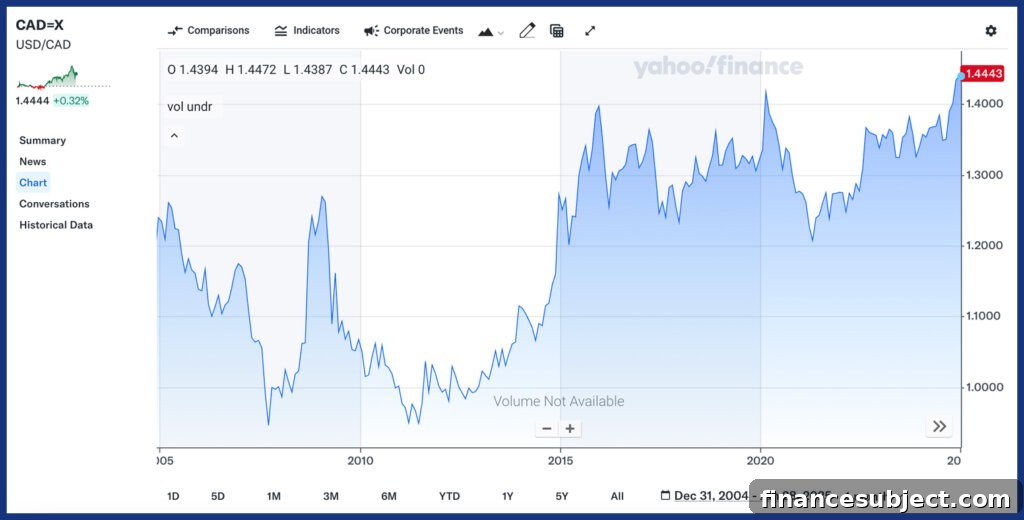
If your portfolio consists of broadly diversified, low-cost ETFs and you have a long investment horizon, the most prudent action is often inaction: stick to your plan, avoid reacting to currency headlines, and don’t let a weaker loonie prompt unnecessary trading. Frequent tinkering can erode returns through trading costs, tax consequences, and poor timing decisions.
Ultimately, use ETFs strategically: choose unhedged U.S. equity ETFs if you want implicit USD exposure, consider currency ETFs like DLR for direct USD positions or cash management, and prioritize low-cost, diversified holdings that align with your long-term goals. That approach keeps currency risk in perspective while letting investment fundamentals drive results.
Read more about ETFs:
- Buying ETFs in Canada Tool: The MoneySense ETF Screener
- Best ETFs in Canada
- Two ways to lower risk in your investment portfolio with ETFs
- AI ETFs in Canada: How investors can ride the AI wave