

Kyle Prevost, creator of 4 Steps to a Worry-Free Retirement, Canada’s DIY retirement planning course, summarizes recent financial headlines and provides context for Canadian investors.
Enjoy the jumbo rate cut — it’s likely the last one
The Bank of Canada (BoC) reduced its key policy rate by 50 basis points on Wednesday, bringing it to 3.25%.
This was the second straight large cut, rather than the more common 25 basis-point move, and it followed a weak November labour report and persistently slow GDP growth in Canada. Equally important was BoC Governor Tiff Macklem’s guidance that future rate cuts will likely be more gradual.
In reaction to the BoC’s guidance, five- and 10-year Canadian government bond yields ticked higher on the day of the announcement. Options markets are pricing roughly a 67% probability of a 25 basis-point cut on January 29, 2025, and expect only two such quarter-point cuts over the course of 2025.
Macklem also flagged the risk of possible U.S. tariffs as a “major new uncertainty,” warning that tariffs at the levels being discussed would be disruptive to the Canadian economy. Such measures could lift inflation in both Canada and the U.S., potentially limiting the BoC’s ability to cut rates as quickly as it otherwise might.
Shortly after the decision, the major Canadian banks (RBC, TD, BMO and CIBC) lowered their prime rates from 5.95% to 5.45%. That change offers immediate relief for borrowers on variable-rate mortgages and lines of credit.
However, five-year fixed mortgage rates saw little immediate movement from the big banks. Homeowners approaching a renewal on a fixed five-year term should temper expectations for a return to sub-3% fixed rates. To gauge likely direction for fixed-rate mortgages, watch five- and 10-year bond yields — they tend to be more predictive of fixed rates than the BoC’s overnight rate.
Sectors of the Canadian stock market that are sensitive to interest rates — utilities, pipelines, telecoms and real estate investment trusts (REITs) — should continue to benefit from lower interest expenses. The S&P/TSX Composite Index rose about 0.60% on Wednesday.
Below you’ll find current mortgage rate information for Canada, including an option to view variable rates by changing the rate-type selector.
Newsletter
Get free MoneySense financial tips, news & advice in your inbox.
U.S. prices re-inflate
The U.S. Bureau of Labor Statistics reported that the Consumer Price Index (CPI) rose at an annualized rate of 2.7% in November, while core CPI increased to 3.3%.
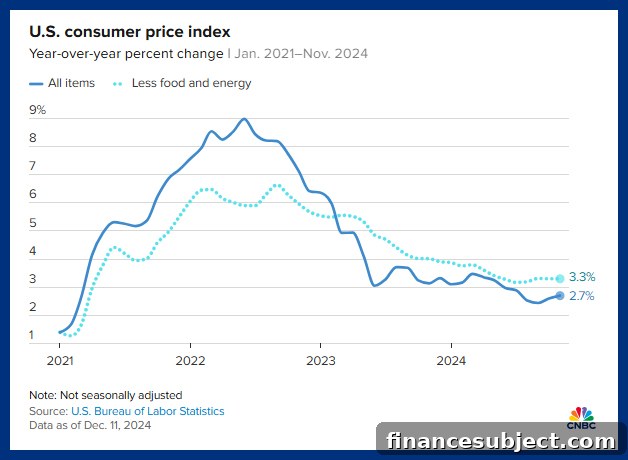
Key takeaways from the December 11 CPI release include:
- CPI rose 0.3% month‑over‑month from October to November.
- Energy prices fell 3.2%, with gasoline down 8.1%.
- Electricity costs increased by 3.1%.
- Shelter remains a significant contributor, up 4.7% year‑over‑year.
- Transportation services rose 7.1% year‑over‑year.
- New and used vehicle prices edged down 0.6% and 0.7% respectively.
Following the report, the CME FedWatch tool showed roughly a 99% probability of a 25 basis-point U.S. Federal Reserve rate cut next week, taking the federal funds target range from 4.50% to 4.25%.
There is less agreement about the likely level of the Fed’s target range a year from now; at the time of the report the tool indicated markets still assign a substantial probability that rates will remain above the 3.75%–4.00% range. That expectation has helped keep the U.S. dollar relatively strong compared with other currencies and suggests limited near-term relief for new mortgage seekers in the U.S.
Incoming U.S. president Donald J. Trump’s stated intent to impose tariffs could push inflation higher and reduce the scope for additional rate cuts. Markets were somewhat reassured, however, when Trump said he would not remove Federal Reserve Chair Jay Powell before Powell’s term ends in May 2026, easing concerns about direct political interference with monetary policy.
Also read
Canada’s best dividend stocks
U.S. earnings are solid, capping off an excellent year
This week featured earnings from established tech names and a leading retailer, and the overall report card was strong.
U.S. earnings highlights
All figures are in U.S. dollars.
- Oracle (ORCL/NYSE): Reported earnings per share of $1.47 (versus $1.48 expected) and revenue of $14.06 billion (versus $14.10 billion expected).
- Broadcom (AVGO/NASDAQ): Reported earnings per share of $1.42 (versus $1.38 expected) and revenue of $14.05 billion (versus $14.09 billion expected).
- Costco Wholesale (COST/NYSE): Reported earnings per share of $4.04 (versus $3.79 expected) and revenue of $62.15 billion (versus $62.08 billion expected).
Oracle’s stock fell about 6.7% on the report, reflecting a pause in the company’s recent momentum rather than a fundamental business concern. Oracle has benefited significantly from demand for cloud infrastructure tied to AI, and its share price has risen sharply year to date.
Costco and Broadcom also beat expectations but saw modest stock price declines on their respective release days. Investors can still take comfort from strong year‑to‑date gains: Costco was up roughly 52% year to date, and Broadcom roughly 66% at the close Thursday (with further after‑hours movement reported).
Costco noted growth in sales of gold products, home furnishings, sporting goods and hardware, with e-commerce sales up 13% year over year. Broadcom emphasized its work on custom AI chips, stating AI revenue is up about 220% year over year and identifying significant near‑term opportunities as large cloud providers develop custom accelerators.
For readers interested in Canadian tech companies, consider comparing U.S. peers with Canadian options to evaluate relative valuations and growth prospects.
Also read
The best online brokers, ranked and compared
The U.S. economy is not the U.S. stock market
It’s natural to assume a country’s stock market reflects the strength of its economy, but the two are different measures. The stock market represents the value investors place on publicly traded companies, which often earn significant revenue outside their home country.
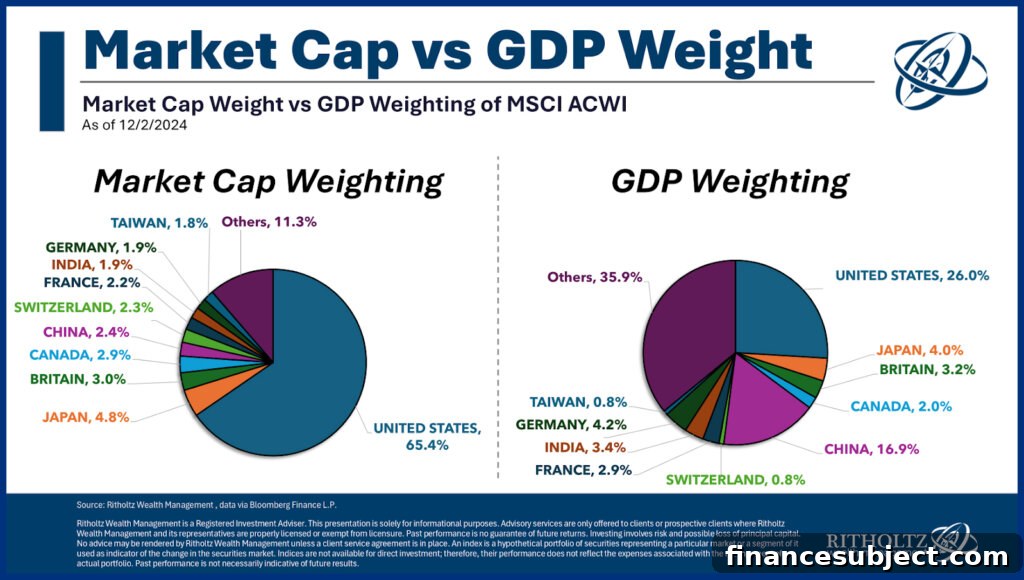
Investors currently pay a premium for U.S. corporate profits compared with many other markets, reflecting a belief that American companies are particularly well positioned to grow earnings over the long term. That preference helps explain why U.S. equities make up more than 65% of global investable equity value, up sharply from about 30% in the 1980s.
Foreign investors continue to view the U.S. market as a destination for capital due to its track record of innovation, deep capital markets and relative legal and institutional stability. Critics question whether current valuations fully reflect long-term fundamentals, and whether U.S. companies truly offer a sufficiently larger opportunity set than firms headquartered elsewhere.
As always, investors should weigh valuations against prospects for future profit growth and diversification benefits from exposure to other regions and sectors. Time will tell whether the premium on U.S. equities is justified or if opportunities elsewhere will offer better relative value.
Rankings
The best ETFs in Canada
More about investing:
- Boost your portfolio: Why and how to increase small-cap exposure with ETFs
- WeBull Canada review
- Best robo-advisors in Canada
- Scared of selling? When holding on to stocks can hurt you financially
- Bitcoin tops USD$100,000 for the first time