

Kyle Prevost, creator of 4 Steps to a Worry-Free Retirement, Canada’s DIY retirement planning course, summarizes this week’s financial headlines and explains what they mean for Canadian investors.
Canada’s economy off the rails
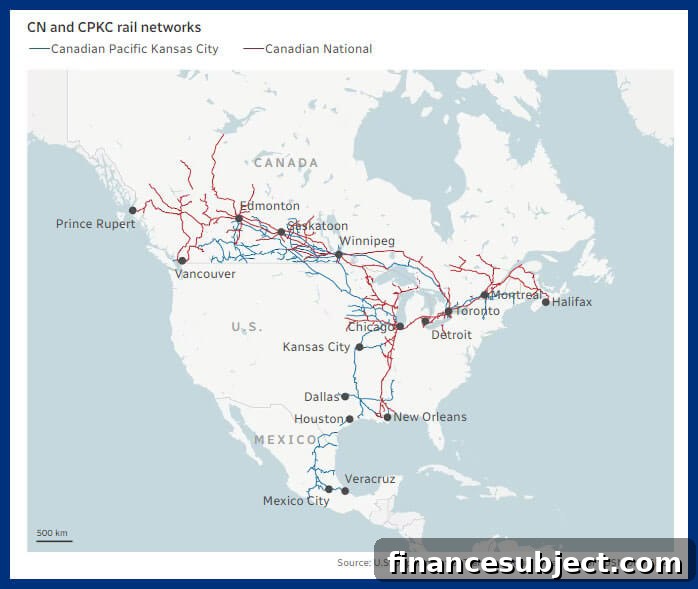
Many Canadians feel the country’s systems are strained, and recent events appeared to confirm those fears. This week, Canadian National Railway (CN) and Canadian Pacific Kansas City (CPKC) locked out employees, threatening major disruption to the supply chain and everyday life across the country.
After several hours of disruption, the federal government intervened and ordered rail employees back to work, directing the Canada Industrial Relations Board to impose binding arbitration and extend existing collective agreements. Officials said they expected regular rail operations to resume “within days.”
Even a short stoppage creates cascading consequences. Analysts estimate that each day of rail disruption requires three to five days to fully recover. The immediate economic and social impacts were wide-ranging and significant:
- Moody’s estimated the shutdown could cost roughly $341 million per day in economic damage.
- The Conference Board of Canada projected a two-week stoppage could shave about $3 billion off GDP and remove about $1.3 billion in wages from households over the same period.
- Tens of thousands of commuters would be affected by reduced passenger service.
- Critical supplies, such as chlorine used to treat drinking water, faced shortages if the disruption persisted.
- Perishable food supplies—meat, fruit and vegetables—would be at risk, especially in Western and Atlantic Canada.
- Ports and non-rail supply chains experienced congestion, producing knock-on delays for many sectors.
- Farmers worried that rail delays could lead to entire harvests spoiling before reaching markets.
- The stoppage risked elevating trade tensions with the United States during ongoing trade negotiations.
Historically, governments can and do step in to avoid large economic disruptions caused by rail labour disputes. The pay and working-time arrangements at the centre of this dispute—particularly compensation for layovers and waiting time—were described by the companies as the primary sticking point. CN and CPKC have said they offered significant pay increases, but the dispute shows how sensitive national supply chains are to labour disruptions.
Inflation in Canada appears under control
Inflation has cooled across much of the Canadian economy. Statistics Canada reported the Consumer Price Index (CPI) rose 2.5% in July year over year, down from 2.7% in June and the lowest rate since 2021.
Core drivers show the moderation is largely tied to housing costs. Shelter-related inflation—mainly rents and mortgage-related expenses—fell between June and July. Excluding shelter, overall inflation is close to zero, which is meaningful because it changes how monetary policy and interest-rate expectations evolve.
| CPI basket items | June 2024 | July 2024 |
|---|---|---|
| All-items Consumer Price Index | 2.7% | 2.5% |
| Food | 2.8% | 2.7% |
| Shelter | 6.2% | 5.7% |
| Household operations, furnishings and equipment | -0.9% | -0.1% |
| Clothing and footwear | -3.1% | -2.7% |
| Transportation | 2% | 2% |
| Health and personal care | 3.0% | 2.9% |
| Recreation, education and reading | 0.6% | -0.2% |
| Alcoholic beverages, tobacco products and recreational cannabis | 3.1% | 2.7% |
Other notable items in July: passenger vehicle prices eased, clothing and footwear costs continued to fall, and food and gasoline prices rose modestly. Regional differences persisted, with some provinces showing higher inflation than others. As inflation trends down and the Bank of Canada considers cutting rates, mortgage costs should ease, which will further influence shelter-related inflation over time.
For investors, this environment affects decisions on fixed-income holdings. If you secured high yields with guaranteed investment certificates (GICs) or short-term bonds when rates were elevated, those positions may remain attractive even as policy rates decline. For those building portfolios, low-risk alternatives and well-chosen ETFs remain relevant in a slower-inflation setting.
Retail snapshot: Target and Lowe’s results
Target reported a stronger-than-expected quarter, posting an earnings beat that lifted its share price. Same-store sales rose after several quarters of declines, helped by discretionary spending on apparel and promotions aimed at price-conscious shoppers. Despite improved sales, company leadership maintained a cautious outlook given the uncertain consumer backdrop.
Lowe’s delivered mixed results: earnings beat estimates, but the retailer cut its full-year outlook. Sales remain sensitive to interest rates because many customers delay large renovation projects until borrowing costs decline. These mixed retail results suggest consumers remain price-focused, but they do not yet point decisively to a broad economic downturn.
TD Bank sets aside a large penalty
TD reported mixed quarterly earnings, but the biggest headline was a substantial provision the bank is preparing to pay for alleged past compliance failures. TD announced it will set aside a large amount to cover anticipated fines and related costs. The size of the charge is notable—amounting to a multi-billion-dollar figure that affects balance sheet planning and capital management.
To preserve regulatory capital, TD sold a portion of its holdings in a U.S. investment as part of the moves to ensure it maintains required capital ratios while meeting the fines. While such a penalty is large, the bank’s core Canadian operations remain profitable, and the market reaction suggested investors viewed the immediate financial hit as manageable relative to TD’s long-term position.
However, the fallout could affect future expansion plans and regulatory scrutiny, particularly for cross-border activities. U.S. regulators may be more cautious in assessing future TD acquisitions or growth initiatives, which could influence strategic planning over the coming years.
Further reading on investing
- Best ETFs in Canada
- How to buy your first stocks in Canada
- Capital gains tax: key questions answered