

Kyle Prevost, creator of 4 Steps to a Worry-Free Retirement, Canada’s DIY retirement planning course, summarizes recent financial headlines and provides context for Canadian investors.
U.S. inflation continues to ease; rates unchanged
The U.S. Consumer Price Index (CPI) showed no monthly change in May (0.0%), and the year‑over‑year increase stood at 3.3%. These results were slightly below expectations and reinforce a broader trend of easing inflation that we are seeing across many developed economies.
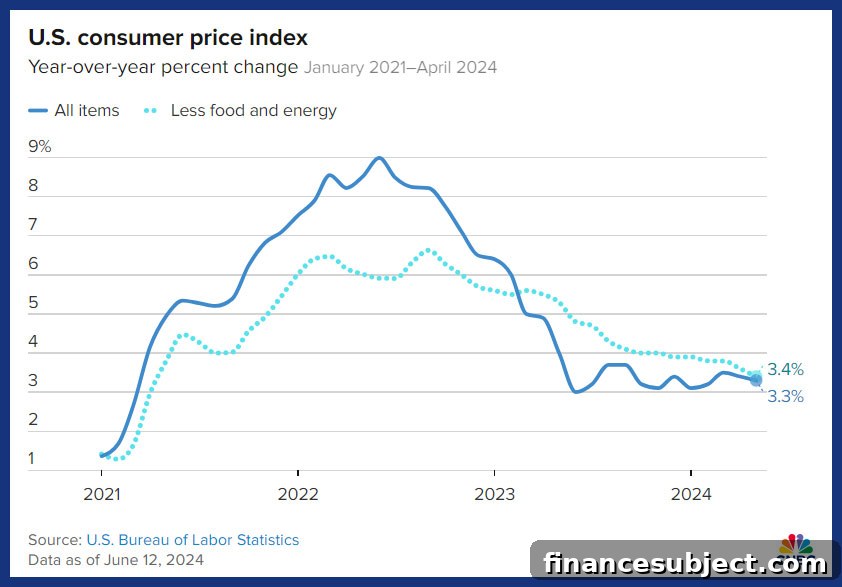
Highlights of the U.S. CPI report
Key takeaways from the inflation release:
- The CPI was flat from April to May.
- Overall CPI rose 3.3% year over year.
- Core CPI, which excludes volatile items like food and energy, climbed 3.4% year over year.
- Energy costs fell about 2%, and gasoline prices dropped nearly 3.6%.
- Shelter remains an outlier, up 5.4% year over year.
Following the data release, the U.S. Federal Reserve opted to keep its policy rate unchanged in the 5.25%–5.5% range.
We see today’s report as progress and as, you know, building confidence. But we don’t see ourselves as having the confidence that would warrant beginning to loosen policy at this time.”
— Jerome Powell, U.S. Federal Reserve Chair
The Fed’s language appeared to soften slightly on the “higher for longer” messaging that dominated recent communications. When asked why public sentiment about the economy can feel muted despite strong indicators, Fed Chair Powell said there’s no single obvious explanation for that disconnect.
U.S. tech continues to outperform
While Nvidia dominates headlines for AI-related momentum, this week’s results from Oracle and Broadcom underscore how the broader U.S. tech sector is benefiting from demand for cloud services and specialized chips. All figures below are reported in U.S. dollars.
U.S. tech highlights
Selected results from recent earnings reports:
- Oracle (ORCL): Earnings per share were $1.63 (slightly below the $1.65 forecast) and revenue came in at $14.29 billion (versus an estimated $14.55 billion). Despite the modest misses, Oracle shares rose strongly on the outlook for cloud infrastructure.
- Broadcom (AVGO): Reported EPS of $10.96 (above the $10.84 estimate) and revenue of $12.49 billion (above the $12.03 billion forecast). Shares also reacted positively after the results.
Broadcom attributed part of its strength to demand for AI-capable semiconductors and the contribution from VMware, which it acquired in late 2023. That purchase helped push revenue substantially higher versus the prior year. Oracle’s upbeat reaction from investors centered on accelerating cloud revenue—Oracle reported cloud growth that outpaced some competitors, and management highlighted ongoing investment in large-scale data centre capacity.
Oracle founder and CEO Larry Ellison described the scale of some new data centres in dramatic terms, noting that several projects are approaching the scale of a gigawatt and could support massive AI training workloads. The broader takeaway is that rising demand for cloud services and AI infrastructure continues to lift many names across the technology sector.
Deal-seeking customers power Dollarama
In Canada, weekly earnings activity was light, with Dollarama (DOL/TSX) posting notable results. Many investors don’t realize that the discount retailer ranks among the largest companies in Canada by market capitalization, larger than well-known telecom and utility names.
Dollarama earnings highlights
What the retailer reported this quarter:
- Dollarama (DOL): Reported earnings per share of $0.77 versus an expected $0.75, and revenues matched analysts’ expectations at $1.41 billion.
Comparable store sales increased 5.6%. Management plans to open another 60 to 70 stores in Canada on top of roughly 1,551 current locations. The company also announced a substantial investment to expand its Dollarcity operations in Latin America, increasing its stake and preparing for entry into markets such as Mexico.
“As anticipated, we are seeing a progressive normalization in comparable store sales, with growth primarily driven by persistent higher than historical demand for core consumables and other everyday essentials.”
— Neil Rossy, Dollarama CEO
Despite the encouraging results, Dollarama shares trimmed gains after news of the Latin American expansion and the sizable investment required for that growth. Long-term holders, however, have seen strong returns, with the stock materially higher year to date and over the past year.
Stock splits for Nvidia and Canadian Natural Resources
Recent price movements in certain large-cap stocks were due to stock splits rather than underlying declines. Canadian Natural Resources (CNQ/TSX) executed a 2-for-1 split, while Nvidia (NVDA/NASDAQ) completed a 10-for-1 split. Broadcom also announced plans for a 10-for-1 split.
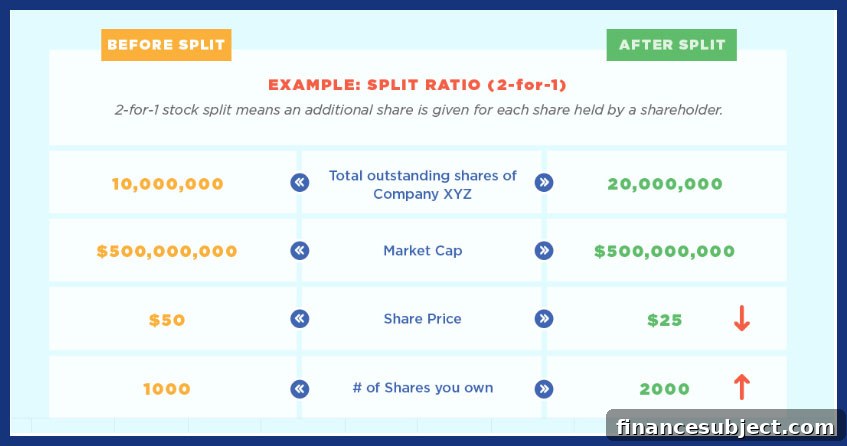
A stock split increases the number of shares outstanding while reducing the price per share proportionately, leaving the total value of an investor’s holdings unchanged. Companies often split shares to make them more accessible to a wider base of investors and to improve liquidity, especially after a long period of price appreciation. While splits can signal confident management, they are not, on their own, a reliable indicator of future performance.
Think of a company’s shares as a single pizza: cutting it into more slices doesn’t change the size of the pizza, it just changes the number of pieces available for investors to buy.
More reading on investing
- Best ETFs in Canada
- National Bank’s planned acquisition of Canadian Western Bank
- How capital gains tax works in Canada
- How long the AI-driven rally might last