
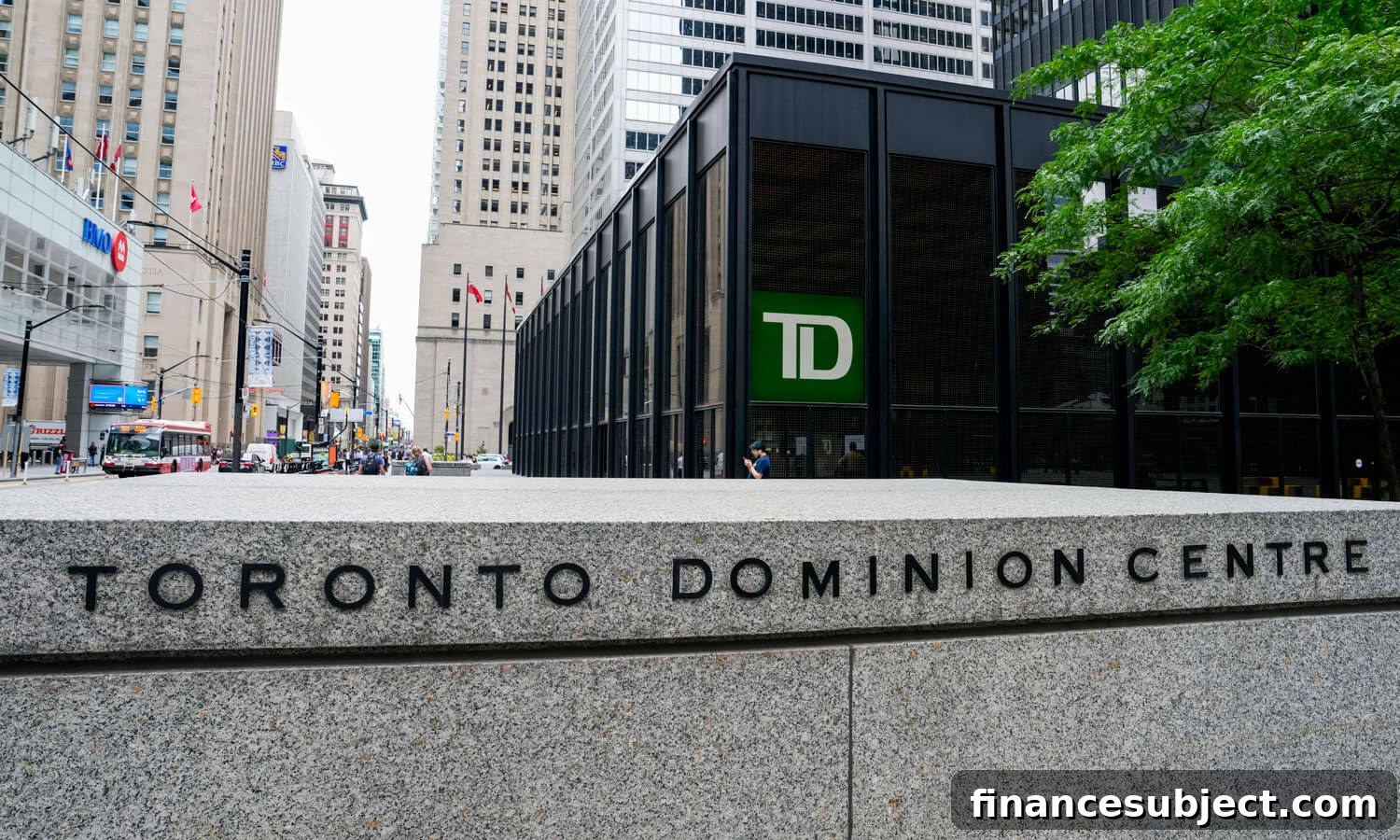
TD Bank Group reported a 22% drop in second-quarter profit compared with the same period last year, citing a large charge tied to shortcomings in its U.S. anti-money laundering controls. The bank had previously stated it would record an initial $615 million charge as part of ongoing discussions with U.S. regulators, a disclosure that allowed analysts to revise forecasts and which TD ultimately exceeded. “It was a strong quarter for TD with all of our businesses outperforming expectations,” CEO Bharat Masrani said on the earnings call Thursday, while acknowledging the bank’s failures in anti-money-laundering oversight. (Is TD a good stock to buy right now?)
TD’s response to money laundering questions
Under sustained questioning from analysts, TD did not provide specific timelines or definitive estimates for penalties related to the several U.S. investigations it faces. Masrani said the bank is cooperating fully and doing everything it can to bring the matters to a close.
TD’s earnings highlights
Key details from TD’s earnings call on Thursday, May 23.
- Toronto-Dominion Bank (TD/TSX): Net income was $2.56 billion, or $1.35 per diluted share, down from $3.31 billion, or $1.69 per diluted share, a year earlier. On an adjusted basis that excludes the one-time charge and other items, TD reported earnings of $2.04 per diluted share versus an adjusted $1.91 per share a year ago. Revenue rose 10% to $13.82 billion, and adjusted results beat the average analyst estimate of $1.85 per share.
Masrani said the bank has provided U.S. regulators, including the Department of Justice, with complete information — even when that material showed weaknesses in TD’s controls. He reiterated that the bank has acknowledged these failings and is taking steps to rectify them.
Excluding anti-money-laundering-related charges — the bank has already spent roughly $500 million to address control deficiencies — the quarter’s underlying performance would have appeared significantly stronger. For the quarter ended April 30, TD recorded net income of $2.56 billion ($1.35 per diluted share), down from $3.31 billion ($1.69 per diluted share) in the prior-year quarter.
Adjusted earnings of $2.04 per diluted share improved from $1.91 a year earlier, supported by a 10% rise in revenue to $13.82 billion. Those adjusted results outpaced the average analyst forecast of $1.85 per share, based on LSEG Data & Analytics figures.
Tools
MoneySense’s ETF Screener Tool
Will it impact business? Or is it business as usual?
Scotiabank analyst Meny Grauman described the quarter as “a big beat with a big asterisk,” noting that the outperformance was driven mainly by lower-than-expected expenses and weaker tax provisions, while the unresolved anti-money-laundering issues remain a significant overhang. Although the regulatory inquiries in the U.S. are a clear risk to TD’s largest growth market, Grauman said he did not yet see material signs of business disruption in the quarter’s results — but cautioned the risk remains.
A Wall Street Journal report, which TD has not disputed, says the U.S. Justice Department is investigating allegations that Chinese drug traffickers used TD to launder at least US$653 million and that some employees were bribed to facilitate the activity. The report escalated concerns that fines, penalties and operational restrictions could be substantial.
Analysts have warned that cumulative fines could reach into the billions and that regulators might impose limits on the bank’s balance sheet growth or other restrictions that could affect operations for years. The Globe and Mail also reported that Canada’s banking regulator has ordered TD to strengthen its risk controls, raising questions about whether the bank’s issues could extend beyond the U.S.
Masrani pushed back on aspects of reporting about the bank’s regulatory interactions, saying TD is in continuous dialogue with both U.S. and Canadian regulators and alleging that some coverage mischaracterizes routine supervisory exchanges.
OSFI point to integrity and security
Canada’s Office of the Superintendent of Financial Institutions (OSFI) declined to comment on specific supervisory actions or confidential correspondence. The regulator has, however, emphasized heightened expectations for banks around integrity and security, as noted by superintendent Peter Routledge.
TD is also wrapping up a previously disclosed restructuring program that reduced staff by around 3%. The program will incur roughly $870 million in charges overall, including a $165 million pre-tax charge in the recent quarter, but is expected to yield about $400 million in pre-tax savings this year and approximately $725 million in annual pre-tax savings thereafter.
National Bank analyst Gabriel Dechaine said he views the bank’s cost-savings measures as at least partially offsetting the anti-money-laundering expenses. He also noted that some of the quarter’s earnings strength reflected a large hedge gain versus a typical loss and stronger performance in capital markets.
Despite those offsets, Dechaine warned the anti-money-laundering-related costs will weigh on TD’s capital and limit its ability to repurchase shares, prompting him to downgrade the stock to underperform. “It could get tougher before it gets better,” he said.
featured1-year GICLock in your deposit and earn a guaranteed interest rate of 3.50%.go to site
featuredSavings accountOpen a High Interest Savings Account right now and earn 4.60% interest for 5 months. Only on eligible deposits up to $100,000.got to site
MoneySense is an award-winning personal finance magazine that has helped Canadians make informed money decisions since 1999. Its editorial team of journalists works with leading experts to evaluate financial products and services from major banks, credit unions and card issuers. Learn more about our advertising and trusted partners.
Credit losses and impaired provisions
TD set aside $1.07 billion in provisions for credit losses, which was higher than many analysts expected. The increase was driven primarily by a rise in impaired provisions, which were up 58% year over year to $870 million, while performing provisions rose to $201 million — more than three times the prior-year level.
For the quarter, total provisions represented about 0.47% of TD’s credit volume.
Masrani highlighted the bank’s solid capital position, noting a capital ratio of 13.4% that provides a buffer against market uncertainty and a range of downside scenarios. He said TD is prepared for slower economic growth and stands to benefit if higher interest rates persist, while continuing to focus on urgent priorities such as risk and control improvements.
“We delivered significant positive operating leverage, while continuing to execute on our restructuring program and prioritizing investments in our risk and control infrastructure,” Masrani said.
Read more on stocks:
- Making sense of the markets this week
- Shopify shares sink as company posts Q1 loss
- TMX enables record oil output
- Top 100 dividend stocks in Canada