
Kyle Prevost, creator of 4 Steps to a Worry-Free Retirement, Canada’s DIY retirement planning course, shares the week’s financial headlines and offers context for Canadian investors.
Disney is back on track
Despite owning some of the world’s most recognisable brands, Disney has struggled in recent years; its share price had been down since early 2019. The return of CEO Bob Iger has reassured investors, and recent results show signs of recovery.
Disney earnings highlights
All earnings and revenue figures are in U.S. dollars.
Disney (DIS/NYSE): Adjusted earnings per share of $1.22 (versus $0.99 expected) on revenues of $23.55 billion (versus $23.64 billion expected).
Shares rose more than 7% in after-hours trading following the earnings release. Management raised profit guidance for 2024 and pointed to several drivers behind the improvement:
- Cost reductions on track to meet or exceed a $7.5 billion savings target for the year.
- A $1.5 billion strategic investment in a partnership with game developer Epic Games.
- Growth in the “experiences” segment—theme parks, resorts and cruises—which reported a 7% revenue increase year over year.
Perhaps the most consequential development is a planned joint sports streaming service announced by Disney (through ESPN), Fox and Warner Bros. Discovery. The yet-unnamed platform would combine live sports programming from ESPN networks, TNT, TBS, TruTV, FS1/FS2, BTN, UFC broadcasts and select ABC and Fox feeds, effectively reassembling much of the traditional cable sports bundle into a streaming product.
If this streaming offering is bundled with Disney+, Hulu and Max, it could recreate a substantial portion of the old cable bundle—now delivered via streaming. The key questions for Canadians will be pricing and availability in Canada.
Big Mac vs. big pharma
This week’s earnings highlighted a striking contrast between consumer food businesses and pharmaceutical firms focused on weight-loss treatments. Eli Lilly’s drugs continue to drive meaningful revenue growth while McDonald’s faced regional sales pressure.
Food and pharma earnings highlights
All figures are in U.S. dollars.
- McDonald’s (MCD/NYSE): Earnings per share of $2.95 (versus $2.82 expected) on revenues of $6.41 billion (versus $6.45 billion expected).
- Eli Lilly (LLY/NYSE): Earnings per share of $2.49 (versus $2.22 expected) on revenues of $9.35 billion (versus $8.93 billion expected).
Eli Lilly reported explosive growth in sales for Mounjaro—rising to $2.21 billion in the fourth quarter of 2023 from $279.2 million a year earlier—and early sales momentum for its newer weight-loss drug, Zepbound. Zepbound received FDA approval in November 2023 and generated $175.8 million in sales in the final weeks of 2023. These products are materially boosting Eli Lilly’s revenue and have helped lift its share price significantly over the past year.
McDonald’s, meanwhile, said global systemwide sales are being affected by geopolitical tensions and related boycotts in some regions. Management warned these pressures could continue to weigh on revenue while the conflict persists, and the stock reacted with a decline after the results.
Over the longer term, widespread adoption of effective weight-loss drugs could alter consumption patterns and create headwinds for snack and fast-food companies—an important theme for investors to monitor.
PayPal cuts 2,500 jobs, and still can’t save its share price
PayPal’s results underscored that not all technology companies are experiencing a smooth rebound. Even with an earnings beat, the stock has struggled to regain momentum from prior highs.
PayPal earnings highlights
Figures are in U.S. dollars.
- PayPal (PYPL/NASDAQ): Earnings per share of $1.48 (versus $1.36 expected) on revenues of $8.03 billion (versus $7.87 billion expected).
Despite a 9% year-over-year revenue increase and a 51% rise in net income, PayPal reported a 2% decline in active accounts. Management announced a global workforce reduction of about 9%—roughly 2,500 jobs—and lowered guidance for late 2024. The market interpreted those moves as signs that PayPal still faces operational challenges and growth pressures, sending the stock lower even after the earnings beat.
Bell’s dividend is up—employee count is down
Canada’s telecom giant Bell reported results close to expectations and increased its annual dividend by 3%, but the more eye-catching announcements centred on cost reductions and strategic spending cuts.
Bell earnings highlights
The Canadian telco reported:
- Bell (BCE/TSX): Earnings per share of $0.73 (versus $0.76 expected) on revenues of $6.47 billion (in line with expectations). The stock declined after the release.
Bell announced a plan to reduce roughly 4,800 roles (about 9% of its workforce), following earlier cuts. It also plans to sell 45 of its 103 regional radio stations and expects annualized cost savings of about $250 million. Management said it would scale back capital expenditure plans by approximately $1 billion, reducing some fibre expansion targets in response to a regulator’s decision to require wholesale access for competitors.
Executives said they are reluctant to invest heavily in fibre if that infrastructure will be resold by competitors, and they called for federal support for Canadian media. These strategic shifts are significant for Canadian telecom investors and merit watching as regulatory and competitive dynamics evolve.
Put me in coach—investors’ dry powder could move markets
One notable trend for market watchers is the large amount of cash investors are holding “on the sidelines.” That cash—sitting in chequing accounts, high-interest savings accounts, short-term bonds, GICs and money market funds—represents potential buying power that could flow into equities if sentiment improves.
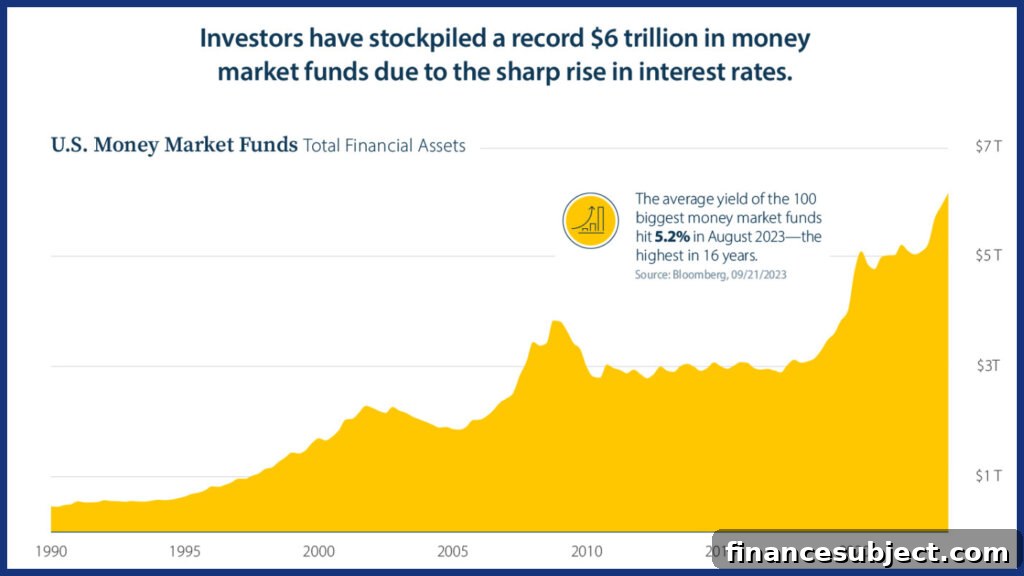
The data shown is U.S.-centric, but similar patterns appear to be present in Canada, where excess savings built up during recent years are substantial. When risk-averse investors feel more confident—whether because interest rates ease, markets hit new highs, or economic headlines improve—some of that cash could flow into stocks and other higher-risk assets. That shift would be meaningful, given the relative size of cash reserves compared with market capitalisations, and it remains a major factor for portfolio and market strategists to watch.
More on investing
- How might inflation impact your retirement plans?
- What is a cashable GIC?
- Will GIC rates keep going up in 2024?